3.1.8.1 - Prices and resource allocation
Learn how prices ration scarce output, signal changing conditions and create incentives, then judge what market allocation achieves and what may change when payment enters a previously non-market activity.
Rationing, signalling and incentives
A changing price coordinates buyers and sellers because it changes both the information they receive and the choices that reward them.
In an illustrative market, a rise in demand shifts D₀ to D₁ while supply conditions remain unchanged. At the old £50 price, buyers want 50 units but sellers supply 30: excess demand is 20. The new equilibrium is 40 units at £60.
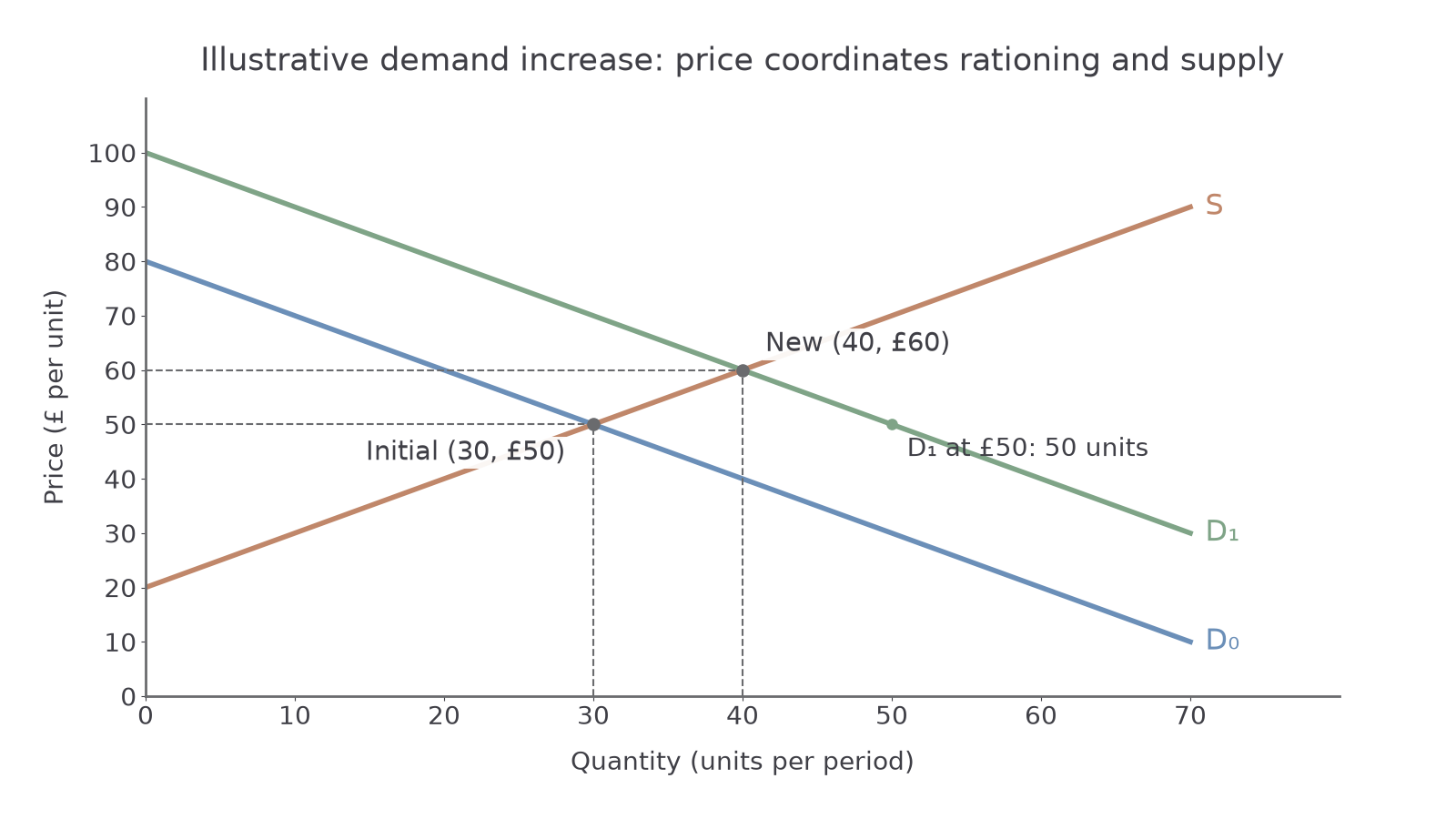
Rationing allocates scarce output among competing buyers. The higher price reduces quantity demanded on D₁ from 50 to 40; people unwilling or unable to pay withdraw or buy less. Price therefore rations by willingness and ability to pay, rather than by need, queue position or an official allocation rule.
Signalling conveys information. A higher relative price indicates stronger demand or greater scarcity and tells producers that buyers are willing to pay more. A lower price can signal weaker demand or more abundant supply. Price alone does not reveal which underlying cause changed; the accompanying demand/supply evidence matters.
Incentives make responses worthwhile. With costs unchanged, the higher selling price encourages suppliers to expand from 30 to 40 units along the existing supply curve and may attract resources into the activity over time. Buyers have an incentive to economise or seek substitutes. The signal is information; the incentive is the reward or saving from acting on it. They operate together but are not the same function.
The initial demand shift and the subsequent movements along curves must remain distinct. This illustration assumes a competitive market, responsive buyers/sellers and no unpriced costs to others. If supply is fixed in the short run, price may rise sharply with little extra output; stronger incentives do not create capacity instantly.
Prices guide production and distribution
Prices influence what is produced, the techniques used and who receives output through the choices of many separate agents.
What: higher expected revenue relative to cost can draw land, labour and capital towards goods whose demand has increased. Falling profitability can release resources from another activity. Profit expectations and entry conditions matter; a price rise caused by higher input costs need not make expansion more attractive.
How: firms compare input prices and productivity. If labour becomes more expensive relative to effective machinery, a firm may adopt a more capital-intensive method. It considers output quality, training, reliability and the cost of equipment, not just one input's price. The response can take time and may be impossible for a particular task.
For whom: income and wealth determine purchasing power, while preferences influence spending. Two people with equally strong needs may receive different quantities because one can afford more. Producers generally do not need to know a buyer's reason for purchasing, but that does not mean the result reflects social need or fairness.
These decentralised decisions connect. Expanding one industry increases its demand for inputs, potentially raising their prices and encouraging other firms to use less. The price mechanism coordinates those choices without one organisation collecting every person's complete plan.
Continue this lesson.
You’re previewing NovaLearn without an account. Create a free account to read the rest.
Create free account