3.2.2.6 - Long-run aggregate supply
Explain what determines sustainable productive capacity, including enterprise, incentives and institutions. Compare vertical LRAS with the Keynesian AS curve and use each model to reason about demand, spare capacity and price pressure.
The vertical capacity model
Long-run aggregate supply (LRAS) represents the economy's normal sustainable capacity, sometimes called potential or full-employment output. Its location depends on productive resources and their effectiveness. Full employment allows normal job search and mismatches; it is not literally zero unemployment or every machine operating without maintenance.
In the classical/neoclassical long-run model, wages, input prices and expectations can adjust. A higher general price level eventually raises selling prices and costs, so it cannot continually create extra real resources or productivity. LRAS is therefore vertical at . This is a claim about long-run real capacity, not a vertical SRAS assumption or a claim that actual output never deviates from .
If AD increases while vertical LRAS stays fixed, the long-run comparison shows a higher price level at the same normal output. In the short run, output may first rise above normal capacity, for example through overtime, before costs adjust. If AD is initially insufficient, actual output may be below potential. The speed and reliability of adjustment are therefore important when applying this model to unemployment.
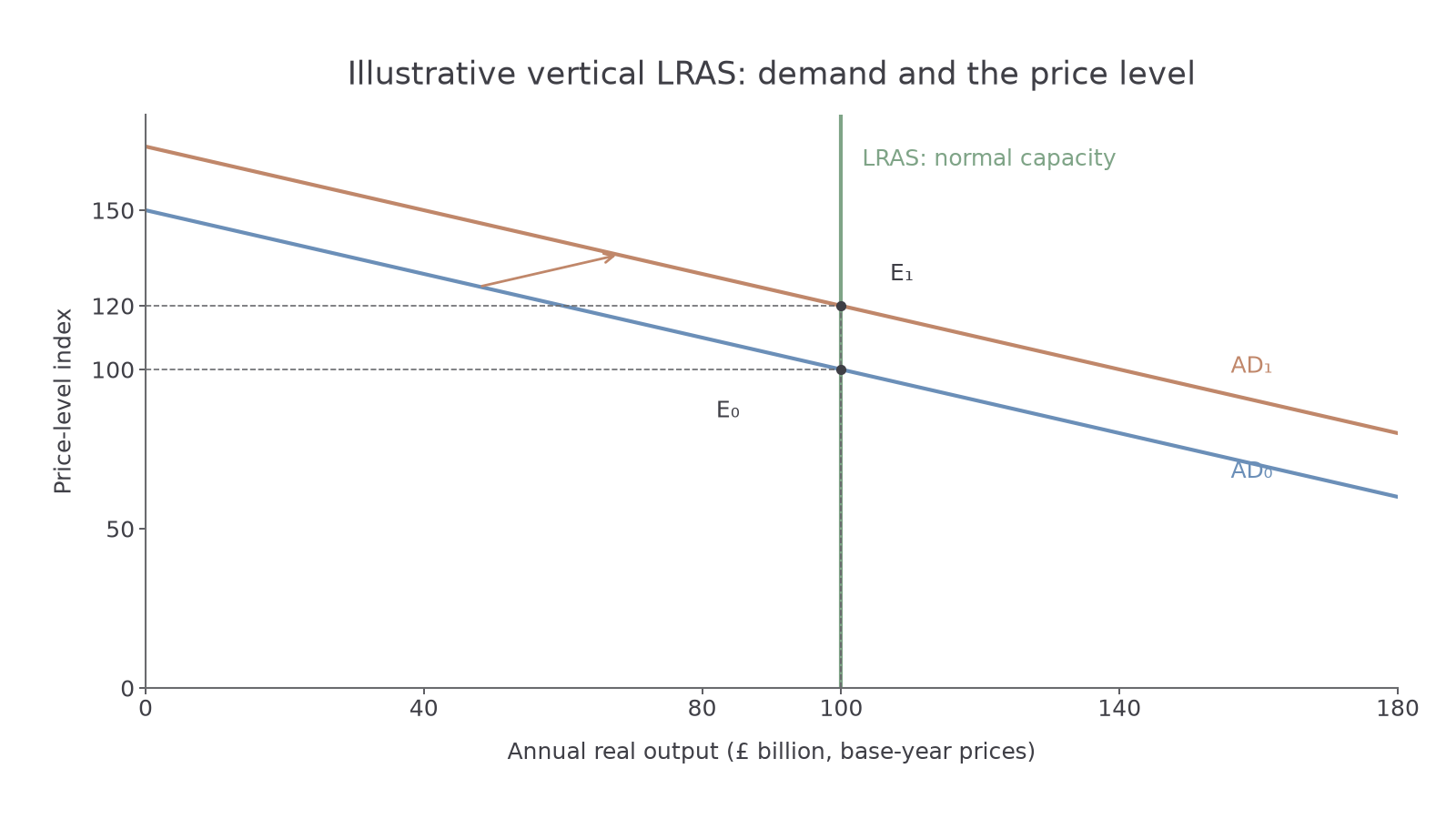
This illustrative graph holds capacity at £100 billion per year. Two AD curves intersect LRAS at price-level indices 100 and 120. The graph establishes no increase in normal capacity. In a notebook, label both AD curves and the vertical LRAS, then compare their intersections at the same output coordinate.
Resources, technology and incentives
Long-run capacity can rise through more usable resources or better use of existing ones. A larger skilled workforce, additional productive capital and reliable infrastructure can expand the amount of sustainable output. Technology and better organisation raise productivity, allowing more output per input. These are microeconomic decisions with aggregate consequences: a firm's improved process can lower costs and, if widely adopted, increase the economy's capacity.
Enterprise combines resources, develops products and accepts risk. Attitudes towards training, innovation, work and risk can affect how effectively opportunities are used. Attitudes are not a fixed characteristic of a population: education, trust, institutions and the rewards or risks people face can shape them. A promising innovation may need complementary skills, equipment and time before it adds capacity.
Factor mobility is the ability of labour and capital to move between occupations, sectors or places. Retraining and improved housing or transport access can help idle labour match vacancies; equipment that can be redeployed reduces bottlenecks. Mobility increases effective resource use even when the total workforce is unchanged. Barriers such as unsuitable qualifications or relocation costs can prevent the adjustment.
Economic incentives affect whether people train, work, invest or innovate. Greater expected after-tax returns may encourage enterprise and capital formation. Yet a tax reduction does not guarantee a net capacity gain: public services funded by taxes can also support health, education and infrastructure, and reactions depend on constraints and confidence. Trace an actual resource or productivity mechanism before shifting LRAS.
A lasting capacity improvement shifts LRAS right. A rise in the price level alone gives no shift; a temporary fall in an input's price mainly changes SRAS. A training programme might affect both: lower unit costs now and greater normal capacity later. Higher potential output is an opportunity; weak demand can still leave it unused.
Continue this lesson.
You’re previewing NovaLearn without an account. Create a free account to read the rest.
Create free account