3.1.8.4 - Externalities in consumption
Learn how consumption can harm or benefit people outside a purchase, use marginal private and social benefits to explain excessive or insufficient consumption, and judge how enforceable rights can affect those incentives.
Consumption effects outside the purchase
A consumption externality arises when a person's use of a good or service affects third parties in a way not fully reflected in their decision.
The private benefit is received by the consumer. A negative consumption externality, such as loud late-night music disturbing neighbours, reduces the net benefit to society below the private benefit. A positive consumption externality, such as a person learning skills that help others they interact with, raises social benefit above private benefit. A consumer's own pleasure or own harm is not a third-party effect, even when it is important.
At the margin, write MPB for marginal private benefit and MSB for marginal social benefit. With external harm, MSB = MPB minus marginal external cost. With external gain, MSB = MPB plus marginal external benefit. The diagrams put consumption effects on the benefit side and assume no production externality, so MPC = MSC.
The curves describe comparable values per extra unit, not total benefit. The market's private decision is MPB = MPC; the social reference is MSB = MSC. The two diagrams below assume competitive supply, accurately perceived private effects and no other distortions. Information failure is a separate reason for a private decision to be mistaken, developed in the next lesson.
External harm causes over-consumption
A consumer who ignores harm to others can buy units whose private attraction exceeds their net social benefit.
The graph is an illustrative model, with quantity in units per period and marginal values in pounds per unit. Each unit imposes £20 of external harm. MSB therefore lies £20 below MPB; the single cost curve is MPC = MSC.
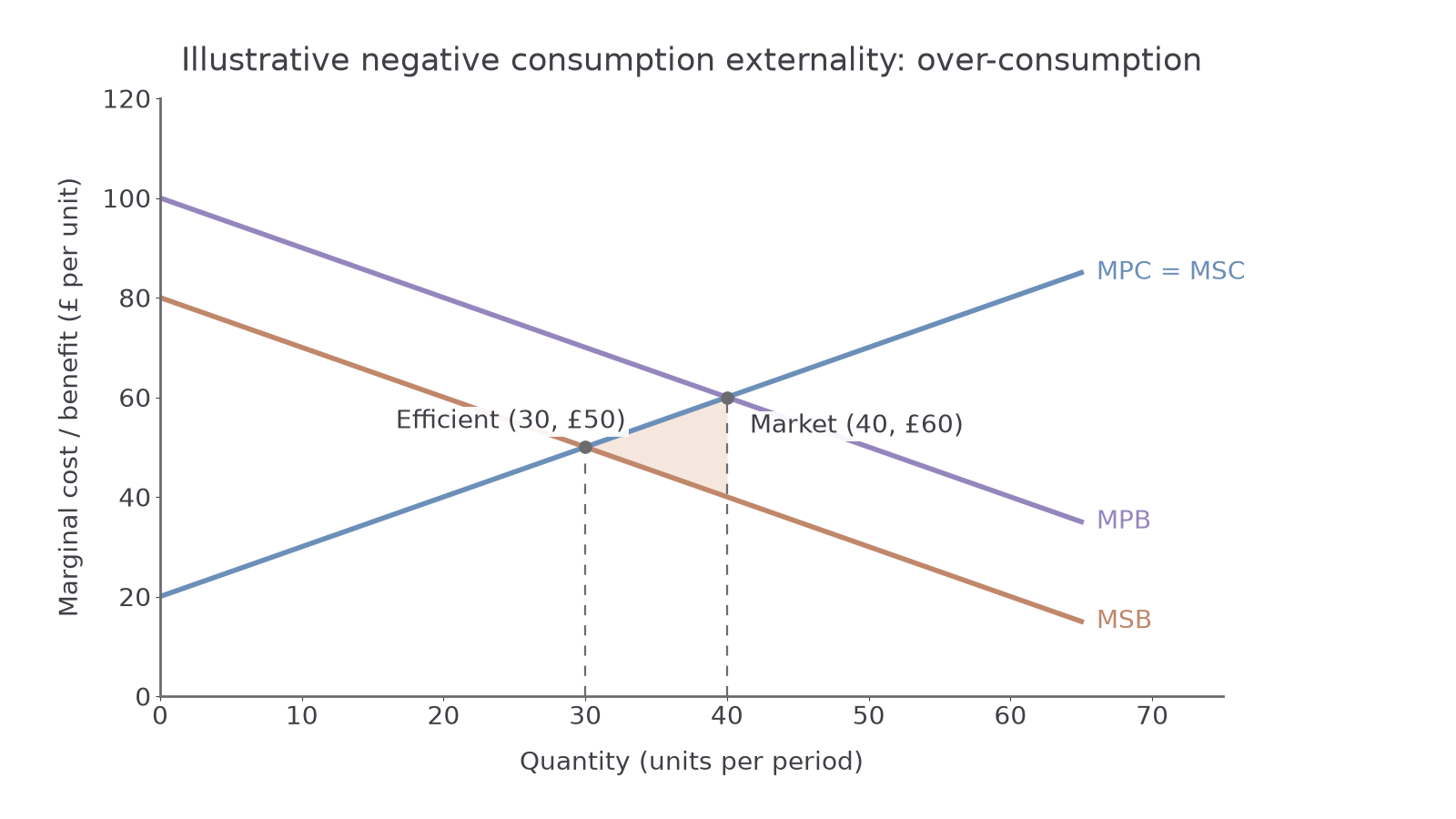
The market chooses 40 units at MPB = MPC = £60. Efficiency requires 30 units at MSB = MSC = £50. The extra 10 units are attractive privately but their social cost exceeds their social benefit. At quantity 40, cost is £60 while MSB is £40. The shaded welfare-loss triangle between quantities 30 and 40 sums that excess cost. Its area is:
Do not shade the entire gap between MPB and MSB over all consumption and call it deadweight loss. That full gap measures external harm, £800 at 40 units in this constant-harm model; the net welfare loss depends on the units beyond the efficient quantity. Efficient consumption need not be zero because earlier units can have benefits above their full social costs.
In your notebook, draw falling MPB and lower MSB, then a rising MPC = MSC. Mark the private and social intersections, drop quantity guides, and shade only the unwanted interval between cost and MSB. The lower social-benefit curve reflects a third-party effect, not a fall in the consumer's perceived enjoyment.
External gains cause under-consumption
A consumer unable to capture benefits they generate for others may choose less than the socially efficient quantity.
Continue this lesson.
You’re previewing NovaLearn without an account. Create a free account to read the rest.
Create free account