2.1 - Particle model of solids, liquids and gases
Use the particle model to compare the arrangement, movement and relative energy of solids, liquids and gases. These microscopic differences help explain why a solid keeps its shape, a liquid flows and a gas spreads out.
Reading the particle model
Matter is made of tiny particles, which may be atoms, molecules or ions. A particle diagram is a simplified model: circles stand for particles, spaces show their separation, and arrows represent motion. The circles are not drawings of what every particle really looks like.
Compare three features: arrangement (spacing and pattern), movement, and relative energy. Read the labels as well as the circles.
[DIAGRAM: asset_name: particle_model_three_states - diagram 1; asset_slug: 060_2_1_particle_model_of_solids_liquids_and_gases_diagram1; file: 060_2_1_particle_model_of_solids_liquids_and_gases_diagram1.png; recommended_method: deterministic_drawn; description: Exact monochrome three-panel particle model comparing solid, liquid and gas. The solid panel shows close particles in a regular arrangement with short vibration arrows and the labels "fixed positions", "vibrate" and "low relative energy". The liquid panel shows close particles in an irregular arrangement with movement arrows and the labels "close together", "move past each other" and "medium relative energy". The gas panel shows particles far apart in a random arrangement with long motion arrows and the labels "far apart", "move rapidly in all directions" and "high relative energy". Deterministic drawing is used because the particle positions, labels and arrow meanings are assessed teaching content. Nearby prose states all assessed information for accessibility.]
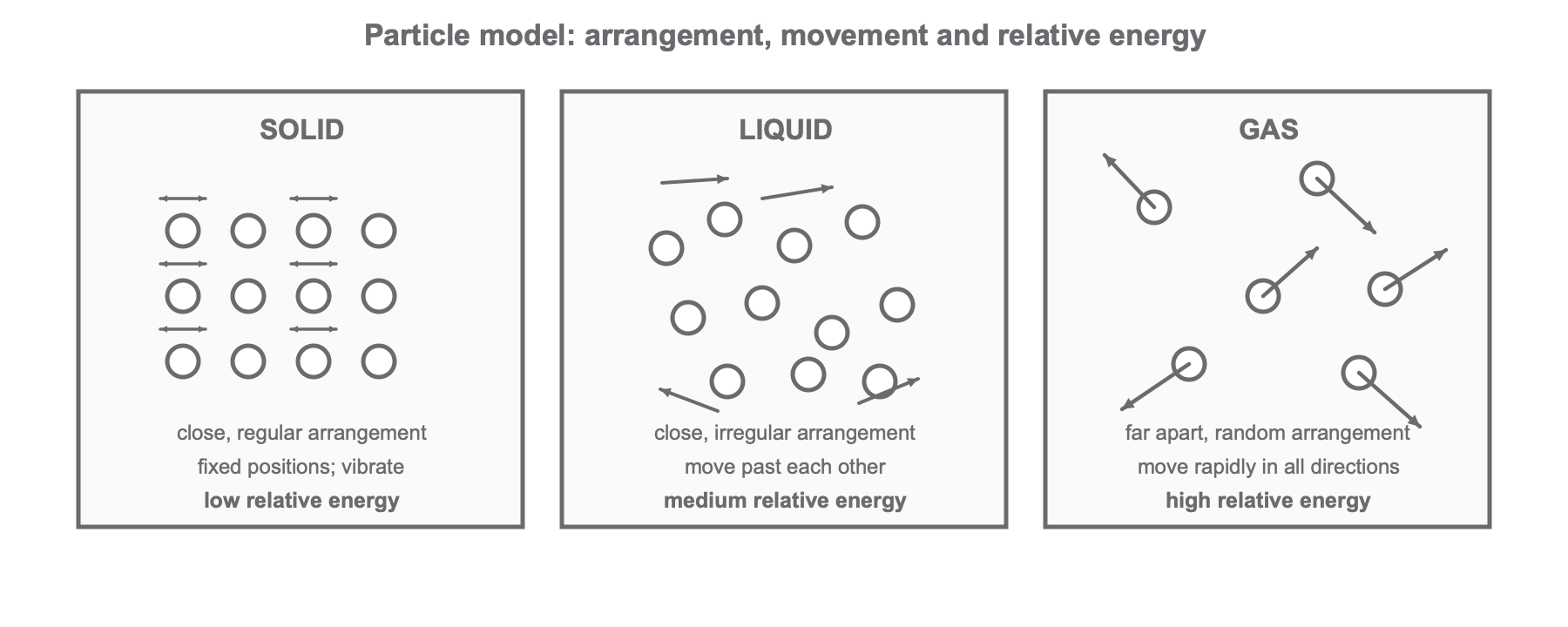
These panels show representative samples, not a tracked set of particles changing state: different circle counts do not mean particles disappear. Distances and arrow lengths are not to scale. In particular, liquid particles remain close together, while gas particles are much further apart in reality.
Solids and liquids
In a solid, particles are close together and held in fixed positions by attractions. They still vibrate about those positions; they are not motionless. The simple model shows a regular repeating arrangement, as in a crystalline solid. Some solids, such as glass, lack this long-range regular pattern.
In a liquid, particles are also close together, but their arrangement is irregular. They can move past one another. This explains why a liquid flows and takes the shape of the bottom of its container, while a solid keeps its shape. A liquid is not mainly empty space like a gas.
Gases and relative energy
In a gas, particles are far apart and randomly arranged. They move rapidly and freely in all directions, colliding with one another and the container. This spreads a gas throughout the available space. The large gaps also explain why a gas can be compressed much more easily than a liquid.
For the same substance as it is heated from solid through liquid to gas, the simple relative-energy comparison is solid < liquid < gas: energy must be supplied to melt and then vaporise it. This is not a claim that every gas particle always moves faster than every liquid particle, or that gases of any substance are always hotter than solids. Energy includes energy associated with particle attractions as well as motion; temperature is linked to average kinetic energy.
| State | Arrangement in the simple model | Movement | Relative energy along heating of the same substance |
|---|---|---|---|
| Solid | close, regular | vibrate about fixed positions | lowest |
| Liquid | close, irregular | move past one another | intermediate |
| Gas | far apart, random | move freely and rapidly in all directions | highest |
Changing state changes the arrangement and motion, not the size of the individual particles. The next lessons explain those changes.