1.40 - Properties of metals
A copper wire carries current and a metal sheet can be pressed into shape. You will use the structure of a metal to explain both electrical conductivity and malleability, distinguishing electron movement from the sliding of layers.
Metallic structure
A metal has a giant metallic structure. In the GCSE model, metal atoms contribute outer-shell electrons to a shared pool. The remaining positive metal ions form a regular lattice in a pure solid metal.
Delocalised electron
A delocalised electron is an electron that is not fixed to one atom or one bond and can move through the structure.
Metallic bond
Metallic bonding is the strong electrostatic attraction between positive metal ions and delocalised electrons.
The electrons are negative, so they attract the positive ions. This attraction acts throughout the structure, holding it together rather than forming separate molecules. Overall, a piece of metal is electrically neutral: the total positive and negative charges balance.
[DIAGRAM: asset_name: metallic_structure_property_links: Metallic structure and metal properties - diagram 1; asset_slug: 046_1_40_properties_of_metals_diagram1; file: diagram_assets/046_1_40_properties_of_metals_diagram1.png; recommended_method: deterministic_drawn; description: Exact monochrome teaching diagram showing a regular lattice of positive metal ions surrounded by delocalised electrons. The left panel labels positive metal ions, delocalised electrons and metallic bonding. The right panel links electron movement to electrical conductivity and sliding ion layers to malleability. This is an assessed structure-property visual, so it is generated deterministically to control labels, arrows and particle positions.]
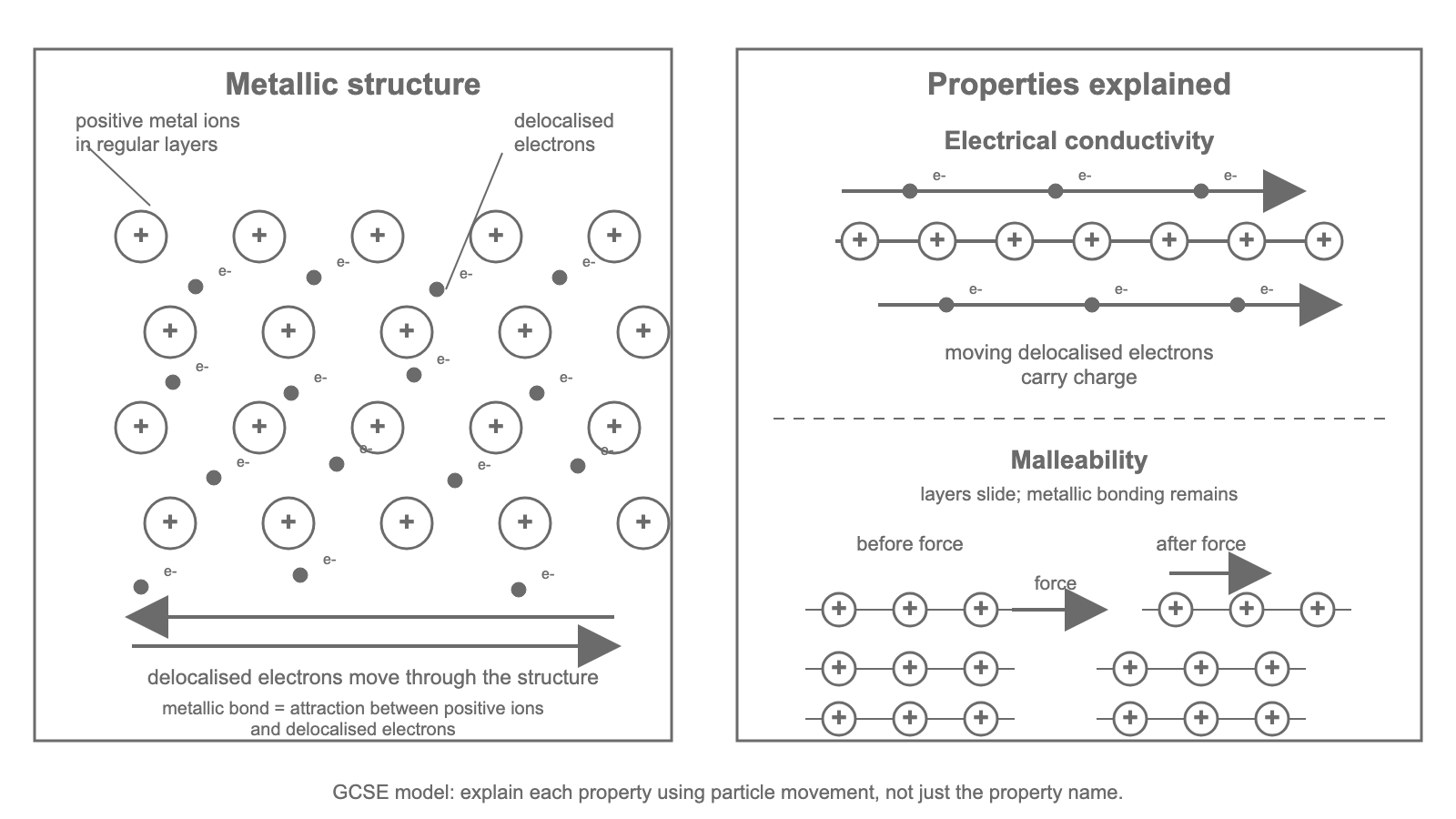
The diagram is a simplified section of the metal, not an electron-counting diagram. Only some electrons are drawn, and they are omitted from the small layer-sliding sketches. The lines through the rows identify layers; they are not separate bonds joining positive ions. In the real metal, attraction to delocalised electrons holds the layers together.
Conducting electricity
An electric current requires charged particles that can move through a material. In a solid metal, the positive ions vibrate about fixed positions. The delocalised electrons can move through the whole structure. When a potential difference is applied, their overall movement carries charge through the metal.
This explains why copper works as the conducting core of a wire. Merely saying that copper contains electrons is insufficient: all substances contain electrons, but their electrons are not necessarily free to travel through the substance.
Changing shape without breaking
Malleable
A malleable material can be hammered, pressed or rolled into shape without breaking.
In a pure metal, the ions can be pictured in regular layers. A force can make layers slide past one another. Metallic bonding does not depend on a particular pair of neighbouring ions remaining together: the delocalised electrons still attract the positive ions after layers shift.
The metal therefore changes shape while remaining held together. This does not mean the bonds are weak, or that a metal can never break. Malleability describes shaping without fracture under suitable forces; it is different from simply being soft.
Electrical conductivity depends on electrons moving and carrying charge. Malleability depends on layers sliding while attraction to delocalised electrons remains.