1.42 - Comparing metals and non-metals
Metals and non-metals show useful patterns in their physical properties, but there are exceptions. You will describe the usual patterns and use several properties together to compare and classify elements.
The usual property patterns
A physical property can be observed or measured without making a new substance. Most metals are shiny solids at room temperature, have high melting points and high density, and conduct electricity well. Freshly exposed metal surfaces are often shiny even if an old surface has become dull.
- A high melting point means a high temperature is needed to change the solid to a liquid.
- High density means a large mass in a given volume. Two samples of the same volume can have different masses; a larger object is not automatically denser.
- A good electrical conductor lets current pass through easily.
Most non-metals have low boiling points and are poor electrical conductors. A boiling point is the temperature at which a liquid boils into a gas, at a stated pressure. It is different from a melting point. Several non-metals are gases at room temperature; others are solids, and bromine is a liquid.
[DIAGRAM: asset_name: metal_non_metal_property_pattern: General property pattern - diagram 1; asset_slug: 048_1_42_general_properties_of_metals_and_non_metals_diagram1; file: diagram_assets/048_1_42_general_properties_of_metals_and_non_metals_diagram1.png; recommended_method: deterministic_drawn; description: Exact monochrome comparison diagram showing the Edexcel 1.42 property pattern. The metal panel states: shiny, solid, high melting point, high density, good conductor of electricity. The non-metal panel states: low boiling point, poor conductor of electricity. The diagram also includes the note that "most" means common patterns rather than every example. Deterministic drawing is required because the labels are assessed specification wording and must be exact.]
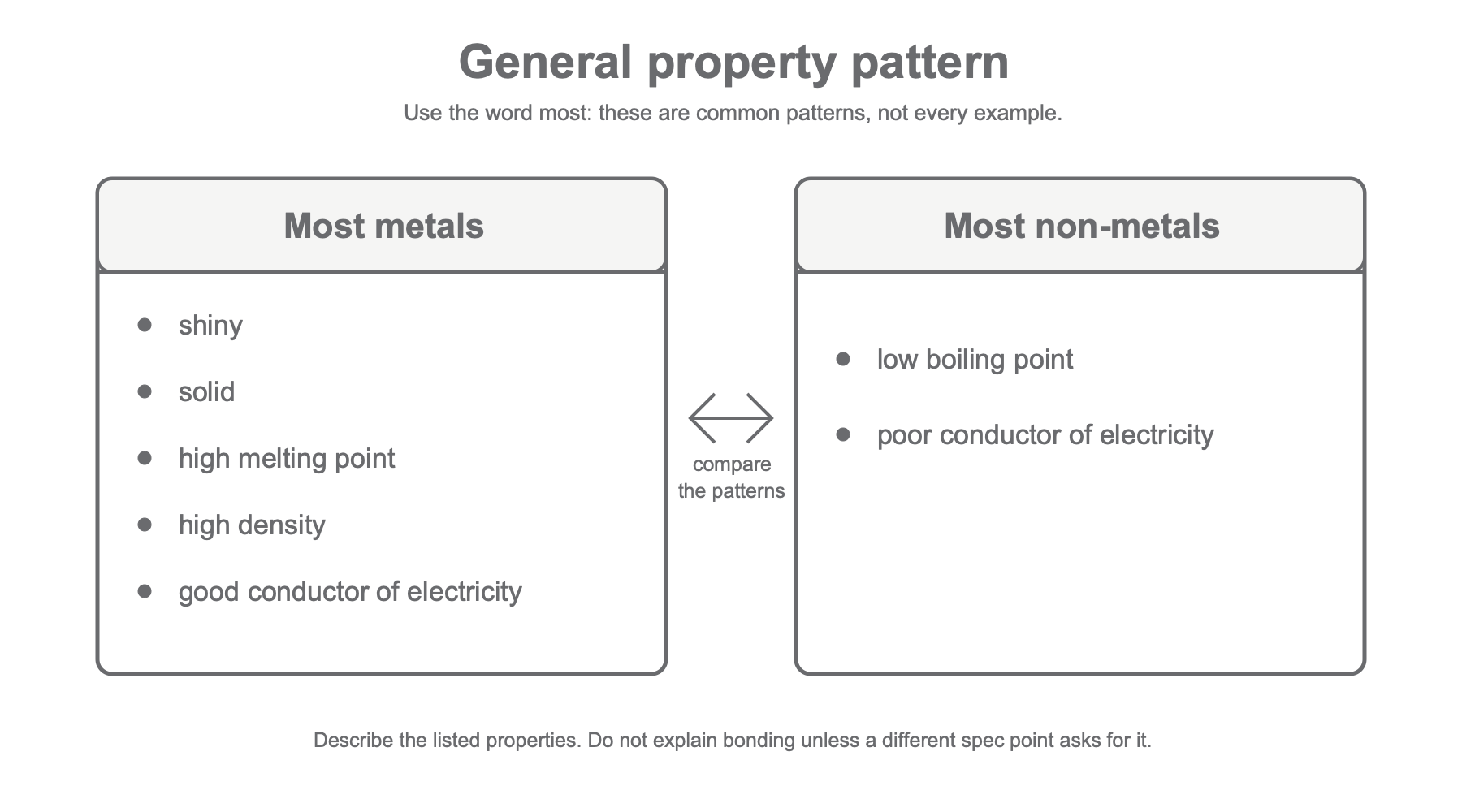
The word most matters. Mercury is a metal that is liquid at room temperature. Graphite is a form of carbon, a non-metal, that conducts electricity. One exception disproves a statement about all elements in a group, but it does not remove a useful general pattern.
Comparing and classifying from evidence
Use several clues when classifying an unknown element. A shiny solid with a high melting point and good electrical conductivity fits the usual metal pattern. An element with a low boiling point and poor conductivity fits the usual non-metal pattern. Electrical conductivity alone is not proof of being a metal, as graphite shows.
When comparing, name both groups and the relevant properties. For example: "Most metals conduct electricity well, whereas most non-metals conduct poorly." Melting and boiling points describe different changes of state, so do not treat one as a measurement of the other.
Worked comparison
Suppose element A is a shiny, dense solid that conducts electricity. Element B is a poorly conducting gas at room temperature. A fits several common metal properties. B fits the non-metal pattern: being a gas at room temperature is consistent with a low boiling point. This is a classification supported by evidence, not identification of the exact elements.
Use the pattern of several properties and allow exceptions. Most metals are shiny, solid, dense, high-melting electrical conductors; most non-metals have low boiling points and conduct poorly.