1.44 - Empirical formulae from masses and percentages
Mass data can be used to work out the formula of a simple compound. The important move is to convert masses, or percentages by mass, into a ratio of atoms. The formula you calculate in this way is an empirical formula: the simplest whole-number ratio of atoms of each element in the compound.
What an empirical formula means
An empirical formula tells you the simplest ratio of atoms of each element in a compound. It does not describe the mass ratio directly, and it does not always show the actual number of atoms in a molecule.
Empirical formula
The empirical formula of a compound is the simplest whole-number ratio of atoms of each element in that compound.
For example, the formula shows one magnesium atom for every one oxygen atom in the simplest ratio. The formula shows two aluminium atoms for every three oxygen atoms in the simplest ratio.
If your calculation gives a ratio that can be simplified, the empirical formula uses the simplified ratio. For example, a calculated atom ratio of 2 : 4 should be written as 1 : 2. Here you will find that atom ratio from reacting masses or percentage composition.
The calculation route
Mass ratios are not usually the same as atom ratios because atoms of different elements have different relative atomic masses. A magnesium atom and an oxygen atom do not have the same mass, so you must convert each mass into a comparable amount before making the ratio.
Use this relationship for each element:
amount value = mass of element / Ar of element
When mass is in grams, these amount values are the amounts of atoms in moles: each mole contains the same number of atoms. You can compare the values without counting individual atoms. Then convert them into the simplest whole-number ratio:
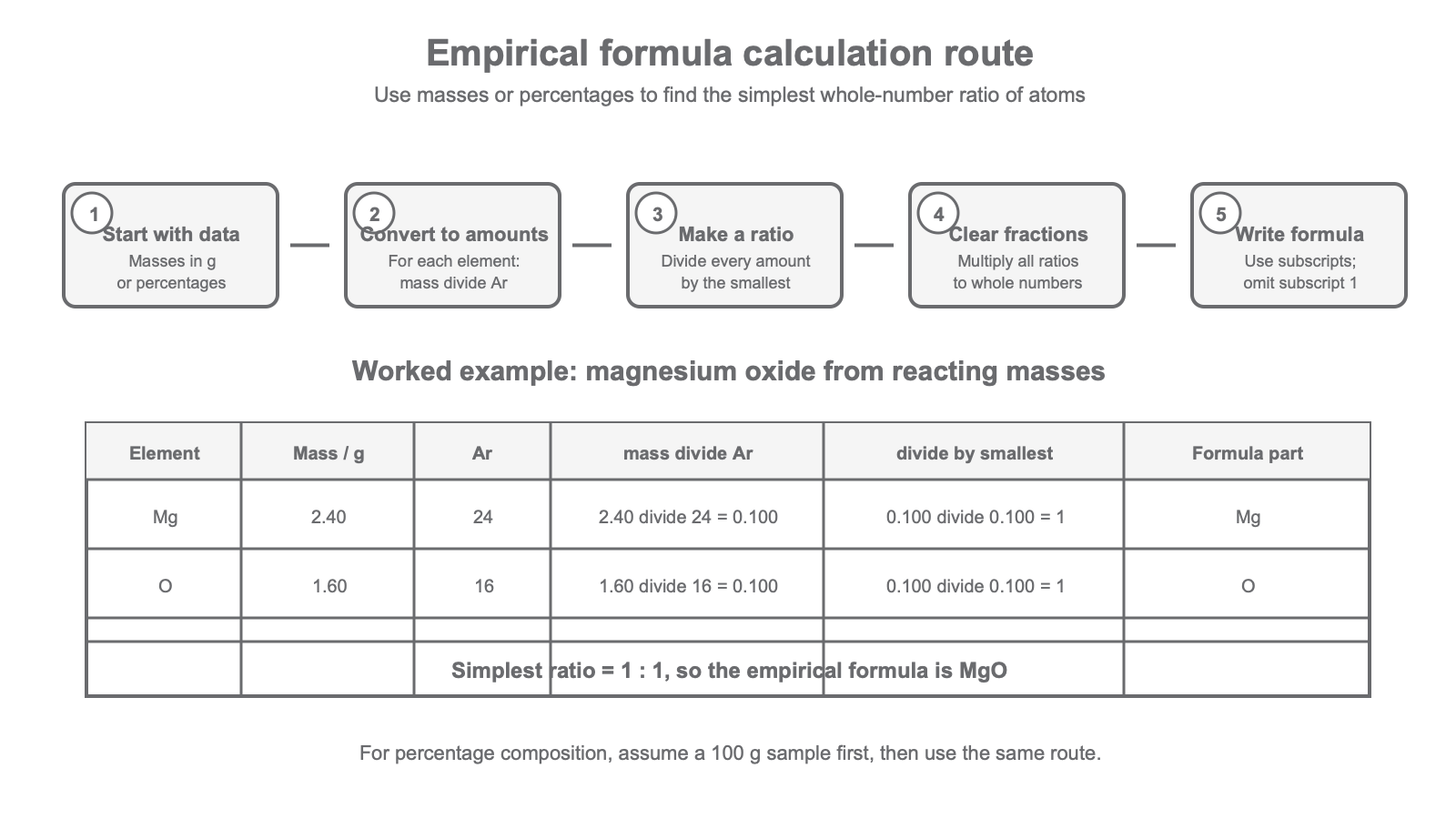
- Write the mass of each element in grams. If percentages are given, assume a 100 g sample first.
- Divide each mass by the relative atomic mass, , of that element.
- Divide every result by the smallest result.
- If the ratio contains a simple fraction, multiply every part of the ratio to make whole numbers.
- Write the empirical formula using subscripts. Do not write the subscript
1.
[DIAGRAM: asset_name: empirical_formula_calculation_route: Empirical formula calculation route - diagram 1; asset_slug: 050_1_44_formulae_of_simple_compounds_from_reacting_masses_or_percentage_compositio_diagram1; file: diagram_assets/050_1_44_formulae_of_simple_compounds_from_reacting_masses_or_percentage_compositio_diagram1.png; recommended_method: deterministic_drawn; description: Exact assessed calculation-route visual showing the five steps for empirical formula calculations from masses or percentages: start with masses or percentages, divide each mass by Ar, divide by the smallest amount value, multiply to whole numbers if needed, and write the empirical formula with subscript 1 omitted. It includes a small worked magnesium oxide table with masses 2.40 g and 1.60 g, Ar values 24 and 16, amount values 0.100 and 0.100, ratio 1:1, and final empirical formula MgO. Deterministic drawing is used because the formulae, ratios, table headings and calculation route must be exact.]
The final empirical formula has no unit. The working uses masses in grams, but the answer is a chemical formula such as , or .
From reacting masses
Reacting mass data may tell you the mass of each element that combines to make a compound. Once you have the mass of each element, use the route from the previous section.
Worked example: magnesium reacts with oxygen to form magnesium oxide. A sample contains 2.40 g of magnesium and 1.60 g of oxygen. Calculate the empirical formula.
| Element | Mass / g | Ar | Mass / Ar | Ratio |
|---|---|---|---|---|
| Mg | 2.40 | 24 | 2.40 / 24 = 0.100 | 0.100 / 0.100 = 1 |
| O | 1.60 | 16 | 1.60 / 16 = 0.100 | 0.100 / 0.100 = 1 |
The simplest whole-number ratio is , so the empirical formula is:
MgO
Some ratios contain a half. Do not round 1.5 to 2. Multiply every part of the ratio by 2.
Worked example: a sample of aluminium oxide contains 1.35 g of aluminium and 1.20 g of oxygen. Calculate the empirical formula.
| Element | Mass / g | Ar | Mass / Ar | Divide by smallest |
|---|---|---|---|---|
| Al | 1.35 | 27 | 1.35 / 27 = 0.0500 | 0.0500 / 0.0500 = 1 |
| O | 1.20 | 16 | 1.20 / 16 = 0.0750 | 0.0750 / 0.0500 = 1.5 |
The ratio is . Multiply both parts by 2:
1 : 1.5 = 2 : 3
So the empirical formula is:
Al2O3
If a question gives the total mass of a compound and the mass of only one element, first subtract to find the mass of the other element. For example, if 5.00 g of compound contains 3.20 g of oxygen, the mass of the other element is . Then continue with the same empirical formula method.
From percentage composition
Percentage composition tells you the percentage by mass of each element in a compound. The easiest method is to assume there is 100 g of the compound.
In a 100 g sample:
40.0% carbon means 40.0 g carbon
6.7% hydrogen means 6.7 g hydrogen
53.3% oxygen means 53.3 g oxygen
Worked example: a compound contains 40.0% carbon, 6.7% hydrogen and 53.3% oxygen by mass. Calculate the empirical formula. Relative atomic masses are , , .
| Element | Mass in 100 g / g | Ar | Mass / Ar | Divide by smallest |
|---|---|---|---|---|
| C | 40.0 | 12 | 40.0 / 12 = 3.33 | 3.33 / 3.33 = 1 |
| H | 6.7 | 1 | 6.7 / 1 = 6.7 | 6.7 / 3.33 = 2.01 |
| O | 53.3 | 16 | 53.3 / 16 = 3.33 | 3.33 / 3.33 = 1 |
The value 2.01 is close to 2 because the percentage data have been rounded. The simplest whole-number ratio is:
C : H : O = 1 : 2 : 1
So the empirical formula is:
CH2O
This method is the same as the reacting-mass method. The only extra step is turning the percentages into masses by assuming 100 g.
Checking and common errors
Empirical formula calculations are often marked for method as well as the final formula. When the command word is Calculate, show the relevant working: division by , the ratio step, any multiplier used to remove fractions, and the final formula.
Use these checks before writing the answer:
| Ratio after dividing by the smallest | What to do | Example empirical formula pattern |
|---|---|---|
1 : 1 | already whole numbers | XY |
1 : 2 | already whole numbers | XY2 |
1 : 1.5 | multiply all parts by 2 | X2Y3 |
1 : 1.33 | treat as about 1 : 4/3, then multiply by 3 | X3Y4 |
1 : 1.25 | treat as 1 : 5/4, then multiply by 4 | X4Y5 |
Keep unrounded calculator values until you have divided by the smallest amount value; the worked tables display rounded values for readability. Values such as 1.99, 2.01 or 2.02 are usually intended to be 2 when the data have been rounded. Values such as 1.5, 1.33 and 1.25 are not rounding errors; they are fractions that need multiplying to make a whole-number ratio.
Common errors are predictable:
- Using the mass ratio as the atom ratio, such as turning
24 gmagnesium and16 goxygen into . - Forgetting to divide by .
- Rounding
1.5to2instead of multiplying the whole ratio by2. - Writing coefficients instead of subscripts, such as instead of .
- Adding units to the final formula. The empirical formula has no unit.
- Forgetting that the formula is the simplest ratio, so should be simplified to .
To calculate an empirical formula, convert each mass or percentage into an amount value using mass / Ar, divide by the smallest value, multiply to whole numbers if needed, and write the simplest formula.