1.37 - How structure explains uses of diamond and graphite
Use the bonding in graphite and diamond to explain why graphite works as an electrode and lubricant, while diamond makes an effective cutting edge. Follow each structure → property → use link.
Graphite as Electrodes
An electrode must conduct electricity. Most non-metals do not conduct electricity, but graphite is the important exception in this lesson.
In graphite, each carbon atom forms three covalent bonds to other carbon atoms. Carbon has four outer-shell electrons, so one electron from each carbon atom is not fixed in one covalent bond. These electrons are delocalised, meaning they can move through the layers of graphite.
When graphite is used as an electrode, the delocalised electrons can carry charge. This makes graphite a suitable electrical conductor. The carbon atoms stay in place; the delocalised electrons carry the charge.
Worked explanation:
Graphite can be used as an electrode because each carbon atom is bonded to three other carbon atoms, leaving one electron per carbon atom delocalised. These delocalised electrons can move through the layers and carry charge, so graphite conducts electricity.
Delocalised Electron
A delocalised electron is an electron that is not fixed between one pair of atoms and can move through part of a structure.
Graphite also needs a very high temperature to disrupt its many strong covalent bonds. The electrode property explained here is electrical conductivity.
Graphite as a Lubricant
A lubricant reduces friction between moving surfaces. Graphite is useful as a lubricant because of how its layers behave.
The carbon atoms in each graphite layer are joined by strong covalent bonds. However, the forces between the layers are weak compared with covalent bonds. This means the layers can slide over each other easily.
That sliding is the important link to the use. When graphite is between two surfaces, the layers can slide, so the surfaces can move past each other more easily. Graphite is not a lubricant because the covalent bonds are weak; the covalent bonds within each layer are strong.
Diamond in Cutting Tools
Diamond is used in cutting tools because it is very hard. Its hardness comes from its bonding and structure.
In diamond, each carbon atom forms four covalent bonds to four other carbon atoms. These strong covalent bonds extend throughout a 3D giant covalent structure. There are no layers that can slide over each other easily.
When a cutting tool presses against another material, the diamond structure resists being scratched or deformed because many strong covalent bonds would have to be broken or disturbed. That is why diamond can be used on cutting edges, drill tips, and similar tools.
Worked explanation:
Diamond is used in cutting tools because each carbon atom is covalently bonded to four other carbon atoms in a 3D giant covalent structure. There are strong covalent bonds in all directions, so diamond is very hard and can cut or scratch other materials.
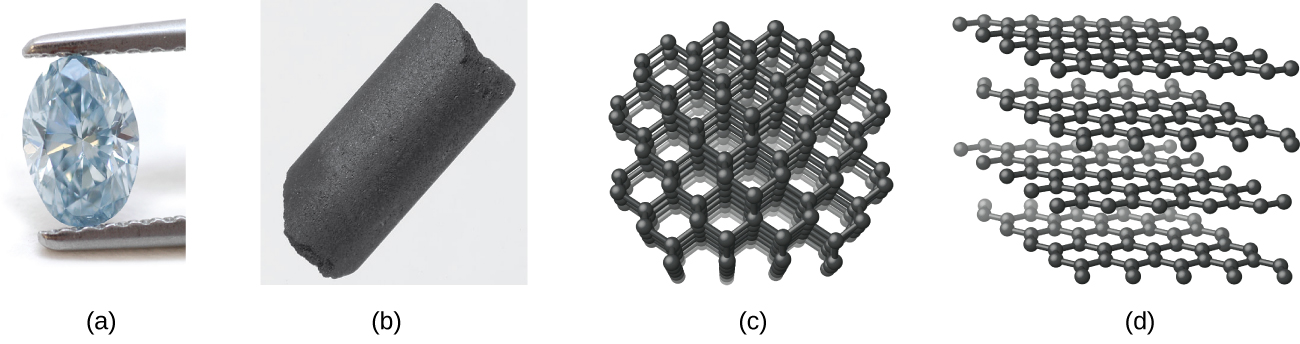
OpenStax, Chemistry, Figure 18.20, CC BY 4.0. Photos: Fancy Diamonds/Flickr and images-of-elements.com. Diamond is shown in (a), (c); graphite in (b), (d). The continuous diamond network resists scratching; the gaps between graphite sheets help explain sliding.