1.38 - Properties of fullerenes, C60 and graphene
Compare a hollow C₆₀ molecule with a one-atom-thick graphene sheet. Use the difference between separate molecules and a continuous network to explain their strength, electrical conduction and response to heating.
Cages and sheets
Fullerenes are carbon structures with hollow cages or tubes. Buckminsterfullerene, C₆₀, is a molecule containing 60 carbon atoms in a roughly spherical cage of pentagonal and hexagonal rings. Each carbon is bonded to three other carbon atoms. A sample contains many separate C₆₀ molecules.
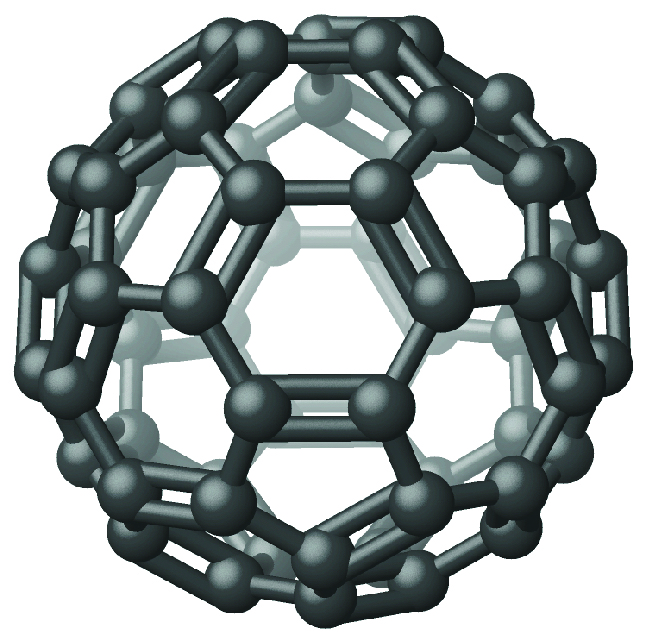
OpenStax, Chemistry, Figure 18.22, CC BY 4.0. Each sphere is a carbon atom. The cage has pentagonal and hexagonal faces; the back is partly hidden by the front.
Graphene is a continuous sheet of carbon atoms, one atom thick, arranged in hexagonal rings. Each carbon has three carbon neighbours in the sheet. It is the structure of a single graphite layer.
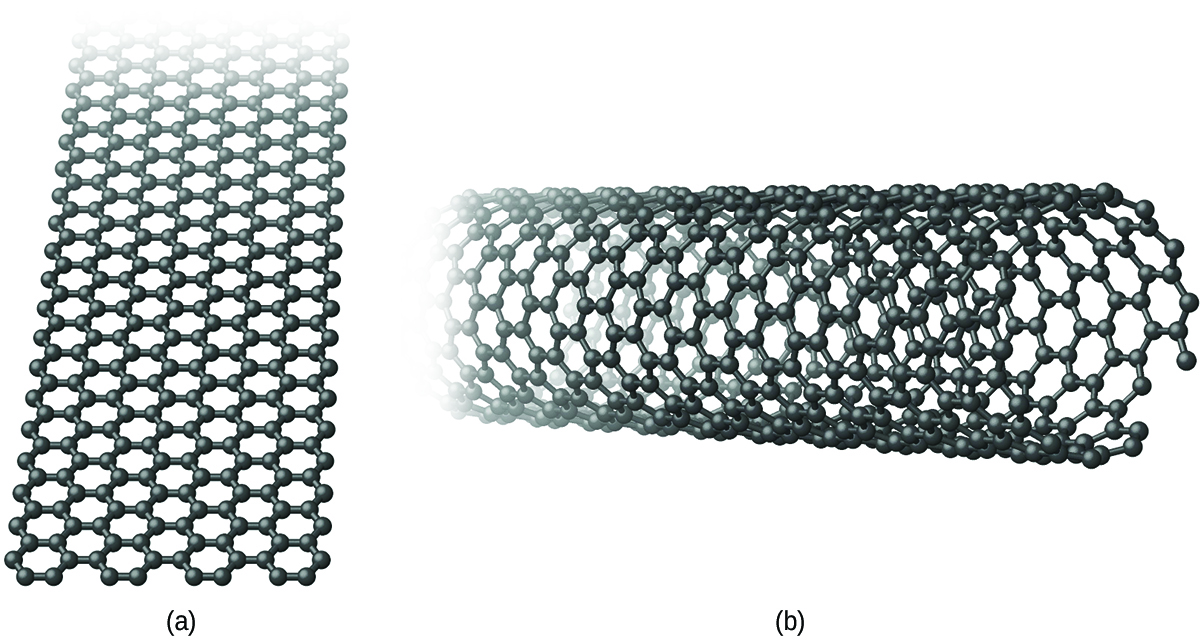
OpenStax, Chemistry, Figure 18.23, CC BY 4.0. (a) shows a graphene sheet; (b) shows a carbon nanotube, whose wall has a similar hexagonal arrangement curved into a tube. The sheet continues beyond the faded edges.
The useful distinction is scale: C₆₀ has a fixed molecular cage; graphene's covalent network extends across the sheet.
Strong cages, weaker attractions between cages
The bonds inside each C₆₀ cage are strong covalent bonds. Between separate molecules there are much weaker intermolecular forces. Separating intact molecules therefore requires less energy than breaking a giant covalent carbon network.
At ordinary pressure, heated C₆₀ can sublime: change from solid to gas without becoming liquid. Its molecules can remain intact because the attractions between cages are overcome, not the covalent bonds inside a cage. The important thermal comparison is molecular attractions versus an extended covalent network; do not assume that all carbon structures simply melt on heating.
Separate, roughly spherical C₆₀ molecules can move past one another, which can help fullerene materials reduce friction in lubrication applications. This does not mean the covalent bonds in the cages are weak.
Pure solid C₆₀ is a poor electrical conductor. Its electrons do not move freely from one molecule to the next throughout the solid. Merely having carbon atoms bonded to three neighbours does not guarantee good conduction.
A strong conducting sheet
Strong covalent bonds extend across graphene. Stretching or tearing an intact sheet requires breaking these bonds, so graphene is very strong for its thickness. Being one atom thick gives it a low mass per unit area; thin does not mean weak bonding.
Each carbon contributes an electron to electrons delocalised over the sheet. These electrons can move across the continuous structure and carry charge, so graphene conducts electricity. C₆₀ also has electrons spread within its cages, but it lacks this same continuous path across the whole solid.
For example, a very thin conducting film needs both a connected structure that resists tearing and mobile charged particles. Graphene supplies these through its covalent sheet and its delocalised electrons. “It is carbon” alone does not explain either property: diamond and C₆₀ have different structures and behave differently.