1.29 - How covalent bonds form molecules
Covalent bonds can join atoms into separate particles called molecules. You will distinguish atoms from molecules and recognise molecules of elements and compounds.
From atoms to a molecule
Molecule
A molecule is a discrete group of two or more atoms joined by covalent bonds.
Discrete means a separate unit. Two hydrogen atoms sharing an electron pair form one hydrogen molecule, . There are still two atoms, but they now belong to one bonded particle. Two unbonded hydrogen atoms would be two separate particles, not a molecule.
[DIAGRAM: asset_name: covalent_bonding_to_molecules - diagram 1; asset_slug: 035_1_29_covalent_bonding_results_in_the_formation_of_molecules_diagram1; file: 035_1_29_covalent_bonding_results_in_the_formation_of_molecules_diagram1.png; recommended_method: deterministic_drawn; description: Title: Covalent bonding forms molecules. Deterministic monochrome teaching diagram. Shows separate atoms becoming one molecule by covalent bonding, then two examples: an element molecule labelled hydrogen molecule, H2, and a compound molecule labelled water molecule, H2O. Uses simple atom circles and bond lines only, no dot-and-cross electrons. Students should learn that covalent bonding joins atoms into molecules and that molecules may contain one element or more than one element.]
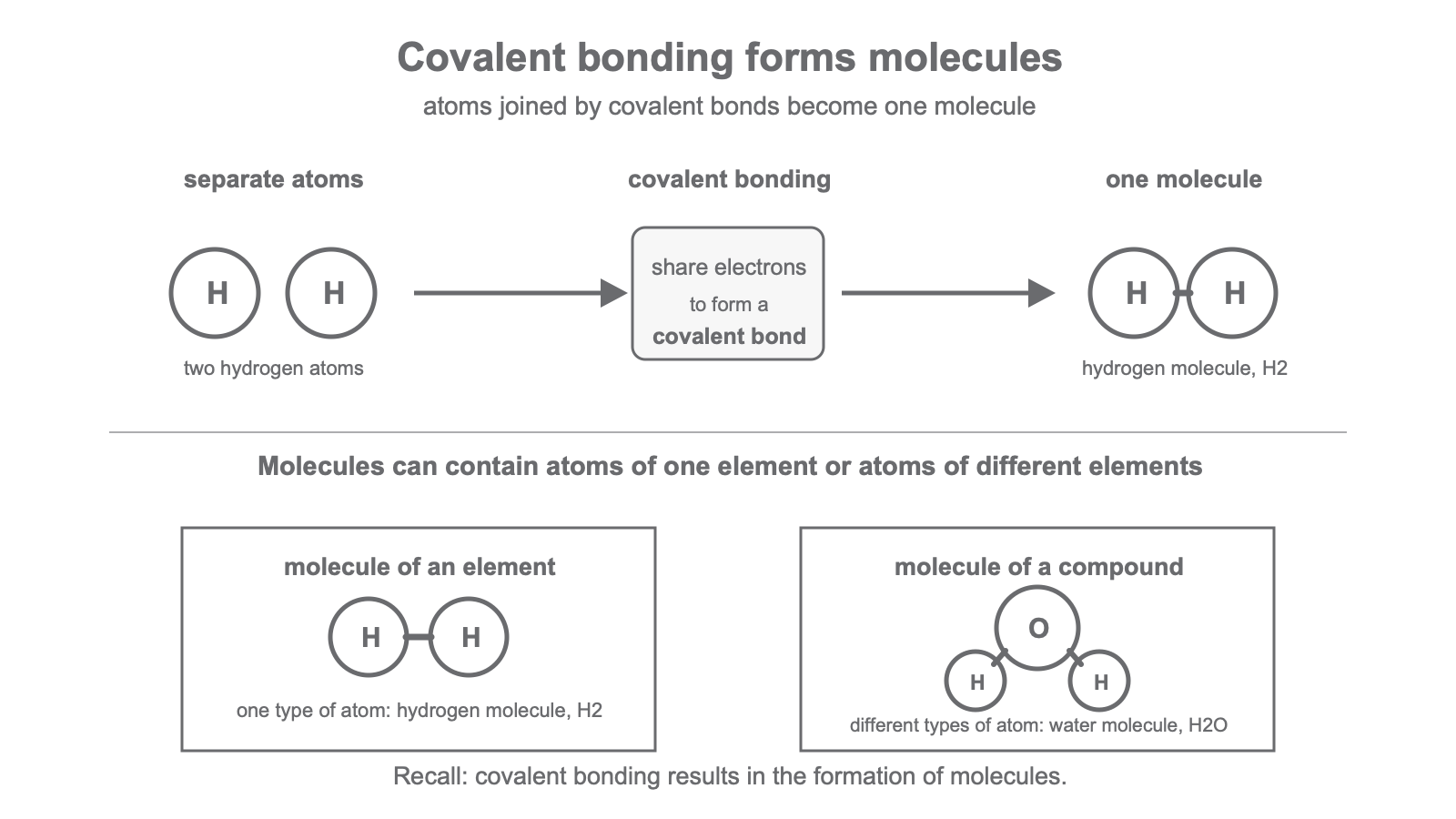
Covalent bonds join the atoms within each molecule. For example, a sample containing three separate water molecules contains three particles, each with its own bonded group of atoms. It is not one nine-atom molecule.
This lesson concerns simple molecular substances. Covalent bonding can also form giant networks, such as diamond, which have no separate small molecules; those structures are studied later.
Molecules of elements and compounds
A molecule can contain atoms of the same element or atoms of different elements. Its formula tells you the atoms in one molecule: a subscript applies to the element just before it, and no subscript means one atom.
| Formula | Atoms in one molecule | Classification |
|---|---|---|
| Two hydrogen atoms | Molecule of an element | |
| Two oxygen atoms | Molecule of an element | |
| Two hydrogen atoms and one oxygen atom | Molecule of a compound | |
| One carbon atom and two oxygen atoms | Molecule of a compound |
A compound contains different elements chemically bonded together. Oxygen is a molecule but not a compound because both its atoms are oxygen. Water is both molecular and a compound. Conversely, not every compound consists of molecules: an ionic compound such as sodium chloride forms a lattice of ions.