1.27 - The ionic lattice
Ionic crystals contain a regular arrangement of positive and negative ions. You will connect this three-dimensional structure to the attractions between ions and interpret what a small, flat lattice diagram can show.
A repeating structure of ions
Ionic lattice
An ionic lattice is a regular, repeating, three-dimensional arrangement of positive and negative ions.
In sodium chloride, the particles are sodium ions, , and chloride ions, . The pattern extends through the crystal. It does not consist of separate sodium chloride molecules: the formula gives the simplest 1:1 ratio of sodium ions to chloride ions.
The ions are held together by strong electrostatic attractions between opposite charges. These attractions are the ionic bonds. Each ion interacts with several surrounding ions; one sodium ion is not bonded only to the chloride ion that received its electron. Attractions act throughout the lattice in all directions.
For example, magnesium oxide has a lattice of and ions. Its formula records their 1:1 ratio, while its bonding is the electrostatic attraction between the oppositely charged ions.
Reading a slice of the lattice
[DIAGRAM: asset_name: ionic_lattice_slice: Ionic lattice structure as a 2D slice of a 3D arrangement - diagram 1; asset_slug: 033_1_27_ionic_lattice_structure_diagram1; file: diagram_assets/033_1_27_ionic_lattice_structure_diagram1.png; recommended_method: deterministic_drawn; description: Exact assessed teaching diagram in NovaLearn monochrome style. Shows a 2D slice of a sodium chloride ionic lattice with alternating Na+ and Cl- ions in a regular repeating pattern, one Na+ ion highlighted with attractions to neighbouring Cl- ions, and labels for regular lattice, positive ion, negative ion, strong electrostatic force (ionic bond), and continuation in three dimensions. Students should learn that a 2D lattice diagram represents part of a 3D repeating structure and that ionic bonds are attractions between oppositely charged ions throughout the lattice.]
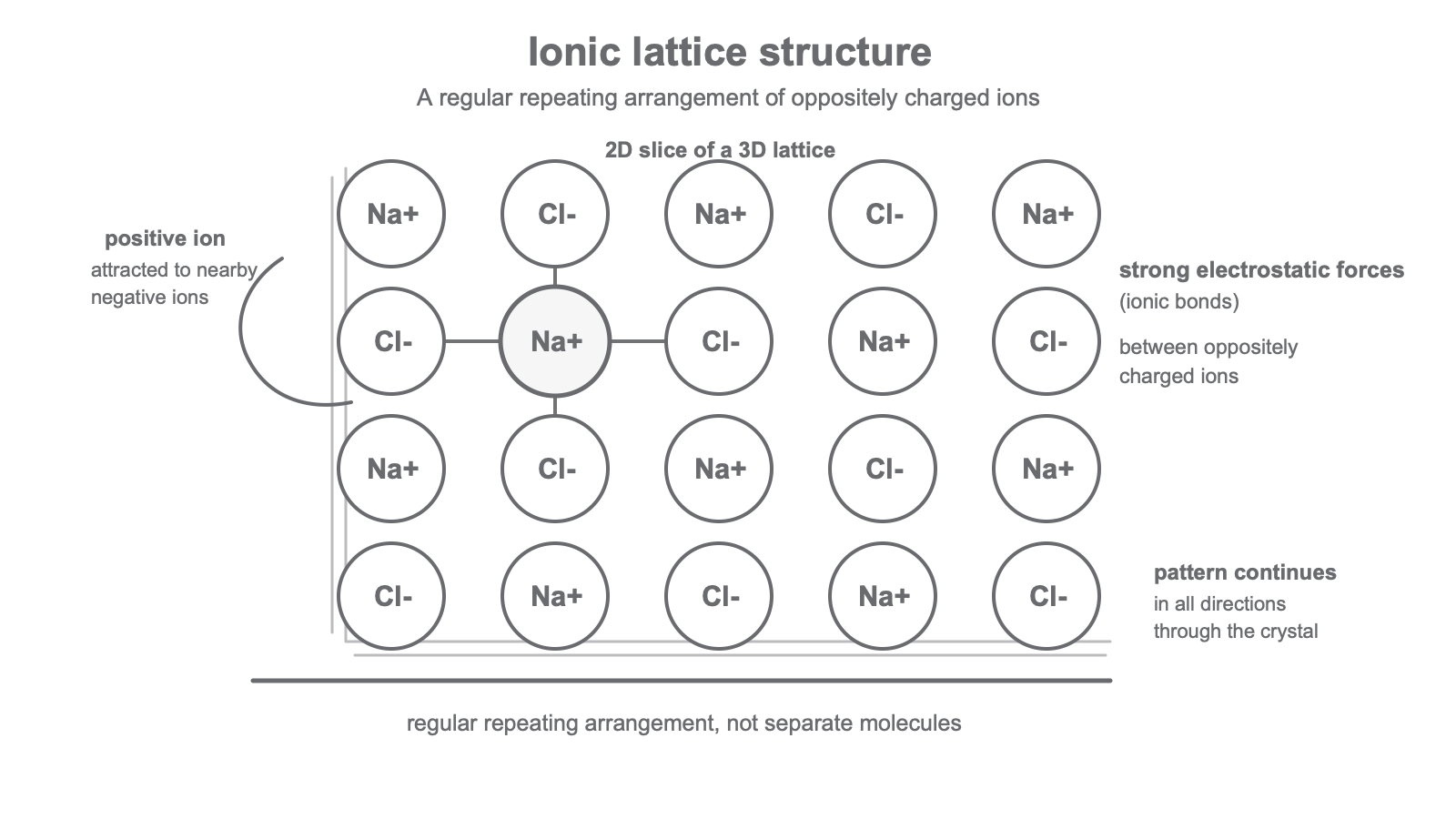
This diagram shows a small two-dimensional slice of the three-dimensional sodium chloride lattice. Look at the highlighted sodium ion: chloride ions lie immediately above, below, left and right in the slice. Other neighbours lie outside this flat view. The repeating pattern continues beyond every edge and into and out of the page.
The lines indicate attractions, not material rods or shared electron pairs. Only some attractions are highlighted; ions elsewhere in the lattice are also held by electrostatic forces. Circle sizes are schematic, so the drawing cannot establish actual ion sizes or distances.
A lattice model describes the ions after formation. It need not show electron-transfer arrows. Electron transfer explains how the ions form; their opposite charges explain the ionic attraction.