1.30 - The sizes of atoms and molecules
Atoms and small molecules are far too small to measure with a classroom ruler. You will learn their approximate scale, convert between metres and nanometres, and use that scale in a simple estimate.
The scale of atoms and small molecules
Atoms and small molecules have typical sizes of the order of . A useful reference size is , equal to .
Order of magnitude
An order of magnitude describes an approximate scale using a power of ten.
The reference value is not an exact diameter for every atom or molecule. Different atoms have different sizes; small molecules may be a few tenths of a nanometre across. For example, and are still on the atomic scale.
Converting nanometres to metres
The prefix nano means one billionth. Nanometres are convenient because they avoid writing many zeros.
Nanometre conversion
To convert a length in nanometres to metres, multiply its numerical value by .
For the reference atom size:
For a small molecule across:
The unit conversion is always the same. One nanometre is ten times the reference atom size of ; it is not itself the typical atom size.
Using the scale to estimate
[DIAGRAM: asset_name: Atom and small molecule order-of-magnitude scale - diagram 1; asset_slug: 036_1_30_typical_size_order_of_magnitude_of_atoms_and_small_molecules_diagram1; file: 036_1_30_typical_size_order_of_magnitude_of_atoms_and_small_molecules_diagram1.png; recommended_method: deterministic_drawn; description: Deterministic monochrome log-scale comparison showing a typical atom or small molecule at about 10^-10 m / 0.1 nm, 1 nm at 10^-9 m, and a human hair near 10^-4 m. The visual teaches the order-of-magnitude recall value and prevents confusion between 0.1 nm and 1 nm. It is an exact assessed scale visual, so deterministic drawing is used.]
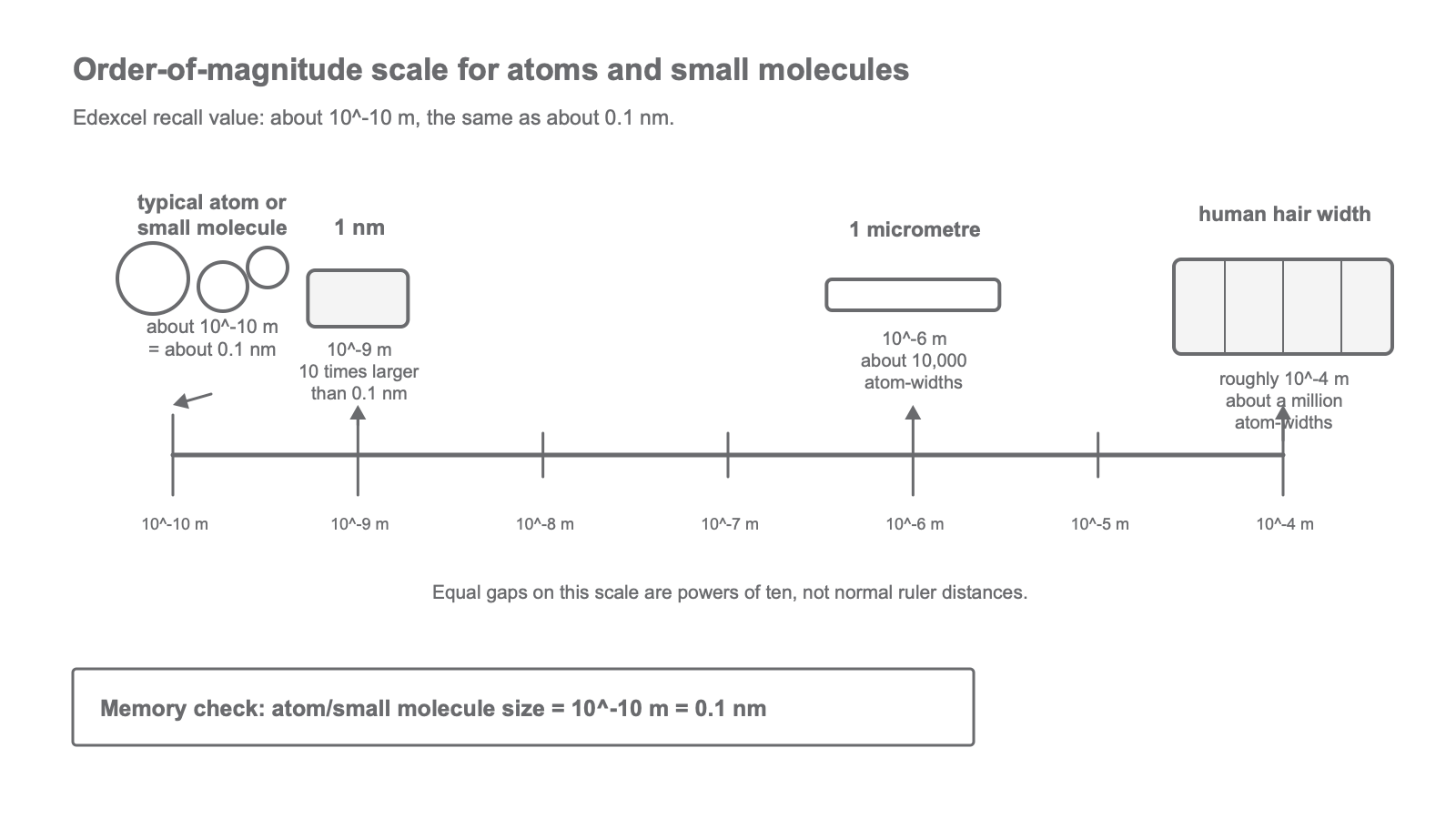
Each equal gap on the scale represents a factor of ten. The drawings are symbols, not objects drawn at their relative sizes. A hair about wide is about a million times wider than an atom of size .
To estimate how many atom-widths fit along a length, divide the total length by the size of one atom. Use the same unit for both lengths.
Atom-widths across one millimetre
Using for one atom and :
About ten million atom-widths fit along one millimetre. This is an estimate treating atoms as adjacent widths; it is not an exact count in a real material.