1.47 - Conservation of mass in closed and open systems
In a chemical reaction, atoms are rearranged into new substances. The law of conservation of mass says that atoms are not made or destroyed in ordinary chemical reactions, so the total mass is conserved when every substance is included. The important GCSE skill is explaining why the measured mass may stay the same in a closed flask but appear to change in an open flask.
The System Boundary
When you decide whether the mass should stay the same on a balance, first decide what is being measured. The measured system might be a sealed flask and everything inside it, or it might be an open flask where gases can enter or leave.
Law of Conservation of Mass
The law of conservation of mass states that the total mass of reactants is equal to the total mass of products in a chemical reaction, provided all substances are included.
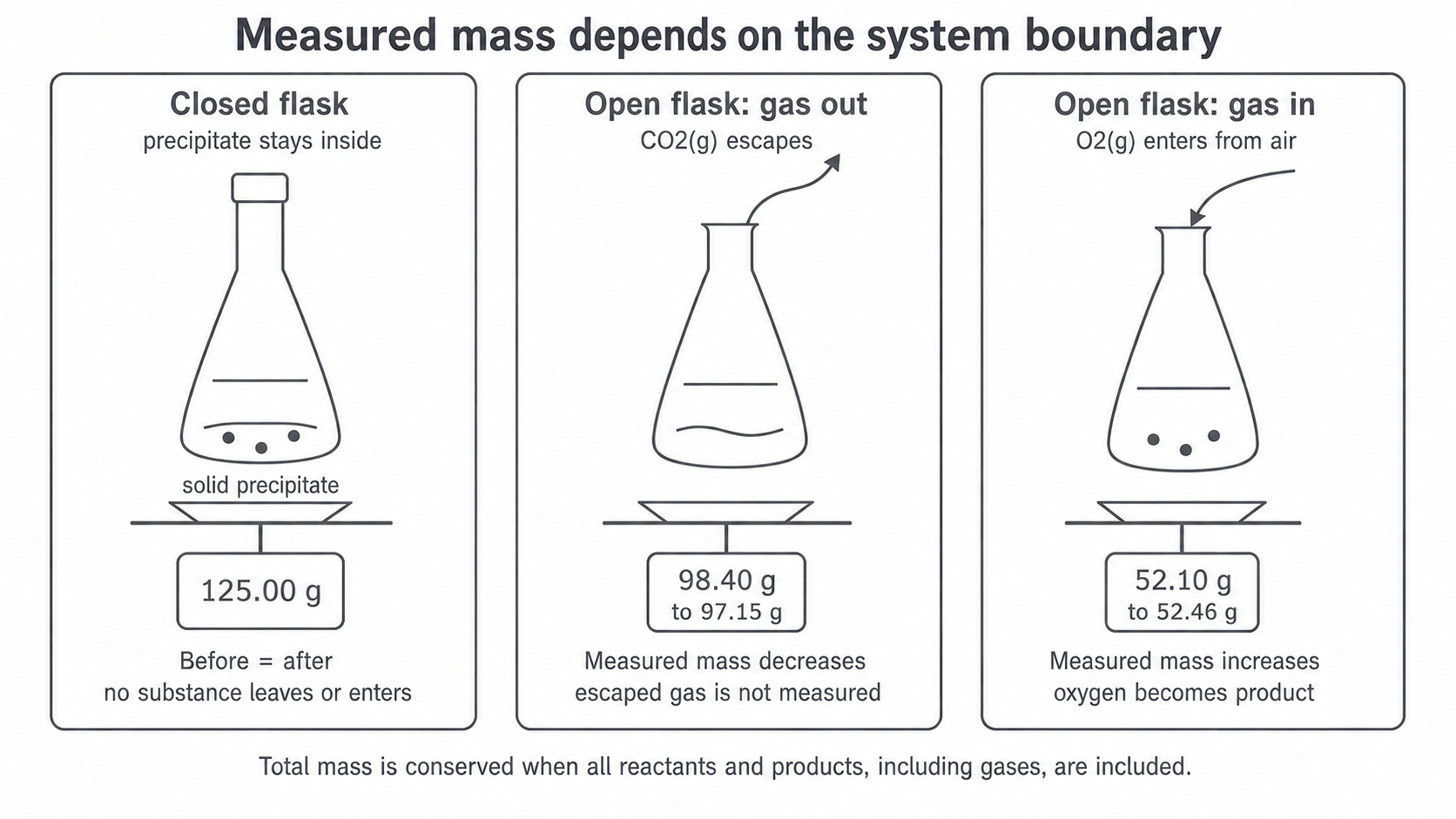
A closed system does not allow substances to enter or leave. In a closed flask, any gas, liquid, solution or solid produced by the reaction remains inside the flask. A non-enclosed system is open to the surroundings, so a gas can escape from the flask or a gas from the air can enter the flask.
Use the word "system" carefully. The law is about the total mass of all reactants and products. A balance may only be measuring the flask and its contents, not the gas that has escaped into the room or the oxygen that has entered from the air.
[DIAGRAM: asset_name: mass_system_boundary_comparison: Conservation of mass in closed and open systems - diagram 1; asset_slug: 053_1_47_conservation_of_mass_in_closed_and_open_systems_diagram1; file: 053_1_47_mass_system_boundary_repaired.png; recommended_method: imagegen; description: Exact monochrome teaching diagram comparing three balance setups: a closed stoppered flask with a precipitation reaction where measured mass before equals measured mass after; an open flask giving out CO2(g) where gas escapes and measured mass decreases; and an open flask taking in O2(g) from air where measured mass increases. Inspected corrected boundary visual with clear gas-direction arrows and measured-mass heading. Nearby prose explains that total mass is still conserved when all substances are included.]
Closed Flask Precipitation
A precipitation reaction forms an insoluble solid from substances in solution. The solid is called a precipitate. For example, when sodium carbonate solution and calcium chloride solution are mixed, calcium carbonate forms as a solid precipitate.
The appearance changes because a solid forms, but the mass of the closed flask and its contents does not change. The atoms that were in the solutions are still in the flask. Some are now in the solid precipitate and the rest are still in solution.
A good explanation links the observation to the law:
In a closed flask, the measured mass stays the same because no substance can leave or enter the flask. The precipitate is a product, but it remains inside the flask, so all the atoms are still included in the balance reading.
Worked example:
A stoppered flask contains two solutions in separate small containers. The sealed flask has a mass of 142.36 g. The flask is tilted so the solutions mix and a precipitate forms. The mass after mixing is 142.36 g.
The mass does not change:
142.36 g - 142.36 g = 0.00 g
This supports conservation of mass because the closed system includes the solutions, the precipitate, and the flask throughout.
In a closed precipitation reaction, a new solid can form without changing the measured mass, because the solid stays inside the closed system.
Open Flask Giving Out Gas
Some reactions produce a gas. If the flask is open, the gas can escape into the air. The balance then measures the flask and the substances still inside it, but not the gas that has escaped.
For example:
calcium carbonate + hydrochloric acid -> calcium chloride + water + carbon dioxide
Carbon dioxide is a gas. In an open flask, some carbon dioxide leaves the flask, so the mass reading decreases. This does not break the law of conservation of mass. The escaped gas still has mass; it is just no longer part of the system being measured on the balance.
Worked example:
An open flask has a mass of 98.40 g before an acid-carbonate reaction. After the fizzing stops, the flask and remaining contents have a mass of 97.15 g.
Mass lost from the measured flask:
98.40 g - 97.15 g = 1.25 g
The best explanation is not "mass disappeared". Assuming no liquid or solid was lost and evaporation is negligible, the 1.25 g is the mass of carbon dioxide that escaped from the open flask.
Open Flask Taking In Gas
An open reaction can also appear to gain mass. This happens when a gas from the air becomes part of the products. Oxygen is the common GCSE example.
For example:
magnesium + oxygen -> magnesium oxide
If magnesium reacts with oxygen from the air in a crucible that allows gas exchange, oxygen atoms from outside the original measured contents join with magnesium atoms. The balance reading can increase because oxygen gas has entered the measured system and become part of the solid product.
Worked example:
An open flask contains a reacting solid. Before heating, the flask and solid have a mass of 52.10 g. After oxygen from the air reacts with the solid, the flask and product have a mass of 52.46 g.
Mass gained by the measured flask:
52.46 g - 52.10 g = 0.36 g
The extra 0.36 g is not new mass created by the reaction. It is the mass of oxygen taken in from the air and now included in the product.
An open container need not change measured mass
Being open allows matter to cross the boundary; it does not mean that matter must cross it. If two solutions form a precipitate in an open beaker, with no gas produced, no splashing and negligible evaporation, the measured mass stays the same. The solid and solution both remain on the balance.
Mass is conserved in chemical reactions. A measured mass changes only when matter enters or leaves the system being weighed.