1.18 - Metals and non-metals in the periodic table
An element’s position gives clues to whether it is a metal or a non-metal. You will connect the broad regions of the periodic table to outer-shell electrons, while recognising the limits of the pattern.
Finding metals and non-metals
Most elements are metals. They occupy the left and centre of the periodic table. Non-metals are mainly on the right. Hydrogen is a non-metal, even though it is usually drawn above Group 1 on the left.
[DIAGRAM: asset_name: Metal and non-metal regions - diagram 1; asset_slug: 024_1_18_metals_and_non_metals_in_the_periodic_table_diagram1; file: diagram_assets/024_1_18_metals_and_non_metals_in_the_periodic_table_diagram1.png; recommended_method: deterministic_drawn; description: Simplified monochrome periodic-table map showing the broad metal region on the left and centre, the non-metal region on the right, and hydrogen labelled as a non-metal above Group 1. The visual is a schematic support for identifying position, not a substitute for a full periodic table.]
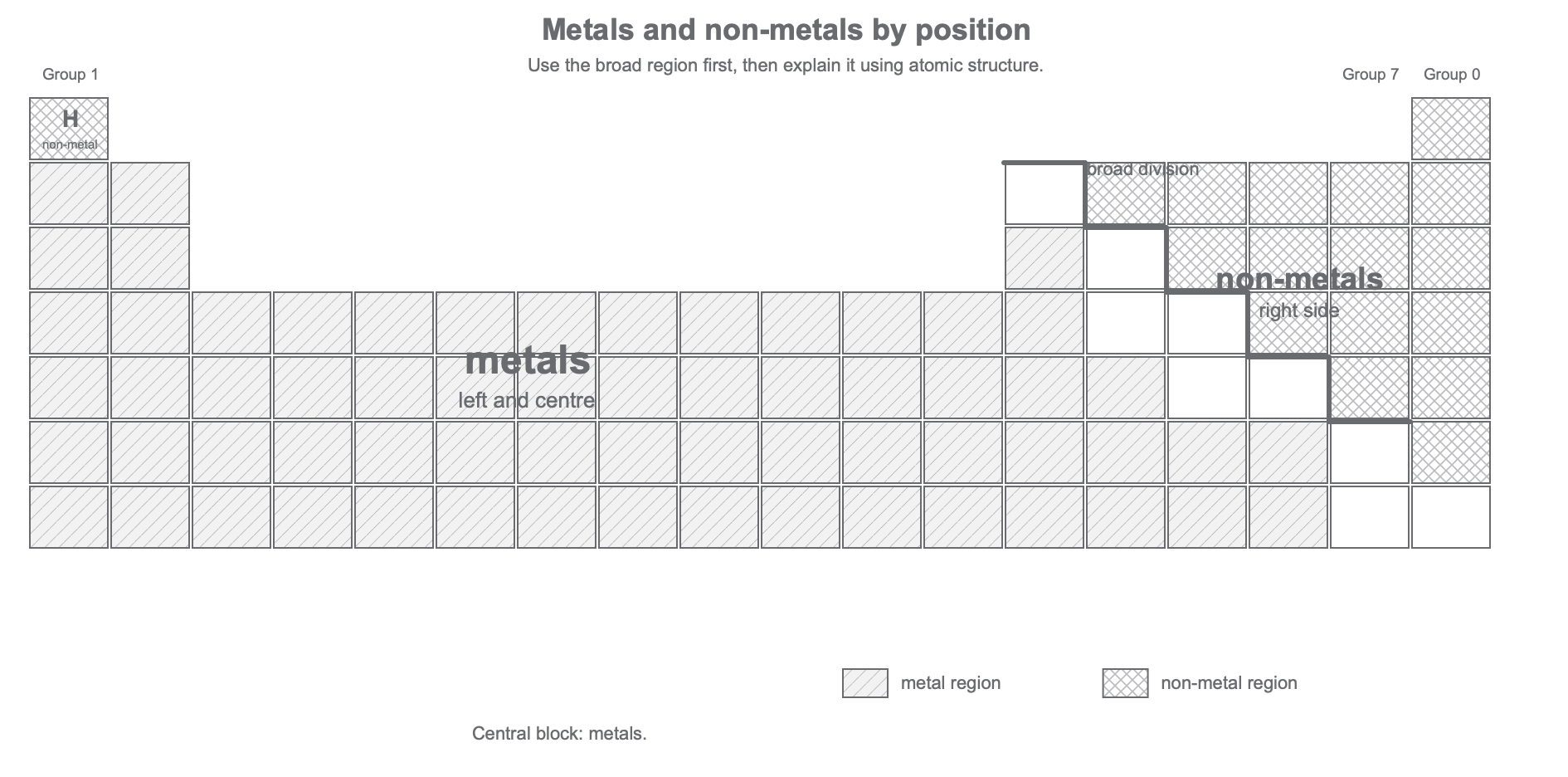
This is a broad map, not a rule that every right-hand element is a non-metal. Elements near the stepped boundary need care: some have intermediate properties and are called metalloids, for example silicon. The unshaded boundary boxes in the map are not assigned by the broad two-region key. Use named examples or a labelled table when a boundary position is involved.
Sodium, magnesium, aluminium, iron and copper are metals. Oxygen, sulfur, chlorine and the Group 0 noble gases are non-metals. A single period can therefore contain both types.
Connecting position to electrons
As atomic number increases across a period, neutral atoms gain electrons as well as protons. For the main-group elements, the number of outer-shell electrons generally increases across the period.
Metal atoms on the left usually have only a few outer-shell electrons and tend to lose electrons in reactions, forming positive ions. Non-metal atoms on the right usually have fuller outer shells; they often gain electrons or share electrons in reactions. The Group 0 non-metals already have full outer shells and are generally unreactive. These electron arrangements help explain the change in chemical behaviour across the table.
For example, magnesium has 2 outer electrons and sulfur has 6. Magnesium can lose its two outer electrons; sulfur can gain two or share electrons. The different outer shells help explain why these elements behave differently. Do not use “more electrons” without saying outer-shell electrons: a heavy metal may have far more electrons in total than a light non-metal.
This is a general pattern for the main groups, not a universal counting test. Hydrogen has one outer electron but is a non-metal. Detailed bonding and ion formation are developed in later lessons.