1.52 - Limiting reactants and mass of product
In many reactions, one reactant is used up before the others. Once that reactant has gone, the reaction cannot keep making product, even if another reactant is still present. In this Higher-tier lesson, you will use mole ratios to find the limiting reactant and calculate the maximum mass of product.
Limiting and excess reactants
A balanced equation gives the ratio in which particles react. If the available reactants are not in that ratio, one reactant is used up first.
Limiting reactant
The reactant that is completely used up first in a reaction. It is the reactant not in excess and it controls the maximum amount of product that can form.
An excess reactant is present in more than the amount needed to react with the limiting reactant. Some of the excess reactant is left over when the reaction stops. If reactants are supplied in exactly the reacting ratio, both can be used up together and neither is in excess. These calculations assume the reaction goes to completion; the maximum calculated product mass may differ from the mass actually collected.
For example:
The equation says that 1 mol of iron reacts with 1 mol of sulfur to form 1 mol of iron sulfide. If there are more moles of iron than sulfur, sulfur runs out first. The extra iron cannot form more iron sulfide because there is no sulfur left to react with it.
Reaction portions from an equation
A useful way to read a balanced equation is to count complete reaction portions. Each complete portion has the reactants in the correct mole ratio.
For the reaction:
one complete portion is:
1 mol Fe + 1 mol S -> 1 mol FeS
If a mixture contains 0.15 mol of iron and 0.10 mol of sulfur, only 0.10 mol of complete Fe + S portions can react. Sulfur is the limiting reactant. Iron is in excess.
[DIAGRAM: asset_name: Limiting reactant controls reaction portions - diagram 1; asset_slug: 058_1_52_limiting_reactants_and_mass_of_product_diagram1; file: diagram_assets/058_1_52_limiting_reactants_and_mass_of_product_diagram1.png; recommended_method: deterministic_drawn; description: Exact monochrome reaction-portion diagram for Fe + S -> FeS. It shows 0.15 mol Fe and 0.10 mol S as available 0.05 mol portions; two complete Fe + S pairs form 0.10 mol FeS while 0.05 mol Fe remains in excess. Assessed conceptual visual, deterministic drawn method.]
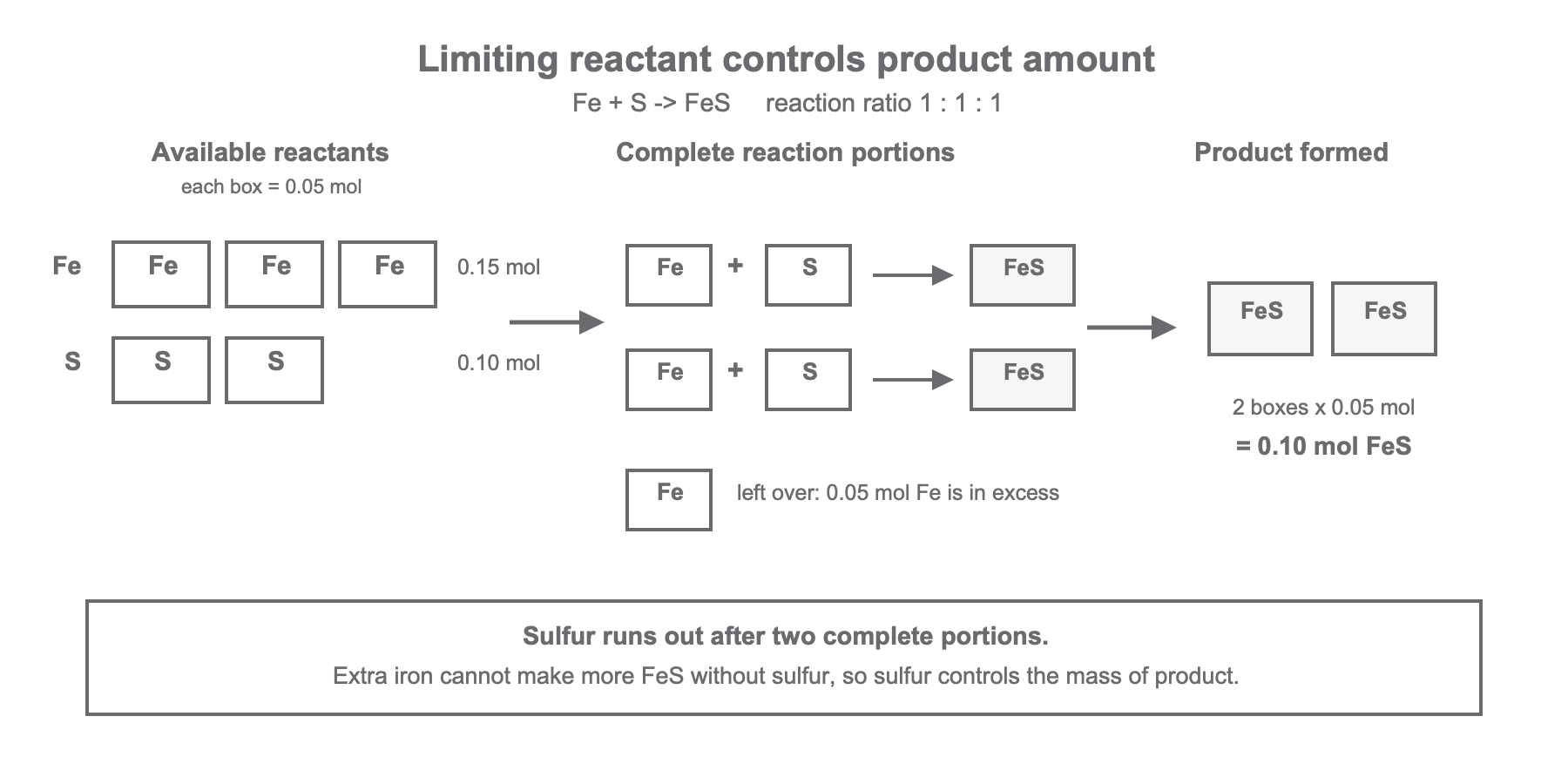
The important explanation is not just "there is less sulfur". The correct link is: sulfur is used up first, so no more complete Fe + S reacting pairs can form, so no more FeS can be produced.
Finding the limiting reactant
For calculation questions, convert the given amounts to moles first, then compare them using the balanced equation.
Amount from mass
Here is amount in mol, is mass in g, and is molar mass in g mol. The numerical value of is the relative formula mass, (or for a substance represented by single atoms).
Use the equation coefficients to decide which reactant can make the smaller amount of product. That reactant is limiting. Do not choose by mass alone, or just by which has fewer moles: the reacting ratio matters. The two possible product amounts are alternative limits for the same reaction, so use the smaller amount rather than adding them.
Worked example:
A student reacts 4.8 g of magnesium with 7.3 g of hydrogen chloride. Determine which reactant limits the mass of hydrogen produced.
Given: , , .
Moles of magnesium:
Moles of hydrogen chloride:
The equation needs 2 mol of HCl for every 1 mol of Mg. Therefore 0.200 mol of HCl can react with only 0.100 mol of Mg. HCl is used up first, so HCl is the limiting reactant and Mg is in excess.
Now apply the same idea with a different coefficient ratio. The limiting reactant is found after the equation ratio has been used, not just by choosing the smaller number of moles.
Mass of product formed
The mass of product depends on how many moles of product can form. In a limiting-reactant question, those moles come from the limiting reactant, not from the reactant in excess.
Worked example:
8.4 g of iron reacts with 3.2 g of sulfur. Calculate the maximum mass of iron sulfide formed.
Given: , , .
Moles of iron:
Moles of sulfur:
The ratio is 1 mol Fe : 1 mol S : 1 mol FeS, so sulfur is limiting and 0.100 mol of FeS forms.
Mass of FeS:
The mass of iron sulfide is controlled by the 3.2 g of sulfur, because sulfur is not in excess. Increasing only the iron would leave more unused iron, but it would not increase the mass of iron sulfide.