1.21 - Electron transfer and ionic bonding
Electron transfer makes positive and negative ions. You will follow this process in sodium chloride and use a dot-and-cross model to distinguish making ions from the attraction that holds them together.
From atoms to ions
A neutral atom has equal numbers of positive protons and negative electrons. When it loses or gains electrons, its nucleus stays unchanged.
- Losing electrons leaves more protons than electrons: a cation, or positive ion, forms.
- Gaining electrons leaves more electrons than protons: an anion, or negative ion, forms.
These names describe the charge of an ion; ions can be single atoms or groups of atoms. Here we follow single atoms gaining or losing electrons.
Ionic bond
An ionic bond is the strong electrostatic attraction between oppositely charged ions.
Electron transfer produces the ions. The attraction between those ions is the bond. Do not describe the bond itself as an electron or as a shared pair.
Following one electron
A sodium atom has electron arrangement 2,8,1 and a chlorine atom has 2,8,7. Sodium transfers its one outer-shell electron to chlorine. Sodium forms with arrangement 2,8; chlorine forms a chloride ion, , with arrangement 2,8,8. Both ions now have full outer shells.
[DIAGRAM: asset_name: sodium_chloride_dot_cross - diagram 1; asset_slug: 027_1_21_ionic_bonds_are_formed_by_the_transfer_of_electrons_between_atoms_to_produ_diagram1; file: 027_1_21_ionic_bonds_are_formed_by_the_transfer_of_electrons_between_atoms_to_produ_diagram1_imagegen_v2.png; recommended_method: imagegen; description: Exact assessed dot-and-cross sequence for sodium chloride. Shows a sodium atom with one outer-shell cross electron and a chlorine atom with seven outer-shell dot electrons before transfer; an arrow labelled one electron transferred; after transfer, bracketed sodium cation Na+ and chloride anion Cl- with chloride showing eight outer-shell electrons including one cross. Monochrome #6A6B6E on white. Students should learn that dot/cross symbols show electron origin, not different types of electrons.]
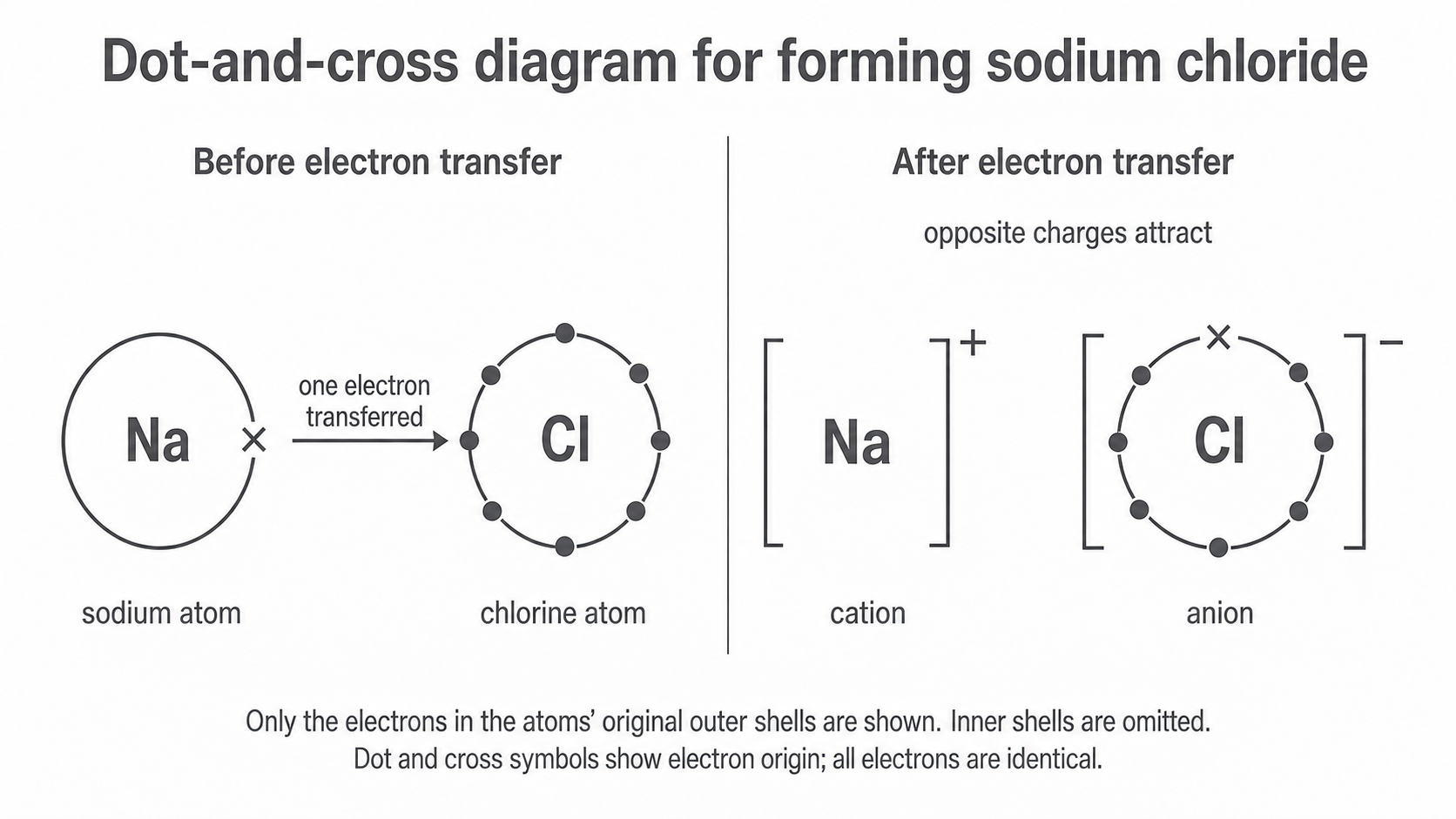
The diagram tracks the electrons in the atoms' original outer shells: one cross from sodium and seven dots from chlorine. After transfer, chloride has seven dots plus the transferred cross. Sodium's inner electrons are omitted from this simplified picture; still has ten electrons in total.
Dots and crosses identify electron origin, not different kinds of electron. The resulting and ions attract because their charges are opposite. A real sodium chloride crystal contains many ions in a repeating lattice, rather than separate pairs of ions.
Reading and drawing the model
In an ionic dot-and-cross model, show each final ion in square brackets with its charge outside. Place any transferred electron on the ion that gained it, using its original symbol. A formation sequence may also show the starting atoms and a transfer arrow; a diagram of the final ions alone need not have that arrow.
For lithium fluoride, lithium transfers its one outer-shell electron to fluorine, which initially has seven. The result is and . The fluoride outer shell contains seven of its own electrons and the one from lithium. Lithium's remaining first shell contains two electrons; it is omitted if the model shows only electrons in the atoms' original outer shells.
Notebook activity — ungraded: draw this lithium fluoride formation sequence. Self-check: one transferred electron; outside the lithium brackets; outside the fluoride brackets; eight electrons around fluoride, with exactly one using lithium's symbol. Compare your drawing with these checks or ask a teacher for feedback.