1.49 - Calculating mass concentration
A solution can contain a small or large mass of dissolved substance in the same volume. This lesson is about calculating concentration in g dm^-3, which means grams of solute per cubic decimetre of solution. You will convert volume units, calculate concentration and rearrange the relationship to find mass or volume.
What Concentration Means
A solution is made when a solute dissolves in a solvent. For this calculation, the solute is the substance being dissolved, and the solution is the final mixture after dissolving and making up to the required volume.
Concentration in g dm^-3
The concentration of a solution in is the mass of solute, in grams, present in of solution.
So a sodium chloride solution with concentration contains 12 g of sodium chloride in every of solution. If the same mass of solute is dissolved in a smaller final volume, the solution is more concentrated. If the same mass is dissolved in a larger final volume, the solution is more dilute.
The unit tells you the calculation:
gtells you to use mass of solute in grams- means "per ", so the volume must be in
- the answer is a mass divided by a volume
Do not mix this up with . Mole concentration is later separate Chemistry content. This lesson only uses concentration in .
The Calculation Relationship
The relationship for this specification point is:
Concentration in g dm^-3
In symbols:
where:
| Symbol | Meaning | Unit |
|---|---|---|
c | concentration | |
m | mass of solute | g |
V | volume of solution |
The volume is the final volume of solution, not just a random volume of water. If a question says the solution is "made up to ", that final solution volume is the value to use after converting it to .
[DIAGRAM: asset_name: concentration_equation_map: Mass, final solution volume and concentration in g dm^-3 - diagram 1; asset_slug: 055_1_49_concentration_of_solutions_in_g_dm3_diagram1; file: diagram_assets/055_1_49_concentration_of_solutions_in_g_dm3_diagram1.png; recommended_method: deterministic_drawn; description: Exact monochrome calculation map for concentration in g dm^-3. It shows mass of solute in g divided by final volume of solution in dm3 to give concentration in g dm^-3, plus the conversion 1000 cm3 = 1 dm3 and cm3 / 1000 = dm3. This is an assessed calculation relationship, so it must be deterministic and all labels/units must be exact.]
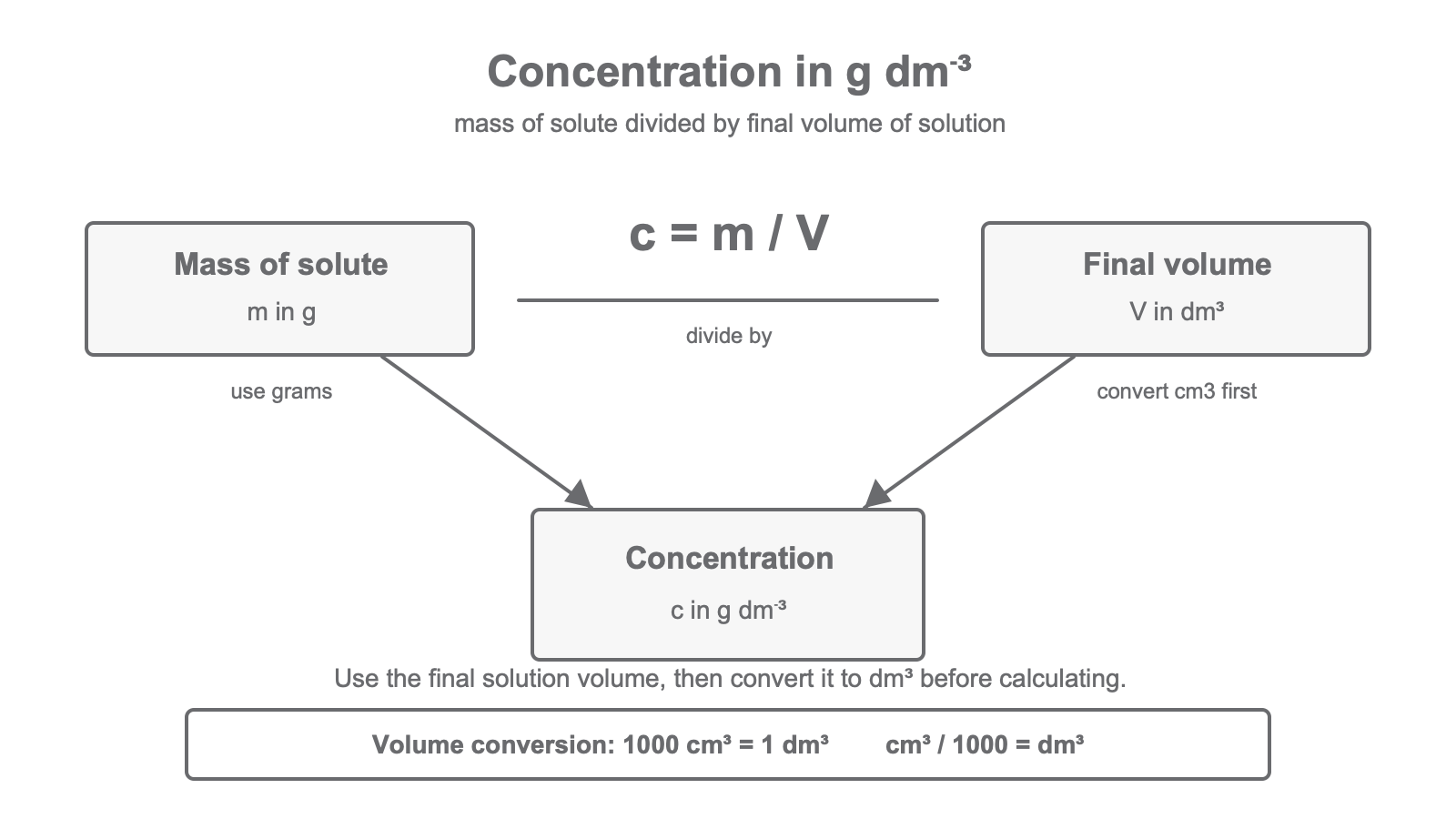
The same relationship can be rearranged if the question asks for a mass or a volume:
| Required quantity | Relationship |
|---|---|
| concentration | |
| mass of solute | |
| volume of solution |
For Edexcel Calculate questions, show the formula or relationship, substitute the data, work out the number, and include the unit.
Converting Volume Units
Most GCSE practical volumes are given in , but the concentration unit is . Convert the volume before substituting it into the equation.
Use:
So:
volume in = volume in / 1000
Common conversions are:
| Volume in | Volume in |
|---|---|
If you divide the mass by a volume still written in , your number will be too small by a factor of 1000 for an answer in .
Worked example:
A student dissolves 4.8 g of potassium chloride and makes the solution up to . Calculate the concentration in .
First convert the volume:
Then calculate:
concentration = mass / volume = 4.8 / 0.200 = 24 g
Now apply the same conversion habit to a fresh calculation.
Using the Relationship
Sometimes the question gives the concentration and volume, then asks for the mass of solute needed. This is the same relationship rearranged:
mass = concentration × volume
Worked example:
Calculate the mass of sodium chloride needed to make of solution with concentration .
Convert the volume:
Substitute into the rearranged relationship:
mass = concentration × volume
mass = 60 × 0.075 = 4.5 g
You can check whether this size of answer is sensible. means 60 g in . A volume of is much less than , so the mass should be much less than 60 g.
The relationship can also be rearranged to find volume:
volume = mass / concentration
For example, if 12 g of solute forms a solution:
volume = 12 / 48 = 0.25
If the question wants the answer in , convert back:
Exam Precision
For this point, Edexcel questions are likely to use Calculate or Determine. A full method is usually short, but it should be clear:
- Write or use the relationship.
- Convert to if needed.
- Substitute the values with the correct units.
- Calculate the answer.
- Write the unit, usually for concentration.
Use the mass of the solute, not the total mass of the solution. Use the final volume of the solution. If the question describes making the solution up to a line in a volumetric flask, the volume at the line is the final solution volume.
Common errors are:
- using directly in the denominator and then writing
- forgetting the final unit
- using when the question asks for
- rounding too early during the calculation
- using the mass of water or the mass of the whole solution instead of the mass of solute
For concentration in , convert the volume to first, then use concentration = mass / volume.
The final check asks you to choose the correct volume before calculating.