1.46 - Finding the formula of magnesium oxide
An empirical formula shows the simplest whole-number ratio of atoms of each element in a compound. In this experiment, magnesium is heated so that it reacts with oxygen to form magnesium oxide. The useful evidence is the mass of magnesium that reacted and the mass of oxygen that combined with it.
Purpose of the Experiment
The experiment is designed to find the ratio of magnesium atoms to oxygen atoms in magnesium oxide. Magnesium is a metal element, oxygen is a non-metal element, and the product is the compound magnesium oxide.
Empirical Formula
The empirical formula is the simplest whole-number ratio of atoms of each element in a compound.
The reaction can be represented as:
Magnesium reacting with oxygen
The balanced equation is useful background, but the experiment must still collect mass data. You need the mass of magnesium and the mass of oxygen. The oxygen is not weighed directly; it is found from the increase in mass when magnesium reacts.
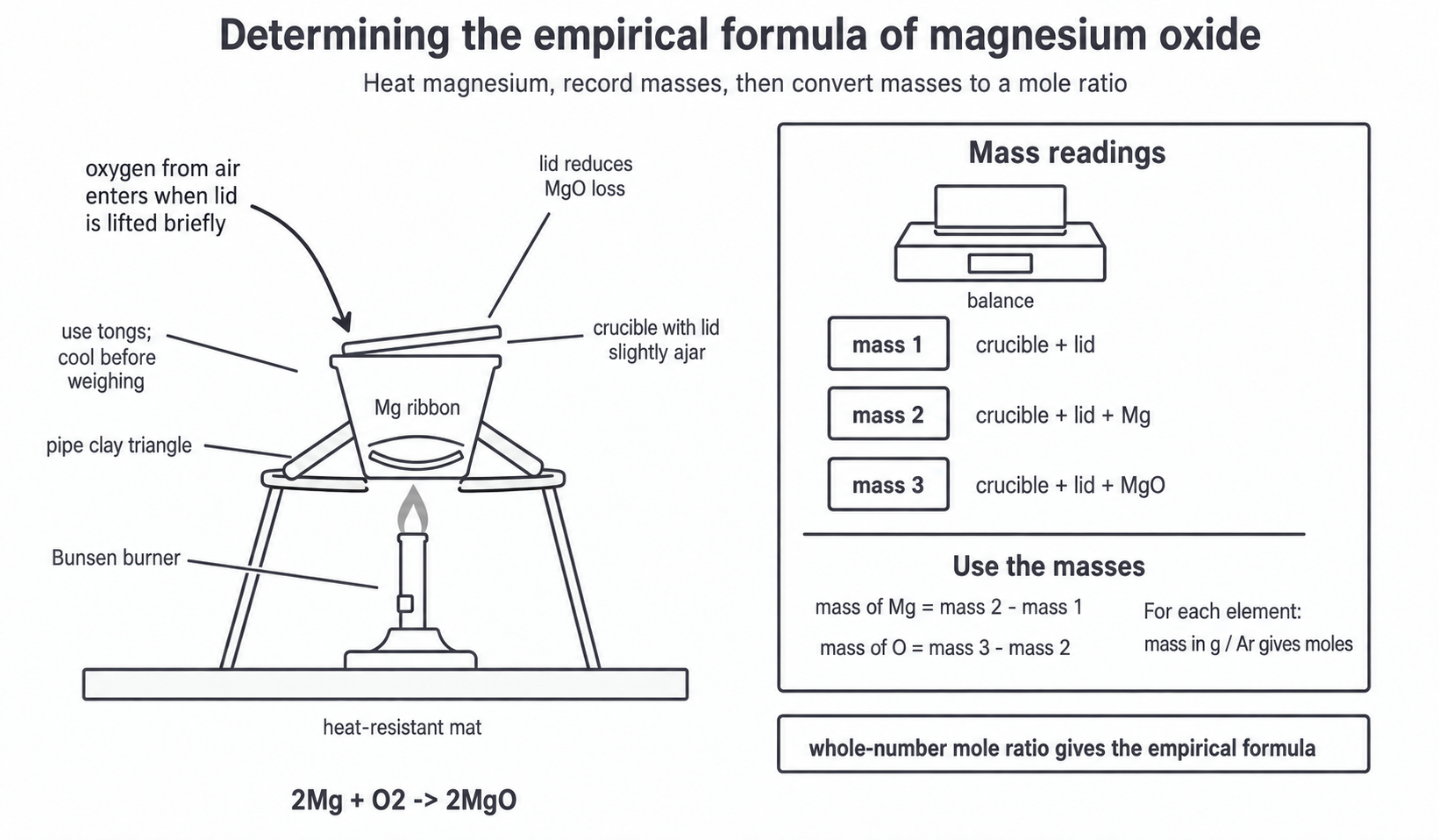
The evidence comes from three mass readings. The method must let oxygen reach the magnesium while keeping the solid product in the crucible.
Apparatus and Safety
The key apparatus is a crucible with a lid, a balance, tongs, a pipe clay triangle, a tripod, a Bunsen burner and a heat-resistant mat. The crucible lets the magnesium be heated strongly, while the lid helps stop powdery magnesium oxide escaping.
[DIAGRAM: asset_name: magnesium_oxide_empirical_formula_apparatus: Magnesium oxide empirical formula apparatus and mass readings - diagram 1; asset_slug: 052_1_46_empirical_formula_experiment_using_magnesium_oxide_diagram1; file: 052_1_46_magnesium_oxide_apparatus_repaired.png; recommended_method: imagegen; description: Exact monochrome teaching diagram showing a crucible with lid slightly ajar on a pipe clay triangle and tripod above a Bunsen burner on a heat-resistant mat, with labels for oxygen entering briefly and the lid reducing magnesium oxide loss. A side panel shows the three required mass readings: crucible plus lid, crucible plus lid plus Mg, and crucible plus lid plus MgO, then the calculations mass of Mg = mass 2 - mass 1 and mass of O = mass 3 - mass 2. Inspected corrected apparatus and data-flow visual; oxygen enters from air and mass relationships are exact.]
The safety points must match the hazards in this procedure:
- magnesium is a flammable solid, so only use the small piece supplied and keep unused magnesium away from the flame
- burning magnesium gives a bright white light, so do not look directly at the burning magnesium
- the crucible, lid and pipe clay triangle become very hot, so handle them with tongs and allow them to cool before weighing
- wear eye protection because hot solid or powder could escape if the lid is lifted too far
"Wear goggles" alone is not a full practical safety answer if the question asks for a risk and precaution. Link the precaution to the hazard.
Method
The method must produce reliable mass data and make sure as much magnesium as possible reacts with oxygen.
- Clean a short piece of magnesium ribbon if it is tarnished to remove the existing oxide layer, then coil it loosely so air can reach it.
- Measure the mass of the empty crucible and lid.
- Add the magnesium to the crucible and measure the mass of the crucible, lid and magnesium.
- Place the crucible on a pipe clay triangle on a tripod, with a Bunsen burner underneath.
- Heat gently at first, then heat more strongly with the lid on.
- Lift the lid slightly at intervals using tongs. This allows oxygen in, but the lid should not be lifted far enough for magnesium oxide powder to escape.
- Continue heating until there is no further visible reaction.
- Allow the crucible and lid to cool, then measure the mass of the crucible, lid and product.
- Heat, cool and weigh again until the mass readings are consistent. This is heating to constant mass.
Heating to constant mass provides evidence that the reaction is complete, provided oxygen can reach the magnesium and no product is lost. If the mass still changes after more heating, not all of the magnesium has reacted or the apparatus has not reached a stable final condition.
Using the Mass Data
The mass readings are useful only if they are turned into the masses of magnesium and oxygen.
| Reading | What is weighed |
|---|---|
| mass 1 | crucible + lid |
| mass 2 | crucible + lid + magnesium |
| mass 3 | crucible + lid + magnesium oxide |
So:
- mass of magnesium = mass 2 - mass 1
- mass of oxygen = mass 3 - mass 2
The mass of oxygen is the increase in mass because oxygen from the air has combined with the magnesium.
Amount of substance from mass
Divide each amount in mol by the smaller amount to find the atom ratio. If necessary, multiply every term by the same small integer to remove fractions. For magnesium oxide, reliable results should give a ratio close to 1:1.
Worked example:
| Quantity | Value |
|---|---|
| mass of crucible + lid | 28.20 g |
| mass of crucible + lid + magnesium | 28.68 g |
| mass of crucible + lid + magnesium oxide | 29.00 g |
Mass of magnesium = 28.68 g - 28.20 g = 0.48 g
Mass of oxygen = 29.00 g - 28.68 g = 0.32 g
Using relative atomic masses Mg = 24 and O = 16:
| Element | Mass in g | Divide by Ar | Amount in mol | Ratio |
|---|---|---|---|---|
| Mg | 0.48 | 0.48 / 24 | 0.020 | 1 |
| O | 0.32 | 0.32 / 16 | 0.020 | 1 |
The ratio is 1 mol Mg : 1 mol O, so the empirical formula is MgO.
Validity and Errors
An empirical formula experiment is only as good as the mass data. Small losses or incomplete reaction can change the mole ratio enough to give an unconvincing formula.
| Problem | Effect on data | Why it matters |
|---|---|---|
| Magnesium oxide escapes when the lid is lifted too far | final product mass is too low | calculated mass of oxygen is too low |
| Magnesium is not heated long enough | final product mass is too low | some magnesium has not combined with oxygen |
| Magnesium ribbon is coiled too tightly | oxygen cannot reach all the magnesium | reaction may be incomplete |
| Crucible is weighed while hot | balance reading may be unreliable | mass data may not be repeatable |
| Product is scraped or spilled before weighing | product mass is too low | calculated oxygen mass is too low |
Two improvements are especially important. First, heat to constant mass, with oxygen access and no loss of product, to check for completion. Second, lift the lid only slightly and briefly, so oxygen can enter but powdery magnesium oxide is not lost.
If a question asks you to Evaluate, make a judgement using the method or data. For example, if repeated masses are still falling or rising, the final mass is not reliable enough to use for an empirical formula calculation.
To determine the empirical formula of magnesium oxide, collect reliable mass data, calculate the masses of magnesium and oxygen, convert each mass to moles, and simplify the mole ratio.