1.41 - What scientific models can and cannot show
Chemical models make invisible structures easier to understand. You will compare dot-and-cross diagrams, ball-and-stick models and flat or three-dimensional representations, choosing what each can tell you and recognising what it leaves out.
Models show selected information
A representation might be a diagram, a formula, a model kit or a computer image. It is a simplified way to show a structure, not the substance itself. A limitation is information that it omits, distorts or cannot tell us.
No single model shows everything. An electron diagram may be useful for bonding, whereas a model kit helps with shape. Judge a model against the question you are trying to answer.
[DIAGRAM: asset_name: representation_limitations_map: Three ways to represent water; asset_slug: 047_1_41_limitations_of_particular_representations_and_models_diagram1; file: 047_1_41_models_water_imagegen_v2.png; recommended_method: imagegen; description: Water shown as a dot-and-cross diagram with six dots and two crosses, a bent ball-and-stick model, and a displayed formula. Captions explain the selected information and limits of each representation. None is to scale.]
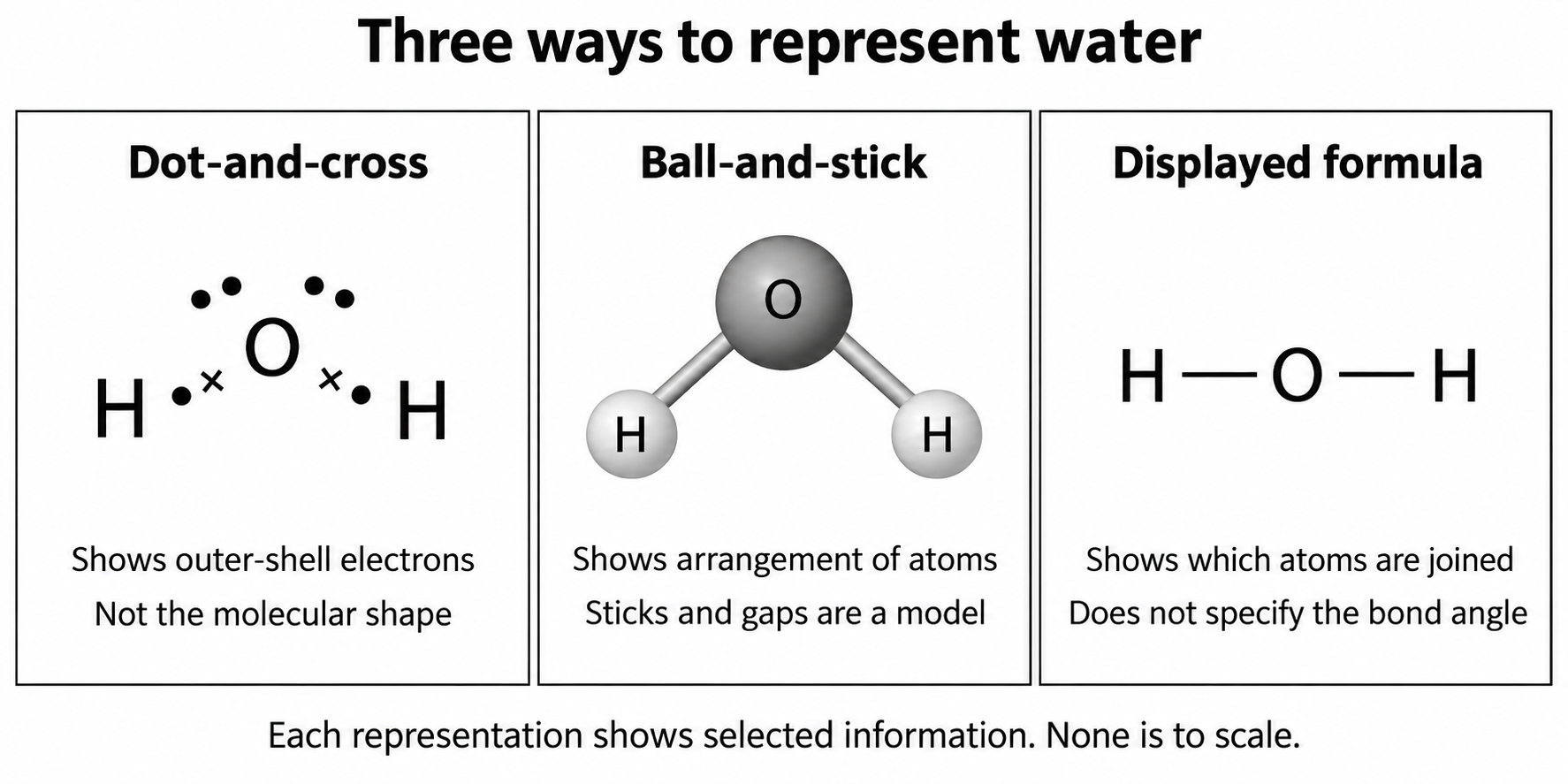
All three pictures represent water: two hydrogen atoms bonded to one oxygen atom. The different appearance does not mean the substance has changed. The straight displayed formula records the connections; it does not claim that the real molecule is straight. Water has a bent shape.
What dot-and-cross diagrams show
Dot-and-cross diagrams show outer-shell electrons. For a covalent molecule, a shared pair represents a covalent bond; unshared pairs can also be shown. For ions, the diagrams can show outer-shell arrangements and charges, and help track electron transfer.
Dots and crosses distinguish where electrons came from in the model. They are not different types of electron: electrons are identical. In the water picture, oxygen contributes six dots and the two hydrogen atoms contribute one cross each. There are two shared pairs and two unshared pairs.
A usual flat dot-and-cross diagram does not give the true molecular shape, relative atomic sizes or distances. A diagram of just one positive and one negative ion also hides the full repeating arrangement of a giant ionic lattice; it must not be read as a separate molecule.
What ball-and-stick models show
A ball-and-stick model uses balls for atoms and sticks for bonds. A three-dimensional model can make connections, bond angles and the arrangement of atoms in space easier to see. The bent water model, for example, conveys more about shape than the straight displayed formula.
The sticks are not literal rods inside a molecule. A covalent bond involves a shared pair of electrons attracted to the nuclei. Large gaps between balls exaggerate the space between bonded atoms, whose electron clouds overlap. Ball sizes may not show accurate relative atomic sizes; colours are chosen to identify elements rather than showing real atomic colours. Such models usually omit electrons and their pairs.
Choosing a representation for the task
A flat two-dimensional displayed formula shows which atoms are joined and how many bonds connect them. It is quick to read and draw, but the positions on the page need not represent real bond angles or depth.
A three-dimensional representation shows spatial arrangement more clearly. A physical model can be rotated to examine it from different directions. A perspective drawing on paper uses depth cues, but some atoms can hide others. Neither a 3D model nor a perspective drawing automatically shows electrons, accurate scale or the whole extent of a giant structure.
For example, if you need to count shared electron pairs, choose a dot-and-cross diagram. If you need to inspect shape, use a suitable 3D model. Using both can answer questions that neither handles fully on its own. A useful evaluation names a specific missing feature instead of saying only "the model is inaccurate".