1.28 - Covalent bonds and shared electron pairs
Atoms can join by sharing outer-shell electrons. This lesson explains what a shared pair means and how a diagram represents one covalent bond.
Sharing a pair of electrons
Covalent bond
A covalent bond forms when a pair of electrons is shared between two atoms.
A pair means two electrons. The shared pair counts towards the outer shell of both bonded atoms; it has not been transferred completely from one atom to the other.
For example, two hydrogen atoms each contribute one electron. Together these electrons make one shared pair. Each hydrogen atom can count both electrons in its first shell, which is full with two electrons. No extra electrons have been created.
[DIAGRAM: asset_name: covalent_bond_shared_pair - diagram 1; asset_slug: 034_1_28_a_covalent_bond_is_formed_when_a_pair_of_electrons_is_shared_between_two_a_diagram1; file: 034_1_28_a_covalent_bond_is_formed_when_a_pair_of_electrons_is_shared_between_two_a_diagram1.png; recommended_method: deterministic_drawn; description: Deterministic monochrome dot-and-cross style teaching visual showing two labelled atoms, overlapping outer shells, and a shared pair made from one dot electron from atom A and one cross electron from atom B. Exact assessed labels: atom A, atom B, shared pair, covalent bond, outer shell of atom A, outer shell of atom B. The visual teaches one covalent bond as one shared pair of electrons, not electron transfer, ions, named molecule dot-and-cross diagrams, multiple bonds, molecular shape, or structure/property links. Nearby prose supplies all assessed facts for accessibility.]
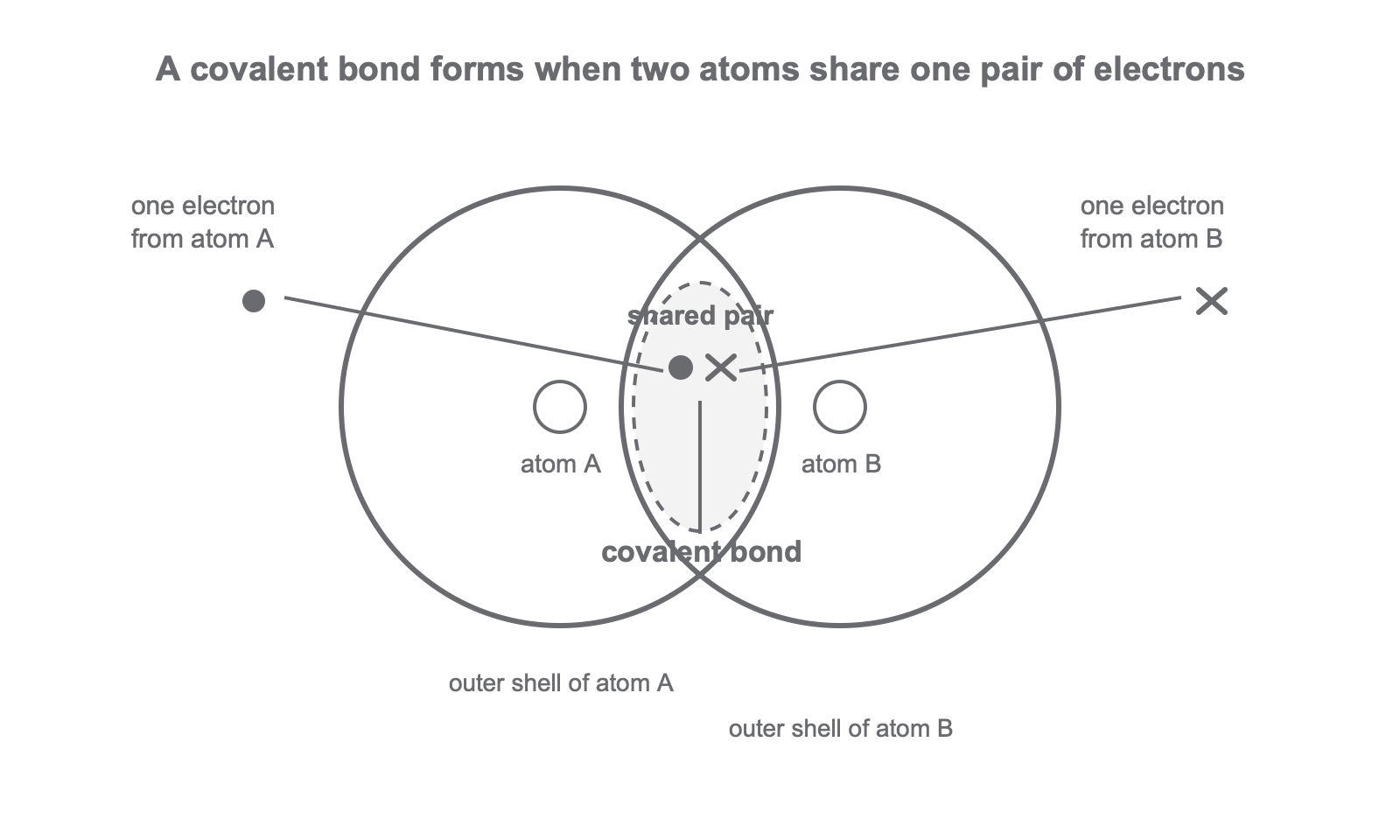
In this schematic diagram, the dot and cross distinguish the two electrons' original atoms. Both symbols lie in the overlap to show sharing. The circles represent shells, not hard surfaces. A line drawn between atom symbols is another way of representing the bond; it is not a physical stick.
The negatively charged shared electrons are attracted to the positive nuclei of both atoms. This attraction holds the atoms together. The electrons are moving: a dot-and-cross drawing records electron counts, not fixed electron positions.