1.2 - Inside the atom
Learn where protons, neutrons and electrons are found, and how a simple diagram represents their arrangement inside an atom.
The nucleus and its particles
An atom contains smaller subatomic particles. Protons and neutrons are grouped in the central nucleus; electrons are outside it.
Nucleus
The small central part of an atom containing its protons and, in most atoms, neutrons.
The most common hydrogen atom has a nucleus containing just one proton and no neutron. The usual diagram below shows an atom that has both protons and neutrons.
[DIAGRAM: asset_name: atom_structure_overview - diagram 1; asset_slug: 008_1_2_structure_of_an_atom_as_a_nucleus_containing_protons_and_neutrons_surround_diagram1; file: diagram_assets/008_1_2_structure_of_an_atom_as_a_nucleus_containing_protons_and_neutrons_surround_diagram1.png; recommended_method: deterministic_drawn; description: Deterministic monochrome labelled atom structure diagram showing a central nucleus containing labelled protons and neutrons, with electrons shown on a shell around it. Exact assessed labels: nucleus, proton, neutron, electron, electron shell. The diagram teaches particle positions only and does not teach relative charge, relative mass, atomic number, mass number, isotope notation, shell capacities, or electronic configurations. Nearby prose supplies all assessed facts for accessibility.]
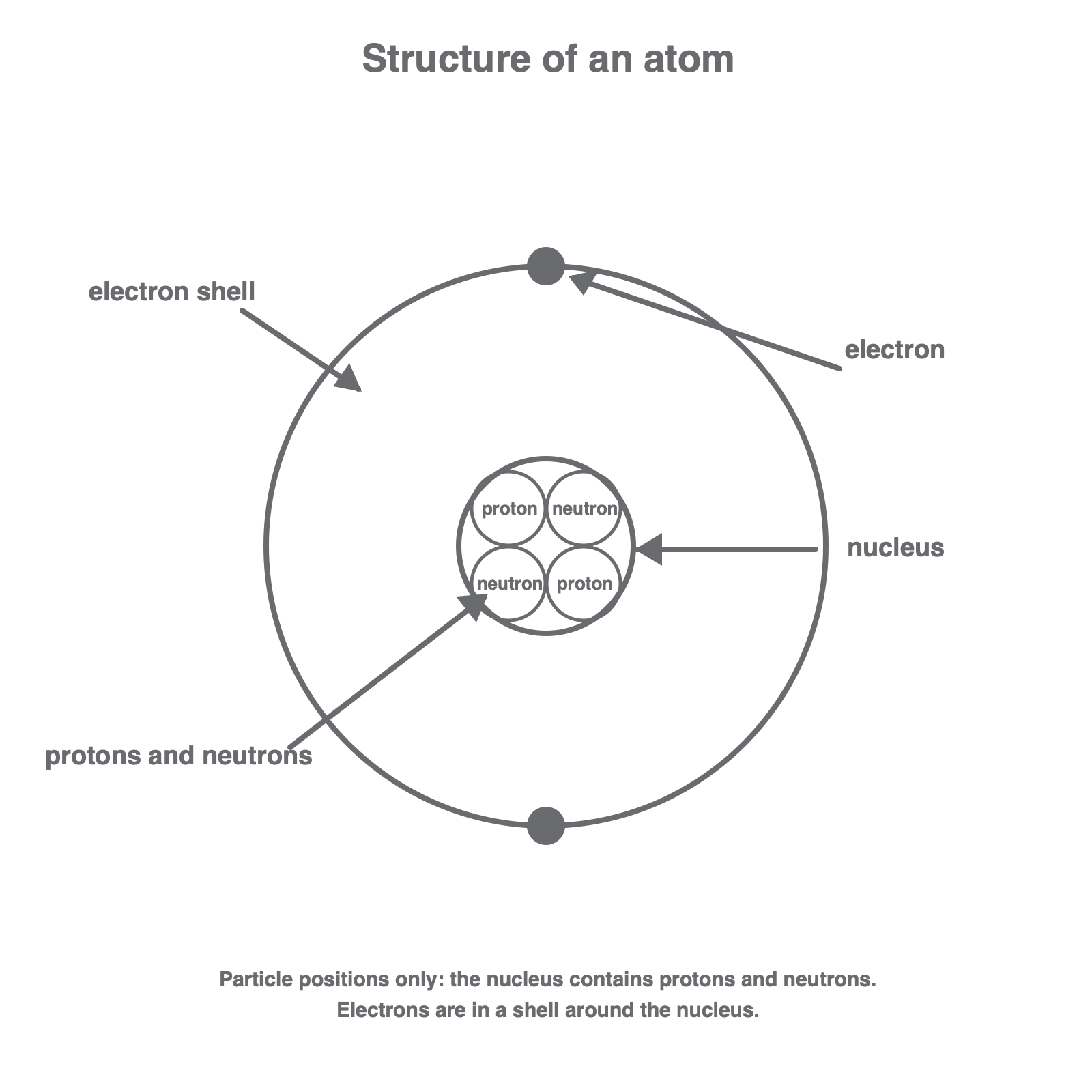
This diagram shows positions, not sizes to scale. The nucleus and particles are enlarged so that they can be seen.
Electrons around the nucleus
Electrons are arranged in shells around the nucleus. In the simple model, circles show these shells; they are guides to the arrangement, not solid walls. The dark dots on the circle represent electrons.
| Region | Particles |
|---|---|
| Nucleus | Protons and neutrons (except atoms with no neutrons) |
| Shells around the nucleus | Electrons |