1.31 - Drawing dot-and-cross diagrams
A dot-and-cross diagram shows how outer-shell electrons are shared in a molecule. You will build and check diagrams for hydrogen, hydrogen chloride, water, methane, oxygen and carbon dioxide, then explain how sharing completes their outer shells.
Reading and planning a diagram
Dots and crosses both represent electrons. Different symbols identify which atom contributed each electron; they do not represent different kinds of electron or opposite charges.
For these molecules, hydrogen has a full first shell with two electrons. Carbon, oxygen and chlorine have full outer shells with eight. A shared pair counts towards both bonded atoms, but remains only two electrons in the molecule's total.
A single bond is one shared pair. A double bond is two shared pairs between the same two atoms. A lone pair is a pair of outer-shell electrons not shared in a bond.
Use this method:
- Write the atom symbols. In water and methane, place O or C centrally; in carbon dioxide use O–C–O.
- Count the available outer electrons: H has 1, C has 4, O has 6 and Cl has 7. Choose dots for one atom and crosses for an atom bonded to it. The same symbol can be reused for equivalent outer atoms.
- Place shared pairs between bonded atoms, with one electron contributed by each atom for every pair in these molecules.
- Add the remaining electrons as lone pairs. Put shared pairs in shell overlaps if drawing shells.
- Check both the shell count (2 for H; 8 for C, O and Cl) and the total number of electrons. Count a shared pair only once in the total.
[DIAGRAM: asset_name: six_simple_molecular_dot_cross - diagram 1; asset_slug: 037_1_31_formation_of_simple_molecular_covalent_substances_using_dot_and_cross_diag_diagram1; file: 037_1_31_formation_of_simple_molecular_covalent_substances_using_dot_and_cross_diag_diagram1.png; recommended_method: deterministic_drawn; description: Exact assessed dot-and-cross reference sheet for H2, HCl, H2O, CH4, O2 and CO2. Shows outer electrons only, shell overlaps, atom labels and formula labels. Dots and crosses are monochrome #6A6B6E on white and distinguish electrons from different atoms. Students should learn the number of shared pairs and lone pairs in each specified molecule; nearby prose provides the accessible explanation.]
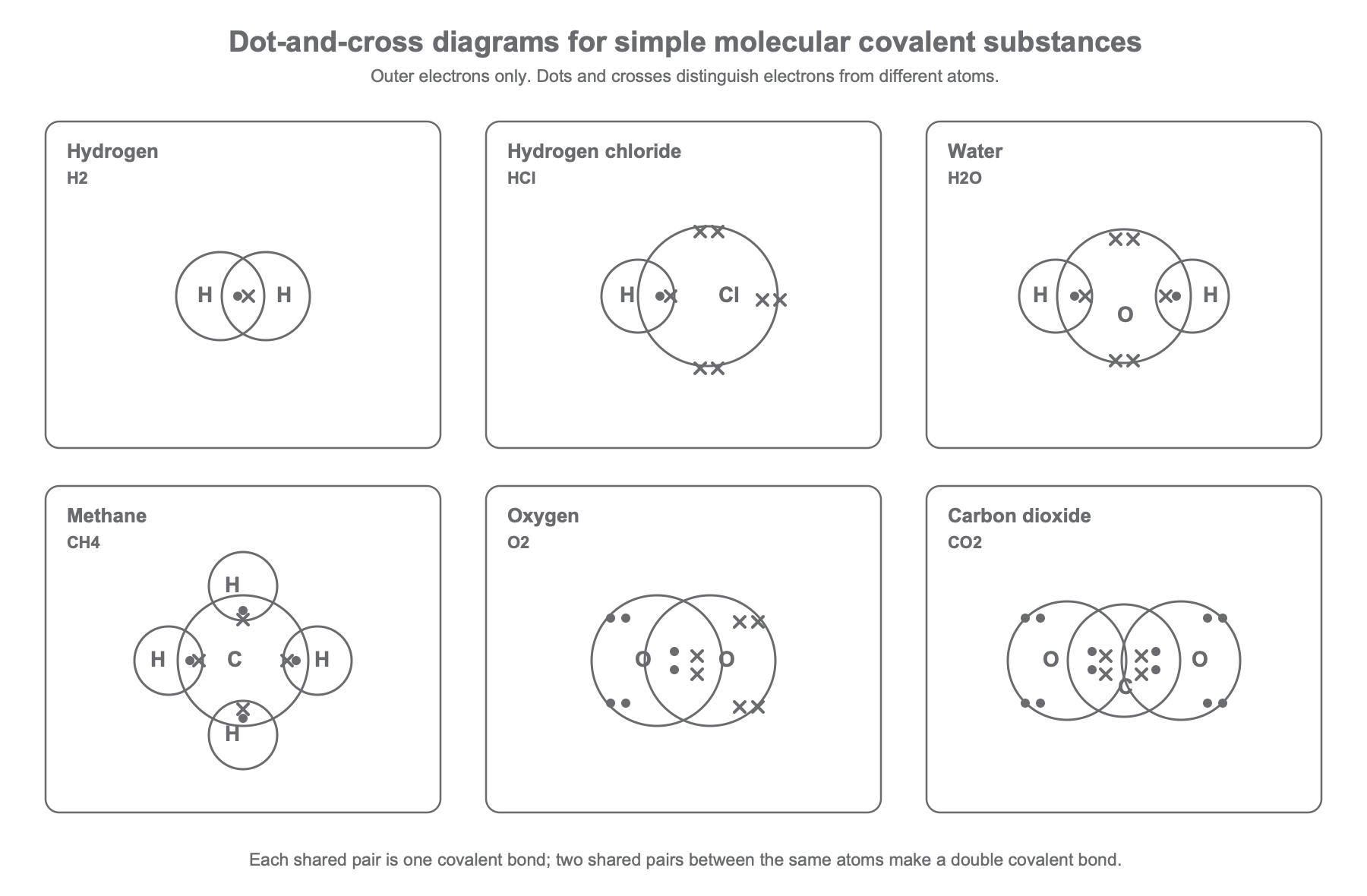
The reference sheet shows electron arrangements, not three-dimensional molecular shapes. Reversing all dots and crosses is equally valid if the origins and counts remain consistent.
Building molecules with single bonds
In hydrogen, , each atom contributes one electron to one shared pair. Both hydrogen atoms count that pair, completing their first shells.
In hydrogen chloride, , the atoms have outer electrons altogether. Put one electron from H and one from Cl in the overlap. The six remaining chlorine electrons form three lone pairs. Hydrogen now counts two electrons and chlorine counts eight.
In water, , the atoms supply outer electrons. Oxygen forms a single bond with each hydrogen: two shared pairs use four electrons. The remaining four electrons are two lone pairs on oxygen. Each H counts two electrons; O counts the four shared electrons plus its four lone-pair electrons, giving eight.
In methane, , the atoms supply outer electrons. Carbon shares one pair with each of four hydrogens. All eight electrons are in four shared pairs, leaving no lone pairs.
| Molecule | Total outer electrons | Shared pairs | Lone pairs |
|---|---|---|---|
| 2 | 1 | None | |
| 8 | 1 | Three on Cl | |
| 8 | 2 | Two on O | |
| 8 | 4 | None |
Building molecules with double bonds
In oxygen, , each atom begins with six outer electrons. One shared pair would leave each oxygen counting only seven. Sharing two pairs allows each atom to count eight, so the bond is double. Four of the molecule's twelve outer electrons are shared; the other eight form two lone pairs on each oxygen.
In carbon dioxide, , there are outer electrons. Carbon shares two pairs with each oxygen, forming O=C=O. Eight electrons are shared, giving carbon a full outer shell. The remaining eight electrons form two lone pairs on each oxygen, completing both oxygen shells.
| Molecule | Total outer electrons | Shared pairs | Lone pairs |
|---|---|---|---|
| 12 | 2 in one double bond | Two on each O | |
| 16 | 4 in two double bonds | Two on each O; none on C |
Draw, then check your electron counts
Notebook activity — ungraded drawing practice
Draw all six molecules on paper without copying the reference sheet. Use dots and crosses for outer electrons, show every shared pair and lone pair, and label each atom. Then compare your drawings with the sheet and the tables. Ask a teacher to check any differences you cannot resolve. The written questions on this page check your reasoning; they do not assess the drawings in your notebook.
For each drawing, check that:
- hydrogen counts two outer electrons and each C, O or Cl counts eight;
- the total electrons equal the sum supplied by the atoms;
- each shared pair has one electron from each bonded atom;
- lone pairs are on the correct atoms;
- these neutral molecules have no ion charges or ionic brackets.
For example, methane has four single bonds, whereas carbon dioxide has two double bonds. Both contain four shared pairs in total, but those pairs are arranged differently. State how the pairs are distributed whenever you explain a molecule's bonding.