1.26 - Writing formulae of ionic compounds
An ionic compound formula records the simplest ratio of its ions. You will use supplied ion charges to balance positive and negative charge, then use brackets correctly when more than one group ion is needed.
Balancing equal charges
An ionic compound has no overall charge. Its formula shows the simplest whole-number ratio of its constituent ions, rather than a separate molecule.
Charge balance
One balances one : , giving . One balances one : , giving . Equal and opposite ion charges need a 1:1 ratio, regardless of their size.
Write the positive ion first. Use charges to work out the ratio, but do not include them in the neutral compound formula. Write , not , because the ion ratio must be simplest.
Balancing different charges
If charges have different sizes, find the smallest common total charge.
| Ions | Smallest matching totals | Ion ratio | Formula |
|---|---|---|---|
| and | one × (+2), two × (−1) | 1:2 | |
| and | two × (+3), three × (−2) | 2:3 |
For aluminium oxide, the matching charge size is 6: two aluminium ions give +6 and three oxide ions give −6. This is why the 2 belongs after Al and the 3 after O.
The cross-over shortcut gives the same answer if you simplify afterwards. For and , crossing the charge numbers would first give 2:2, which must simplify to 1:1.
Keeping a group ion together
A group ion is treated as one unit when balancing charges. Do not change the formula inside it.
| Group ion | Formula |
|---|---|
| hydroxide | |
| nitrate | |
| carbonate | |
| sulfate |
One needs two ions. Put the repeated group in brackets: . The 2 applies to both O and H. would have only one O for two H, so it fails to preserve two hydroxide groups.
Similarly, with gives . One with one gives : brackets are unnecessary when only one group is needed. Two with one give ; keep the carbonate subscript 3 unchanged.
[DIAGRAM: asset_name: charge_balancing_ionic_formulae - diagram 1; asset_slug: 032_1_26_formulae_of_ionic_compounds_including_oxides_hydroxides_halides_nitrates_c_diagram1; file: 032_1_26_formulae_of_ionic_compounds_including_oxides_hydroxides_halides_nitrates_c_diagram1_imagegen_v1.png; recommended_method: deterministic_drawn; description: Exact assessed formula-deduction visual showing three monochrome worked charge balances: Mg2+ with two Cl- ions gives MgCl2; two Al3+ ions with three O2- ions gives Al2O3; Ca2+ with two OH- group ions gives Ca(OH)2. The visual should show total positive and negative charges adding to zero, use cation-first final formulae, and make the bracket rule for multiple hydroxide ions explicit. Deterministic drawing is used because formulae, charges, subscripts and brackets must be exact.]
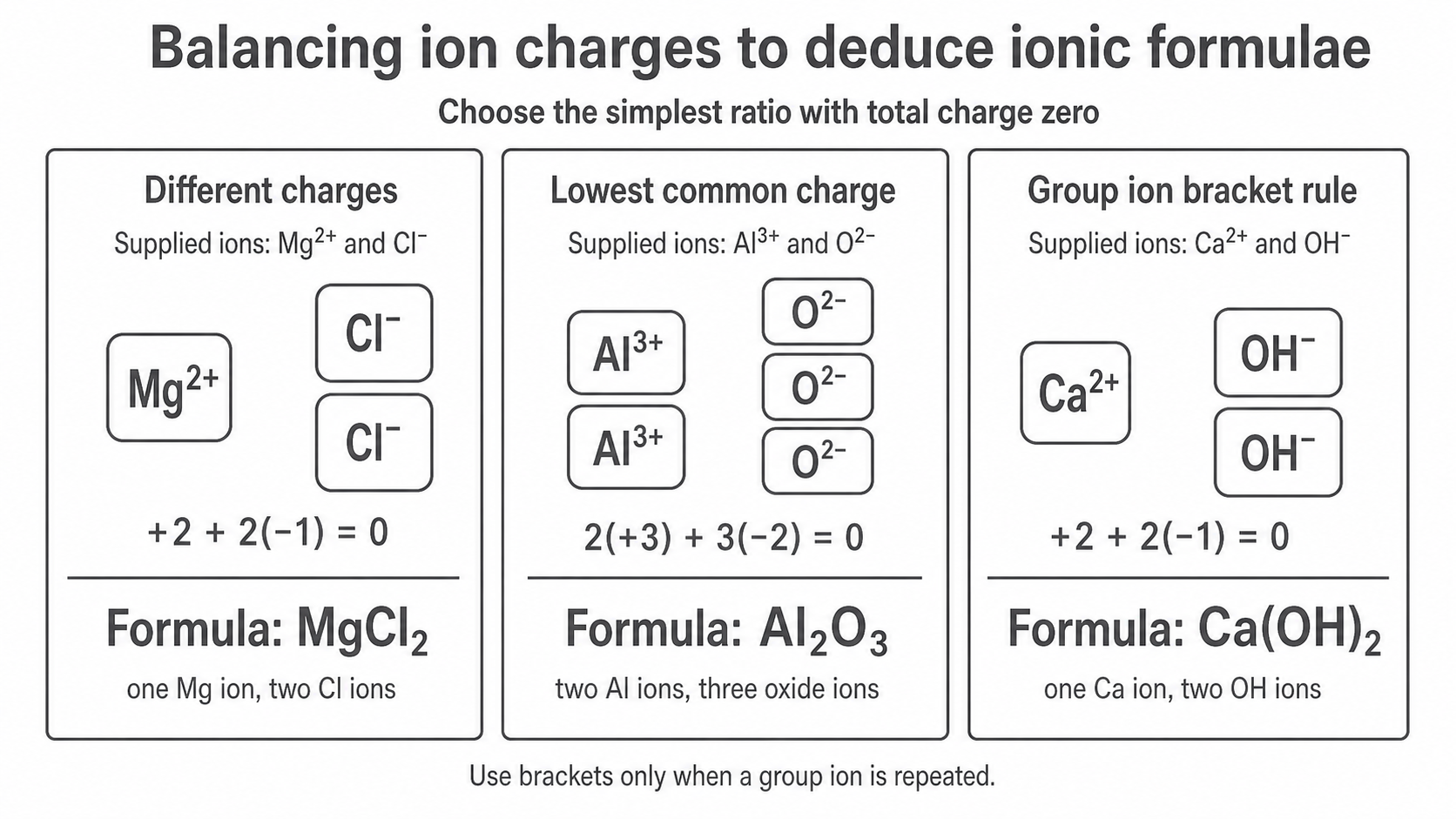
The diagram compares a halide, an oxide and a hydroxide. The same zero-charge rule works for each; only a repeated group ion needs brackets.
Using the method across compound families
Use the supplied ions for oxides, hydroxides, halides, nitrates, carbonates and sulfates. A halide is a fluoride, chloride, bromide or iodide ion. The element chlorine is , but a chloride ion is ; use the supplied ion formula.
| Supplied ions | Charge balance | Formula |
|---|---|---|
| and | two × (+1) and one × (−2) | |
| and | one × (+2) and two × (−1) | |
| and | two × (+1) and one × (−2) | |
| and | two × (+1) and one × (−2) |
For each answer, check: charges cancel; ratio is simplest; each group ion is unchanged; brackets enclose any repeated group; the final formula has no charge label.