1.36 - Structures of graphite and diamond
Compare how carbon atoms join in diamond and graphite. Learn to read a structure model by counting neighbouring atoms and distinguishing a three-dimensional network from stacked sheets.
Diamond: four neighbours in three dimensions
Diamond and graphite are allotropes: different structural forms of the same element. Both contain only carbon and both are giant covalent substances.
In diamond, each carbon atom forms four covalent bonds to four other carbon atoms. The four neighbours lie towards the corners of a tetrahedron, giving a three-dimensional arrangement rather than a flat square. Bonding continues throughout the crystal, so diamond is a giant covalent network, not a collection of small molecules.
A small drawn fragment ends at the page boundary. An atom at that boundary may show fewer than four neighbours because the rest of the crystal is not drawn. Count an interior atom when checking the four-bond rule.
Graphite: three neighbours within a sheet
In graphite, each carbon atom forms three covalent bonds to three other carbon atoms in the same plane. This produces flat sheets of joined hexagonal rings. Many such sheets are stacked to make graphite.
The bonds within a sheet are strong covalent bonds. Between sheets there are much weaker attractions, rather than covalent bonds joining the sheets together. Each carbon contributes one outer electron to electrons delocalised over the sheet: they are not fixed between one pair of atoms.
This separates three features that a drawing can otherwise blur: carbon atoms at the ring corners, covalent bonds along ring edges, and spaces between different sheets.
Reading and comparing the models
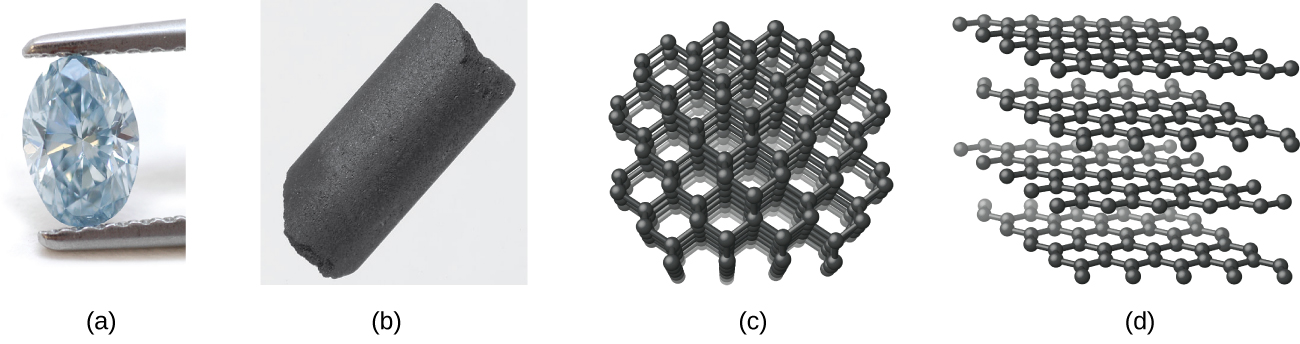
OpenStax, Chemistry, Figure 18.20, CC BY 4.0. Photos: Fancy Diamonds/Flickr and images-of-elements.com. Panels (a) and (c) show diamond; (b) and (d) show graphite.
In (c), the carbon network extends in three dimensions. In (d), the separate sheets are visible: there are no covalent struts across the gaps. Spheres represent carbon atoms and sticks represent bonds; their drawn sizes and gaps are models, not the literal appearance of atoms.
| Feature | Diamond | Graphite |
|---|---|---|
| Carbon neighbours per atom | Four | Three |
| Arrangement | Three-dimensional tetrahedral network | Stacked flat sheets of hexagonal rings |
| Between sheets | No separate sliding sheets | Weak attractions |
| Delocalised electrons | None | One contributed per carbon atom |
These structural differences will explain their properties and uses in the next lesson.