1.50 - The mole and the Avogadro constant
One mole is a counting amount used in chemistry. This Higher-tier Topic 1 idea links a measurable mass in grams to a fixed number of particles. The key recall point is that one mole has two equivalent descriptions: it contains the Avogadro constant number of particles, and it has a mass equal to the relative particle mass in grams.
One mole as a count
Chemists often need to count particles that are far too small and numerous to count one by one. A mole is a way of counting a very large number of particles, just as a dozen counts 12 objects.
Mole
One mole of particles of a substance is the Avogadro constant number of particles of that substance.
The named constant fixes how many particles are counted by 1 mol.
Avogadro Constant
Use the Avogadro constant rounded to three significant figures: (particles per mole).
The particles must be the particles named in the question or statement. They might be atoms, molecules, formula units or ions:
- one mole of magnesium atoms contains magnesium atoms
- one mole of oxygen molecules contains oxygen molecules
- one mole of sodium chloride formula units contains formula units
- one mole of chloride ions contains chloride ions
Do not change the particle type halfway through an answer. If the question says molecules, answer about molecules. If it says ions, answer about ions.
The size of the number
The Avogadro constant is written in standard form because it is enormous:
6.02 x 10^23 = 602 000 000 000 000 000 000 000
The means the decimal point has moved 23 places. In exam answers, use the standard form value unless a question gives a different level of precision.
Particles in one mole
One mole as a mass
One mole also links particle count to a mass you can measure: its mass in grams is numerically equal to the relative particle mass used in the question.
Relative particle mass
The relative particle mass is the relative mass of the particle being counted. It may be a relative atomic mass for atoms, a relative molecular mass for molecules, or a relative formula mass for formula units.
For this lesson, the rule is:
Mass of one mole
So if the relative particle mass is 12, one mole has a mass of 12 g. If the relative particle mass is 18, one mole has a mass of 18 g.
[DIAGRAM: asset_name: Two meanings of one mole - diagram 1; asset_slug: 056_1_50_the_mole_and_the_avogadro_constant_diagram1; file: 056_1_50_mole_count_and_mass_repaired.png; recommended_method: imagegen; description: Exact monochrome teaching diagram showing one mole in the centre linked to two equivalent meanings: 6.02 x 10^23 particles of the substance, and a mass equal to relative particle mass in grams. Includes three example boxes using given relative particle masses: carbon atoms relative particle mass 12 gives 12 g, water molecules relative particle mass 18 gives 18 g, and sodium chloride formula units relative particle mass 58.5 gives 58.5 g. Inspected corrected recall visual; particle count and one-mole masses are shown.]
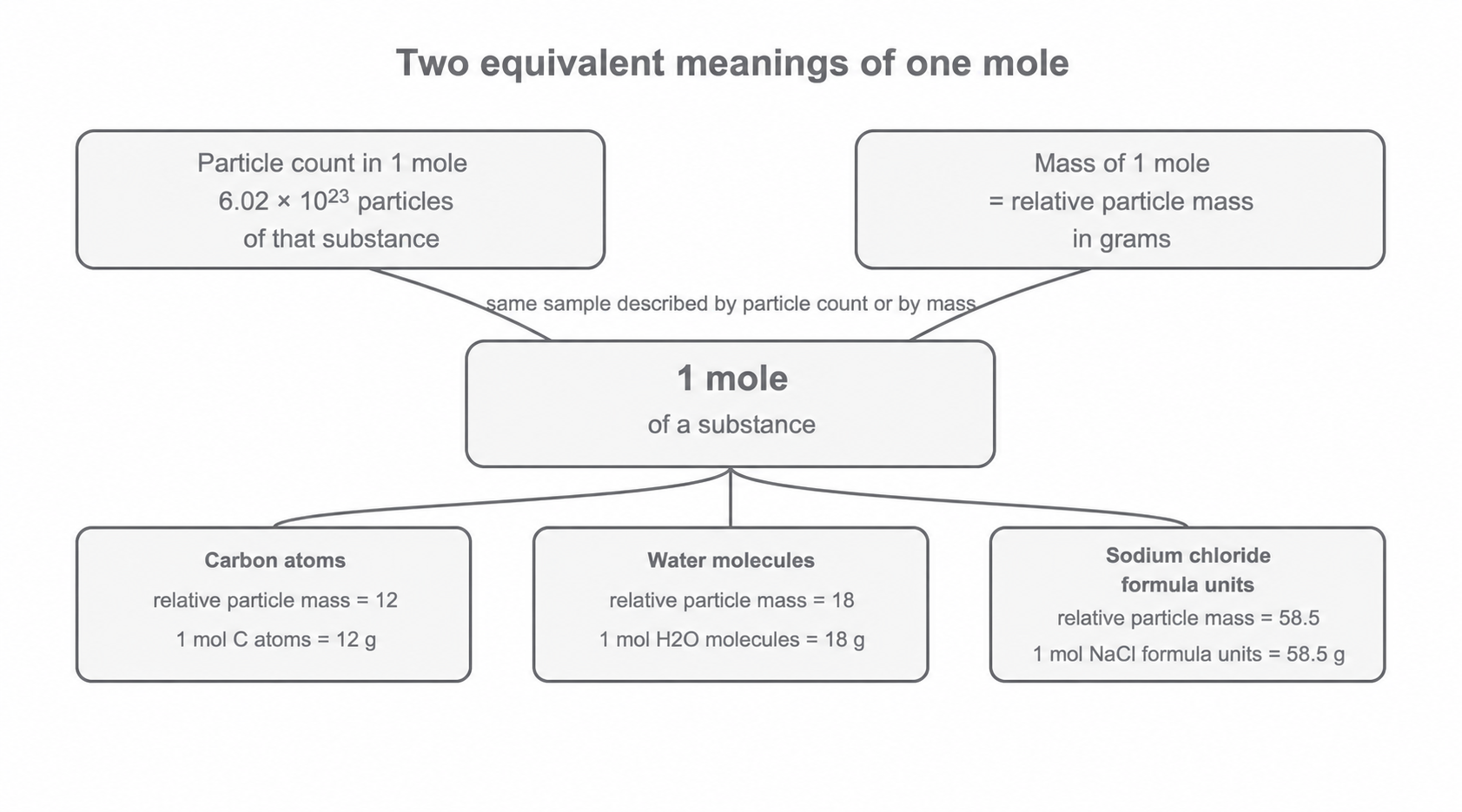
This is why moles are useful in chemistry: a balance measures grams, but chemical reactions involve particles. The mole is the bridge between those two descriptions.
Choosing the particle type
When comparing samples, name the particles being counted. A mole of molecules and a mole of atoms have the same particle count, but those particles differ.
For example, 1 mol of water counts water molecules. It does not count all the individual atoms in those molecules. For an ionic compound such as sodium chloride, use formula units, not molecules, because the ions form a giant lattice.
Equal numbers of particles can have different masses because the individual particles have different masses.