1.43 - Relative formula mass and percentage by mass
Relative formula mass is a way of adding up the relative atomic masses of all the atoms shown in a chemical formula. Once you know the relative formula mass, you can calculate what percentage of the compound's mass comes from one element.
From formula to atoms
A chemical formula tells you which elements are present and how many atoms of each element are represented in one molecule or formula unit. In this lesson, the formula is given to you; your job is to count the atoms correctly and use the relative atomic masses supplied in the question.
Relative formula mass
The relative formula mass, , is the sum of the relative atomic masses of all the atoms shown in the formula of a substance.
The relative atomic mass of an element is written as . For example, if a question gives values of and , then each carbon atom contributes 12 and each oxygen atom contributes 16 to the relative formula mass.
Subscripts apply only to the element or group immediately before them:
| formula | atoms represented |
|---|---|
| 1 carbon atom and 2 oxygen atoms | |
| 2 hydrogen atoms and 1 oxygen atom | |
| 1 magnesium atom and 2 chlorine atoms |
If brackets are used, the subscript outside the bracket multiplies every atom inside the bracket. In , there is 1 magnesium atom, 2 oxygen atoms and 2 hydrogen atoms.
Calculate relative formula mass
To calculate , multiply the number of atoms of each element by its , then add the results. Relative formula mass has no unit because it is a relative mass.
Relative formula mass
Use this layout:
- Count the atoms from the formula.
- Write the value for each element.
- Multiply each by the number of atoms of that element.
- Add the contributions.
- Give the final with no unit.
For magnesium chloride, , using values and :
The chlorine contribution is because the formula contains two chlorine atoms.
Formulae with brackets
Brackets are a common source of errors. Work out how many atoms are inside the brackets before adding the masses.
For magnesium hydroxide, , using values , and :
| element | number of atoms | contribution to |
|---|---|---|
| Mg | 1 | |
| O | 2 | |
| H | 2 |
Do not calculate as 24 + 16 + 2. That would count two hydrogens but only one oxygen, even though the bracket means there are two complete groups.
Percentage by mass
Percentage by mass tells you what fraction of a compound's relative formula mass comes from a named element. First calculate the of the whole compound. Then calculate the total relative mass of the named element in that formula.
Percentage by mass of an element
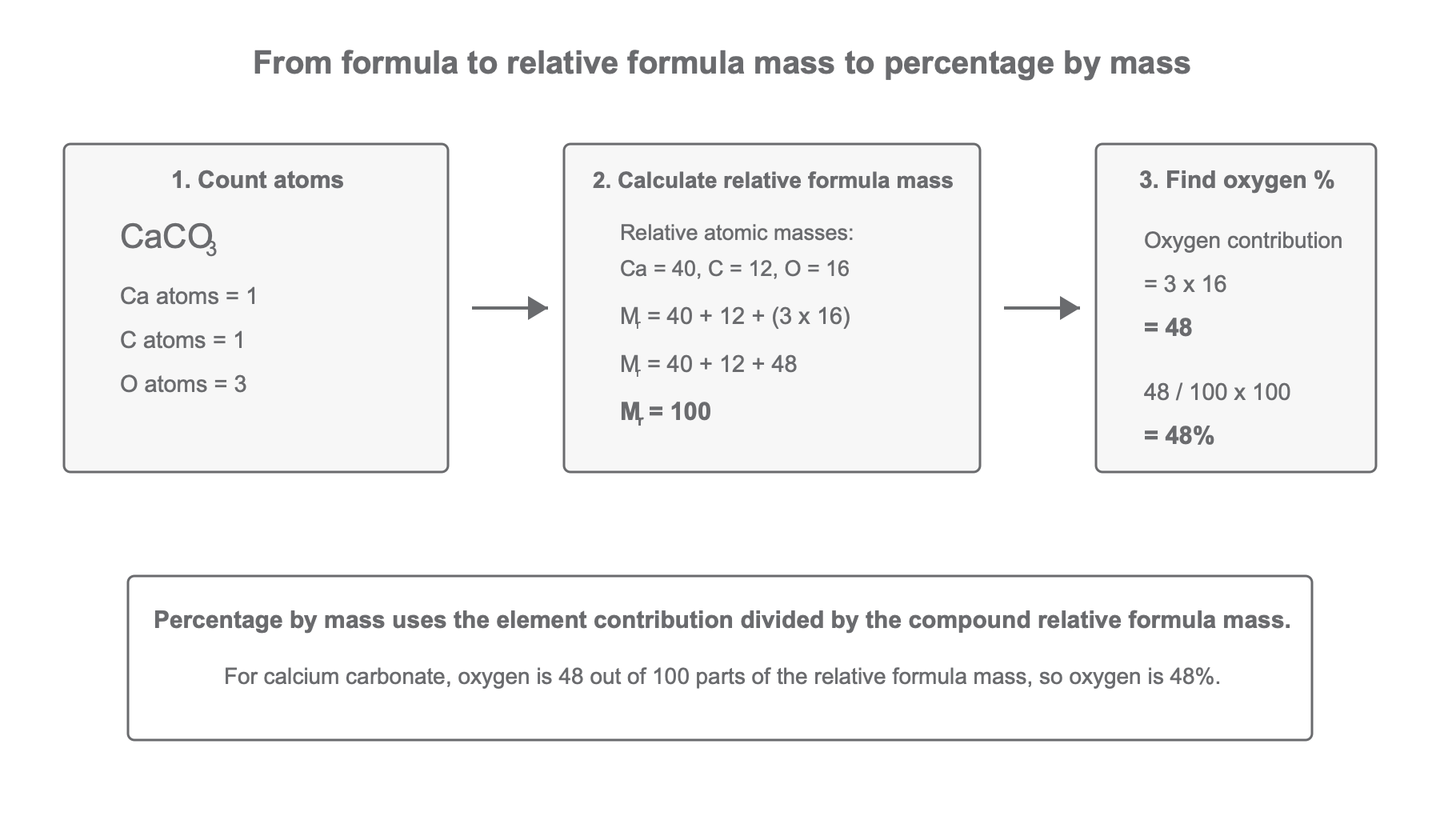
For calcium carbonate, , using values , and :
The total relative mass of oxygen in is .
Percentage by mass of oxygen:
Notice that the percentage calculation uses the total oxygen contribution, not just the of one oxygen atom.
[DIAGRAM: asset_name: formula_mass_percentage_workflow - diagram 1; asset_slug: 049_1_43_relative_formula_mass_and_percentage_by_mass_diagram1; file: diagram_assets/049_1_43_relative_formula_mass_and_percentage_by_mass_diagram1.png; recommended_method: deterministic_drawn; description: Exact assessed formula-calculation visual showing one compound, CaCO3, calculated in stages: count atoms as Ca 1, C 1, O 3; calculate Mr = 40 + 12 + (3 x 16) = 100; then calculate percentage by mass of oxygen as 48 / 100 x 100 = 48%. Use monochrome NovaLearn style with all formulae, subscripts, arithmetic and percentage labels exact. Deterministic drawing is required because the formulae and calculations are assessed details.]
Worked percentage example
A percentage-by-mass calculation can combine both skills from this lesson. Keep the layout steady: whole-compound first, named-element contribution second, percentage third.
Calculate the percentage by mass of oxygen in magnesium hydroxide, . Use values: , , .
Step 1: calculate the relative formula mass.
Step 2: calculate the total relative mass of oxygen in the formula.
oxygen contribution = 2 × 16 = 32
Step 3: divide by the and multiply by 100.
percentage by mass of oxygen = (32 / 58) × 100
percentage by mass of oxygen = 55.172...%
To 3 significant figures, this is 55.2%.
Now try the same structure with a formula that contains four oxygen atoms.
Avoid common errors
Most mistakes in this calculation come from counting, not from difficult arithmetic.
Check your answer against these rules:
- Use the relative atomic masses given in the question.
- Count every atom shown by a subscript.
- Multiply everything inside brackets by the subscript outside the brackets.
- Do not divide by the number of elements; is a total, not an average.
- For percentage by mass, put the named element's total relative mass on the top of the fraction.
- Multiply by 100 to change the fraction into a percentage.
- has no unit, but percentage by mass is written with
%.
A quick sense check helps. A percentage by mass should be between 0% and 100%. If you calculate the percentage by mass of every element in a compound, the values should add to about 100%, allowing for rounding.
That same check applies to any formula: count first, calculate second, then decide whether the question wants or a percentage.
For , add all the relative atomic masses shown by the formula. For percentage by mass, divide the named element's total contribution by the compound's , then multiply by 100.