1.19 - Electron arrangements of the first 20 elements
An electron arrangement shows how an atom’s electrons occupy shells. You will predict arrangements for neutral atoms of the first 20 elements, write them in numbers, and represent them in shell diagrams.
Predicting an electron arrangement
Electron arrangement
The number of electrons in each occupied shell, starting with the shell nearest the nucleus. This is also called the electronic configuration.
For a neutral atom, electron number equals proton number, so its atomic number gives the total electrons. Fill shells from the inside out using this pattern for the first 20 elements:
- Put up to 2 electrons in the first shell.
- Put the next electrons in the second shell, up to 8.
- Put the next electrons in the third shell, up to 8.
- For potassium and calcium, the remaining 1 or 2 electrons begin a fourth shell.
This filling pattern is limited to the first 20 elements; it does not mean the third shell can never contain more than 8 electrons in later elements.
Worked example: aluminium
Aluminium has atomic number 13, so its neutral atom has 13 electrons. Put 2 in the first shell, leaving 11. Put 8 in the second, leaving 3. Those 3 occupy the third shell, giving 2.8.3. Check: 2 + 8 + 3 = 13.
The dots separate shell counts; they are not decimal points. Commas, as in 2,8,3, convey the same arrangement. Argon is 2.8.8; the next electron in potassium begins a fourth shell, giving 2.8.8.1. Always check both the filling pattern and the total: a correct total alone does not prove the arrangement is right.
Drawing and reading shells
A shell diagram represents the same information as the written numbers. Draw a labelled nucleus, then one circle for each occupied shell. Place dots or crosses on the circles to represent individual electrons. The circles are a model of shells, not a scale drawing of fixed electron paths.
[DIAGRAM: asset_name: Shell diagrams and written notation - diagram 1; asset_slug: 025_1_19_electronic_configurations_of_the_first_20_elements_diagram1; file: diagram_assets/025_1_19_electronic_configurations_of_the_first_20_elements_diagram1.png; recommended_method: deterministic_drawn; description: Exact monochrome teaching diagram comparing sodium and calcium shell diagrams with their written configurations. It shows that shell totals are read from the centre outwards and that the written numbers match the electron count in each occupied shell. Assessed visual, deterministic drawn method.]
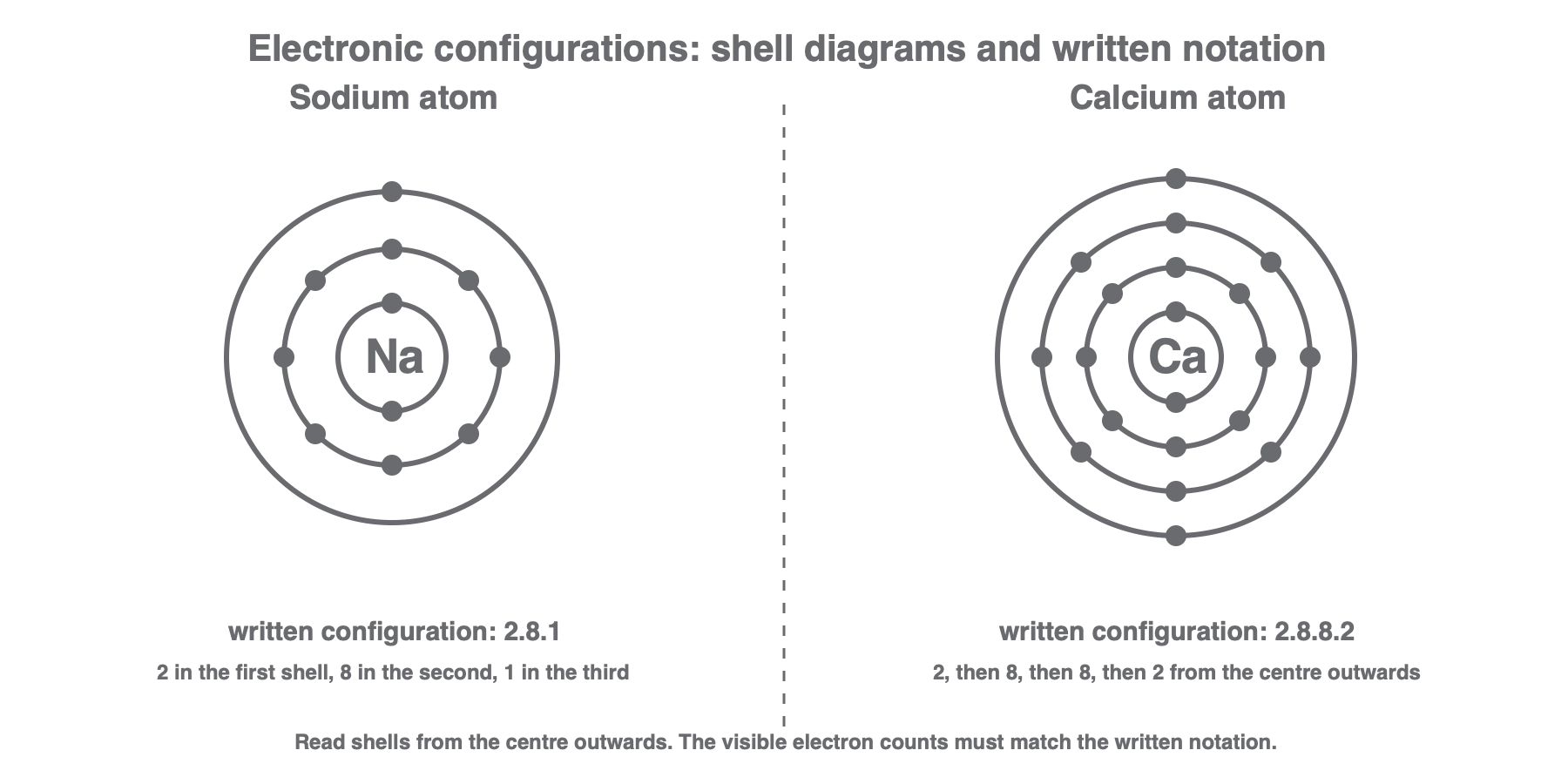
Read from the centre outwards. Sodium shows 2 dots on the first circle, 8 on the second and 1 on the third: 2.8.1. Calcium has four occupied shells with 2, 8, 8 and 2 dots. Count each shell separately before checking the total.
For sulfur, atomic number 16, work out 2.8.6 first. Draw three circles and place 2, 8 and 6 electrons on them. Label the nucleus S. You do not need to draw the individual protons and neutrons for an electron-arrangement diagram.
Notebook activity: draw magnesium (ungraded)
A neutral magnesium atom has atomic number 12. In your notebook, draw a nucleus labelled Mg, the occupied electron shells, and every electron as a dot or cross. This is drawing practice for you to self-check or discuss with your teacher; it is not a scored online question. Try the drawing before using the checklist below.
Self-check: the completed diagram should have a nucleus labelled Mg and three occupied shells. Count 2 electrons on the innermost shell, 8 on the second and 2 on the outermost. The total must be 12. Check the shell counts as well as the total: 2,2,8 would give the right total but the wrong arrangement. Any clear positions for the dots or crosses around each shell are suitable.
Use the sodium diagram above as a visual guide: magnesium has the same first two shell counts and one additional electron on the third shell. Correct your drawing itself if needed. A written arrangement can help you plan and check the diagram, but it does not replace practising the drawing.
Checking the first 20 elements
Use this reference after predicting an arrangement. Count the shells and add the electrons to check your answer.
| Atomic number | Element | Electronic configuration |
|---|---|---|
| 1 | hydrogen | 1 |
| 2 | helium | 2 |
| 3 | lithium | 2.1 |
| 4 | beryllium | 2.2 |
| 5 | boron | 2.3 |
| 6 | carbon | 2.4 |
| 7 | nitrogen | 2.5 |
| 8 | oxygen | 2.6 |
| 9 | fluorine | 2.7 |
| 10 | neon | 2.8 |
| 11 | sodium | 2.8.1 |
| 12 | magnesium | 2.8.2 |
| 13 | aluminium | 2.8.3 |
| 14 | silicon | 2.8.4 |
| 15 | phosphorus | 2.8.5 |
| 16 | sulfur | 2.8.6 |
| 17 | chlorine | 2.8.7 |
| 18 | argon | 2.8.8 |
| 19 | potassium | 2.8.8.1 |
| 20 | calcium | 2.8.8.2 |