1.32 - Classifying structures and bonding
Elements and compounds can be classified by the type of structure and bonding they have. This classification matters because structure and bonding explain physical properties such as relative melting point, boiling point, solubility in water and electrical conductivity. The best answers do not just name a type of substance; they link the particles and bonds to the property being observed.
The four structure types
For this lesson, classify substances into four main types: ionic, simple molecular (covalent), giant covalent and metallic. The classification depends on the particles present and the bonding between them.
Ionic substance
An ionic substance contains positive and negative ions held together by strong electrostatic forces in a lattice.
Ionic substances are compounds. A typical ionic compound is made from metal ions and non-metal ions, although the key evidence is the presence of oppositely charged ions in a lattice.
Simple molecular substance
A simple molecular substance contains small molecules. The atoms inside each molecule are joined by covalent bonds, but there are weaker forces between the molecules.
Simple molecular substances can be elements or compounds. The important distinction is that they contain separate molecules rather than one continuous lattice.
Giant covalent substance
A giant covalent substance contains atoms joined by covalent bonds in a giant network or lattice.
Giant covalent substances do not consist of small separate molecules. Many strong covalent bonds must be overcome to separate the atoms in the network.
Metallic substance
A metallic substance contains positive metal ions in a regular arrangement with delocalised electrons that can move through the structure.
Metals are classified as metallic because the delocalised electrons are part of the structure. Do not classify a substance from one clue alone: use the bonding, structure and physical properties together.
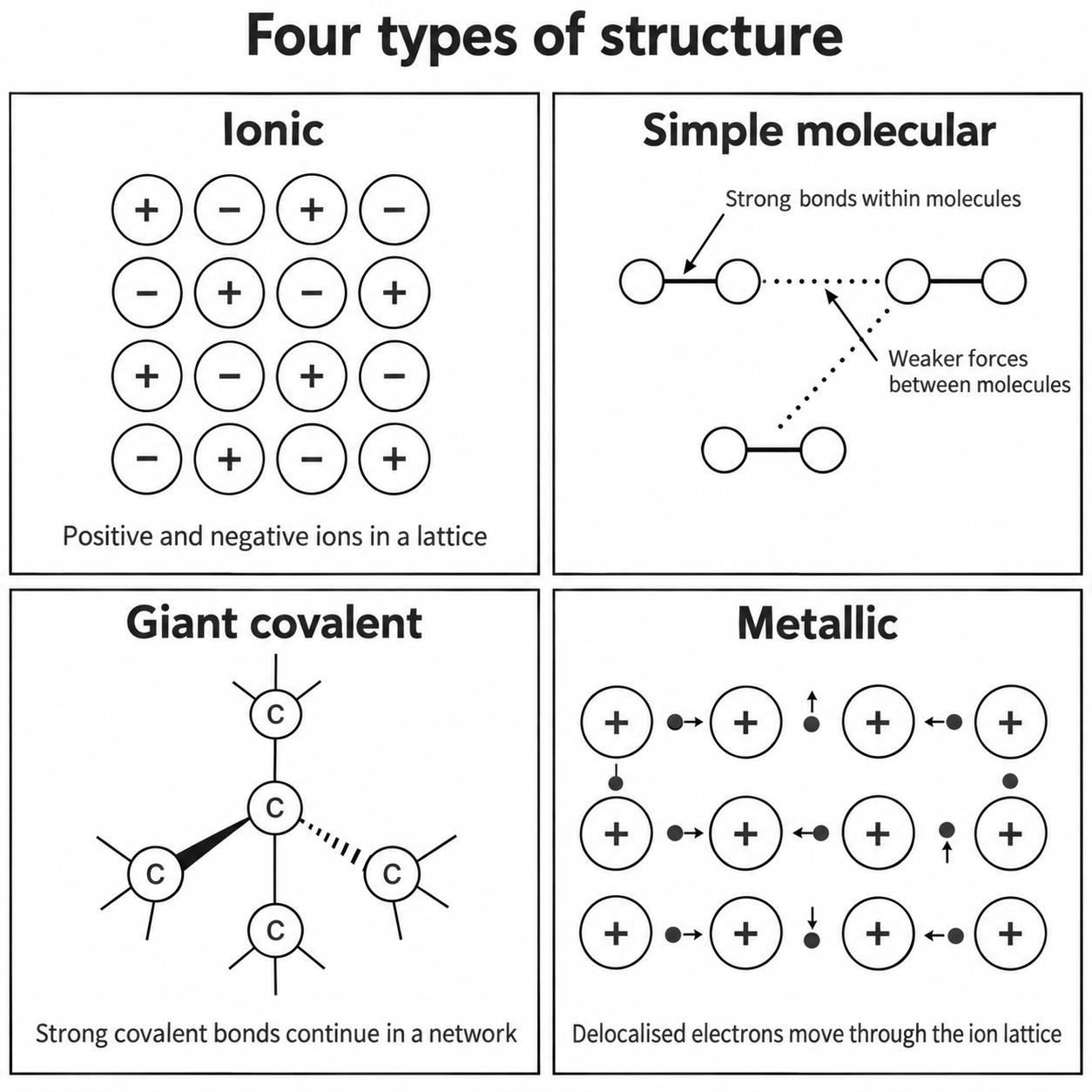
These sketches show connectivity and representative regions, not exact bond angles or complete particle counts. In the giant covalent sketch, short lines continue into the network. Electron dots in the metallic sketch are spread among the positive ions.
Melting and boiling points
Melting and boiling points depend on how much energy is needed to overcome the attractions holding particles in place. The word relative is important: you are comparing the usual pattern for each structure type, not memorising one exact temperature.
| Type of substance | Relative melting point and boiling point | Structure-and-bonding reason |
|---|---|---|
| Ionic | High | Strong electrostatic forces between oppositely charged ions in a lattice need a lot of energy to overcome. |
| Simple molecular | Low | Only the weak forces between molecules are overcome when the substance melts or boils. The covalent bonds inside molecules are not broken. |
| Giant covalent | Very high | Many strong covalent bonds throughout the giant network need a lot of energy to overcome. |
| Metallic | Usually high | Strong attraction between positive metal ions and delocalised electrons needs a lot of energy to overcome. |
The most common mistake is to say that simple molecular substances have low melting points because "covalent bonds are weak". That is not the right explanation. Covalent bonds inside the molecules are strong; melting and boiling separate molecules from each other, so the weaker forces between molecules are the relevant forces.
Solubility in water
Solubility in water can give useful evidence, but it is not a perfect single test. Some ionic compounds dissolve in water, but not all ionic compounds are soluble. Some simple molecular substances dissolve in water, such as sugar, while others have very low solubility.
Use solubility as part of a pattern:
| Type of substance | Relative solubility pattern in water |
|---|---|
| Ionic | Many dissolve in water, producing an aqueous solution containing ions. Some ionic compounds are insoluble, so solubility alone is not enough. |
| Simple molecular | Solubility varies. Many are not very soluble in water, but some dissolve as neutral molecules. |
| Giant covalent | Usually insoluble because the giant network is not broken apart by water. |
| Metallic | Usually insoluble in water as metallic lattices. |
The strongest use of solubility is with conductivity evidence. If a solid dissolves and the solution conducts electricity, that supports ionic classification because the dissolved ions can move. It is not conclusive: some molecular substances react with water to form ions. If a solid dissolves but the solution does not conduct, that suggests the dissolved particles are neutral molecules rather than ions.
Electrical conductivity
Electrical conductivity depends on mobile charged particles. Strong bonding alone does not make a substance conduct electricity. The charged particles must be able to move.
| Type of substance | Conducts as a solid? | Conducts in water if a solution forms? | Reason |
|---|---|---|---|
| Ionic | No | Yes, if it dissolves | Ions are fixed in place in the solid lattice, but dissolved ions can move and carry charge. |
| Simple molecular | No | Usually no | Molecules are neutral and there are no mobile charged particles. |
| Giant covalent | Usually no | No solution usually forms | There are usually no mobile charged particles and the substance is insoluble. |
| Metallic | Yes | Not usually described as an aqueous solution | Delocalised electrons can move through the solid metal and carry charge. |
For ionic substances, be precise about the state. A solid ionic compound has ions, but they are fixed in the lattice, so the solid does not conduct. If the ionic compound dissolves in water, the ions are free to move, so the solution conducts.
Graphite is an important giant covalent exception: it conducts as a solid because it has delocalised electrons.
For metals, the charge carriers are electrons, not ions moving through the solid. The positive metal ions stay arranged in the structure while delocalised electrons move.
Using evidence to classify
Edexcel-style Explain questions need a chain of reasoning. A good classification answer links the evidence to particles, bonding and structure.
Use this route:
- Identify the property pattern.
- Link the pattern to mobile particles or forces between particles.
- Name the structure type.
Here is a model classification from observations.
| Substance | Relative melting point | Solubility in water | Conducts as solid? | Conducts when dissolved? |
|---|---|---|---|---|
| A | High | Soluble | No | Yes |
| B | Low | Low solubility | No | Not tested |
| C | Very high | Insoluble | No | No solution forms |
| D | High | Insoluble | Yes | No solution forms |
Substance A is most likely ionic. It has a high melting point, does not conduct as a solid, but conducts when dissolved. This fits a lattice of ions: the ions are fixed in the solid but mobile in solution.
Substance B is most likely simple molecular. Its low melting point suggests only weak forces between molecules are overcome, and it does not have mobile charged particles.
Substance C is most likely giant covalent. Its very high melting point and insolubility suggest a giant network of strong covalent bonds.
Substance D could be metallic: delocalised electrons would explain conduction as a solid. Graphite also conducts as a solid and is insoluble, so these observations alone cannot rule out a giant covalent structure. A pattern of properties supports a classification; it does not always prove one uniquely.
Do not overclaim from a single property. A low melting point is strong evidence for simple molecular structure, but solubility varies. A high melting point could fit ionic, giant covalent or metallic structures, so you need conductivity and solubility evidence to separate them.
Classify a substance by linking its structure and bonding to a pattern of properties: relative melting and boiling point, solubility in water, and conductivity as a solid and in solution.