1.35 - Carbon and giant covalent structures
Learn how graphite and diamond can be different substances while containing the same element, and what their giant covalent classification means.
Two forms of the same element
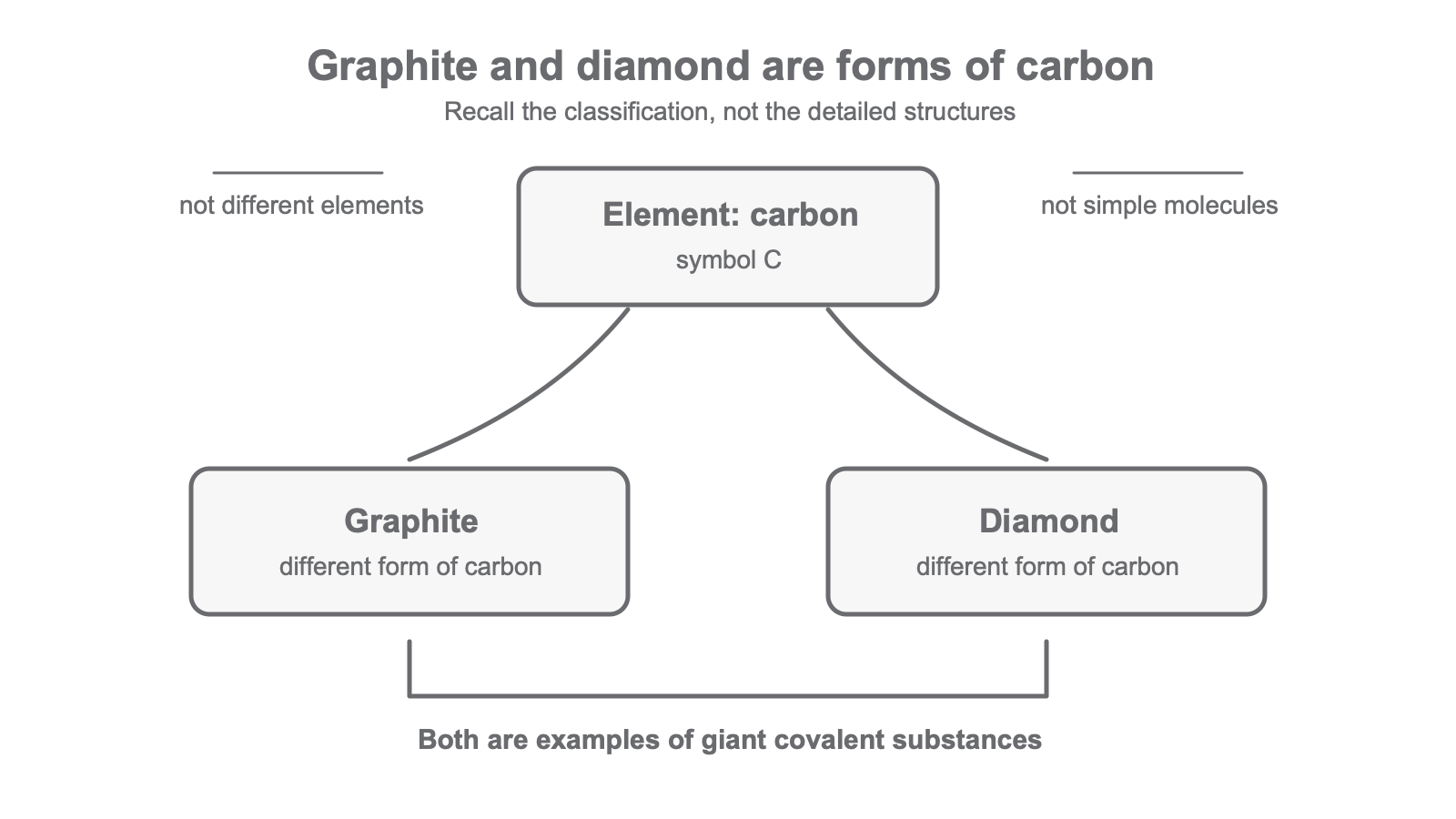
Graphite and diamond are different forms, or allotropes, of carbon. Each contains carbon atoms only. Their atoms are arranged differently, which is why their appearances and properties differ.
A different name or appearance does not make diamond a different element. Neither pure diamond nor pure graphite is a compound: a compound contains two or more different elements chemically bonded together.
[DIAGRAM: asset_name: carbon_forms_map: Graphite and diamond as carbon giant covalent substances - diagram 1; asset_slug: 041_1_35_graphite_and_diamond_as_giant_covalent_carbon_structures_diagram1; file: diagram_assets/041_1_35_graphite_and_diamond_as_giant_covalent_carbon_structures_diagram1.png; recommended_method: deterministic_drawn; description: Exact monochrome classification map showing the element carbon, symbol C, branching to two different forms: graphite and diamond. A shared bracket labels both as examples of giant covalent substances. The diagram deliberately avoids detailed graphite or diamond structures and use-property explanations because those belong to later specification points. Deterministic drawn asset because the labels and classification relationships must be exact.]
A network rather than separate molecules
Both diamond and graphite are giant covalent substances. Many carbon atoms are joined by covalent bonds in extended networks. They are not collections of small, separate molecules.
“Carbon” identifies the element; “giant covalent” describes the structure and bonding. These are different kinds of description, and both apply to graphite and diamond. The next lesson compares their arrangements in detail.