1.20 - Linking electron arrangements to the periodic table
For the first 20 elements, a neutral atom’s electron arrangement connects to its period and group. You will use occupied shells and outer electrons to find a position, then work backwards from a position to an arrangement.
Reading position from the shells
A period is a horizontal row and a group is a vertical column. In an electron arrangement such as 2.8.7, each number gives the electrons in one occupied shell.
For neutral atoms of the first 20 elements:
- The number of occupied shells gives the period: 2.8.7 has three occupied shells, so it is in Period 3.
- In the course's main-group numbering, Groups 1–7 match the number of outer-shell electrons: 2.8.7 ends in 7, so it is in Group 7.
- Group 0 contains the noble gases, which have full outer shells. Helium's single shell is full with 2 electrons; neon is 2.8 and argon is 2.8.8. Group 0 does not mean zero outer electrons.
Some periodic tables use Groups 13–18 for the columns called 3–7 and 0 here. In these lessons, use the stated 1–7 and 0 convention.
[DIAGRAM: asset_name: configuration_position_map: Electronic configuration and periodic-table position - diagram 1; asset_slug: 026_1_20_electronic_configuration_of_an_element_is_related_to_its_position_in_the_p_diagram1; file: diagram_assets/026_1_20_electronic_configuration_of_an_element_is_related_to_its_position_in_the_p_diagram1.png; recommended_method: deterministic_drawn; description: Exact monochrome teaching diagram. Shows selected first-20 elements in periods 2 and 3 with their configurations, groups 1, 2, 3, 4, 5, 6, 7 and 0, and rule boxes linking occupied shells to period, groups 1-7 to outer-shell electrons, and group 0 to a full outer shell. Assessed visual; deterministic SVG rendered to PNG because the asset needs exact labels and positions.]
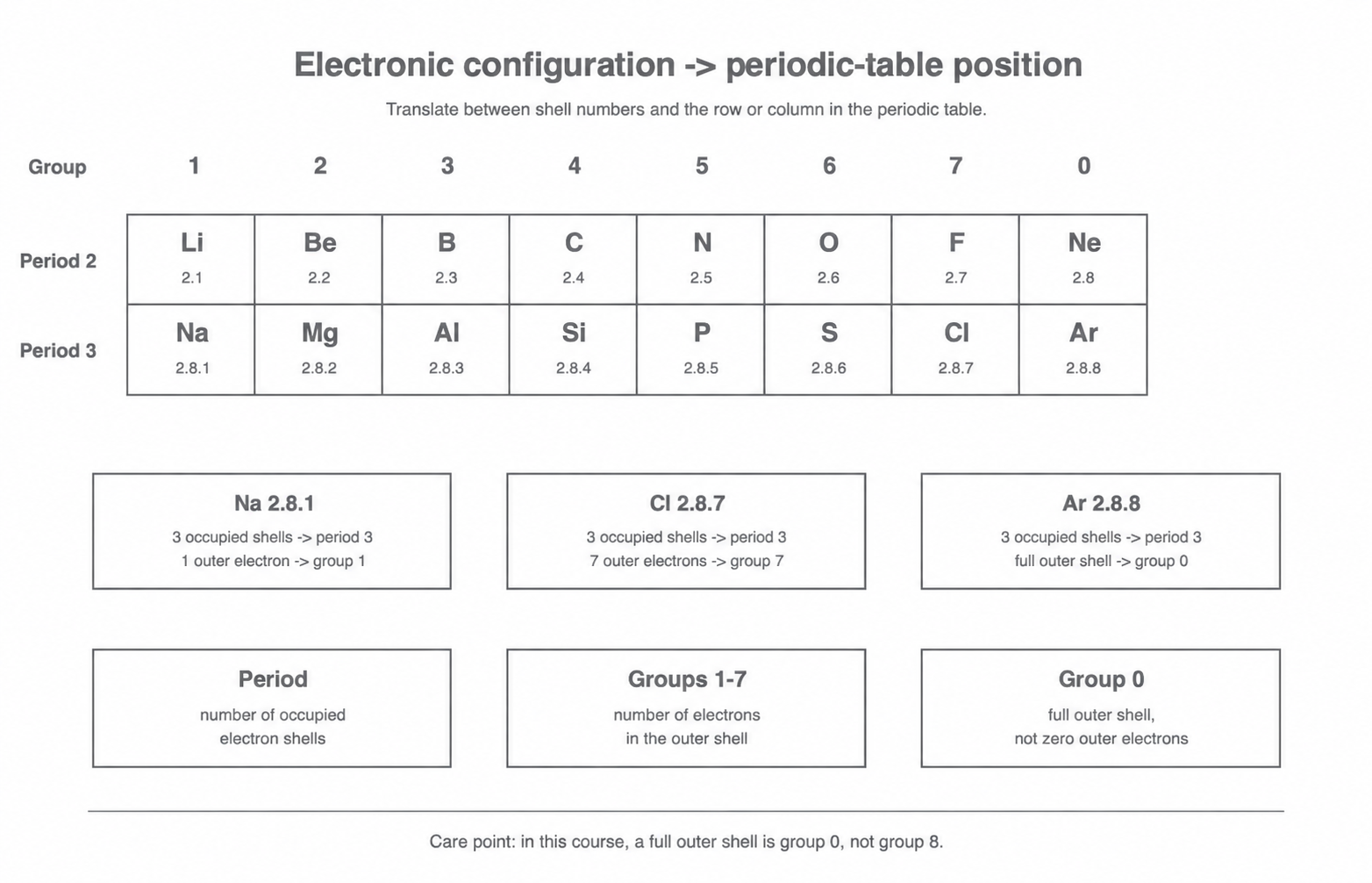
The diagram compares Periods 2 and 3 with the central space omitted. Lithium (2.1) and sodium (2.8.1) each have one outer electron and belong to Group 1, but sodium has one more occupied shell and belongs to the next period. Their common outer-electron pattern helps explain their similar chemical behaviour.
Do not add all the numbers to find the period. The sum gives the electron total and hence the atomic number of a neutral atom.
Working in both directions
From arrangement to position
Calcium has arrangement 2.8.8.2. There are four occupied shells, so it is in Period 4. Its two outer electrons put it in Group 2. Use both pieces of information: the final number alone does not tell you the period.
From position to arrangement
An element in Period 3 and Group 5 has three occupied shells and five electrons in its outer shell. The inner shells contain 2 and 8 electrons, so the arrangement is 2.8.5. Its total is 15, the atomic number of the neutral atom.
For a Group 0 element, use a full outer shell. Period 2 and Group 0 therefore gives 2.8, not 2.0. Always use the arrangement of the neutral atom when locating the element; an ion may have lost or gained electrons.