1.5 - The sizes of atoms and nuclei
The nucleus is central but occupies only a tiny part of the atom. Learn to describe that size difference and recognise when a diagram enlarges the nucleus for clarity.
A tiny nucleus inside a much larger atom
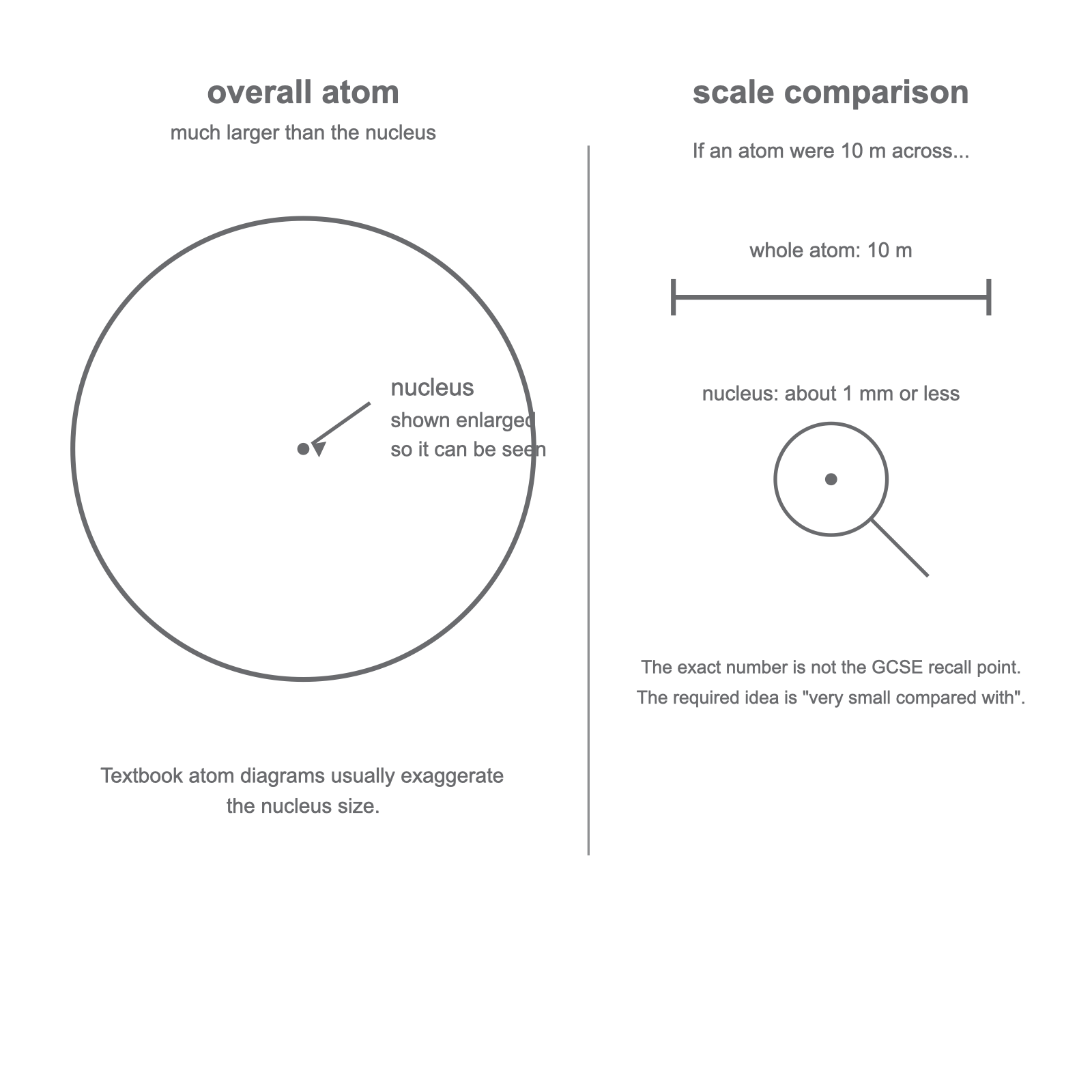
The nucleus is very small compared with the overall atom. The atom includes the surrounding region where electrons are found, so it extends far beyond its nucleus.
A useful scale analogy is an atom enlarged to 10 m across: its nucleus would be about 1 mm or less across. This is a size comparison, not a claim that every atom has exactly the same size.
[DIAGRAM: asset_name: Atom and nucleus scale comparison - diagram 1; asset_slug: 011_1_5_nucleus_of_an_atom_as_very_small_compared_to_the_overall_size_of_the_atom_diagram1; file: diagram_assets/011_1_5_nucleus_of_an_atom_as_very_small_compared_to_the_overall_size_of_the_atom_diagram1.png; recommended_method: deterministic_drawn; description: Deterministic monochrome scale visual showing a large outline circle labelled "overall atom" with a very small central dot labelled "nucleus shown enlarged so it can be seen"; include a scale analogy "if the atom were 10 m across, the nucleus would be about 1 mm or less across" and a note that GCSE atom diagrams usually exaggerate the nucleus size. White background with #6A6B6E linework and text. Assessed idea is the qualitative relative size comparison, not exact numerical recall.]
What a classroom diagram can show
If drawn at its true relative size on a small page, the nucleus would be difficult to see. Diagrams commonly enlarge it to label the parts. Such a diagram can correctly show the nucleus at the centre while giving a misleading impression of its size.