1.39 - Simple polymers and poly(ethene)
Learn to recognise a simple polymer as very large molecules with carbon chains. Use poly(ethene) to read a short structural fragment and distinguish one bonded chain from a whole sample of polymer.
One long chain is one molecule
A polymer consists of very large molecules built from many repeating units. The simple polymers considered here have a long backbone of carbon atoms joined by strong covalent bonds. Poly(ethene) is the example: hydrogen atoms are attached to its carbon chain.
One connected chain is one molecule, even if it contains thousands of atoms. A piece of poly(ethene) contains many such molecules. The atoms within one chain are chemically bonded; the chain is not a row of separate atoms merely touching.
This also distinguishes a chain polymer from diamond. Both contain covalent bonds, but diamond's network extends through the crystal rather than existing as separate long-chain molecules.
Reading a fragment of poly(ethene)
A full polymer chain is too long to draw conveniently, so a diagram normally shows a short fragment.
[DIAGRAM: asset_name: polyethene_carbon_chain: Poly(ethene) as one large carbon-chain molecule - diagram 1; asset_slug: 045_1_39_simple_polymers_and_poly_ethene_diagram1; file: diagram_assets/045_1_39_simple_polymers_and_poly_ethene_diagram1.png; recommended_method: deterministic_drawn; description: Exact monochrome teaching diagram showing a short section of one poly(ethene) molecule. It labels a chain of carbon atoms joined by covalent bonds, hydrogen atoms attached to the carbon chain, continuation marks at both ends, and a note that only a short section of one very large molecule is shown. Assessed structure-description visual; deterministic drawing is used for exact labels and to avoid implying separate small molecules or a polymerisation mechanism.]
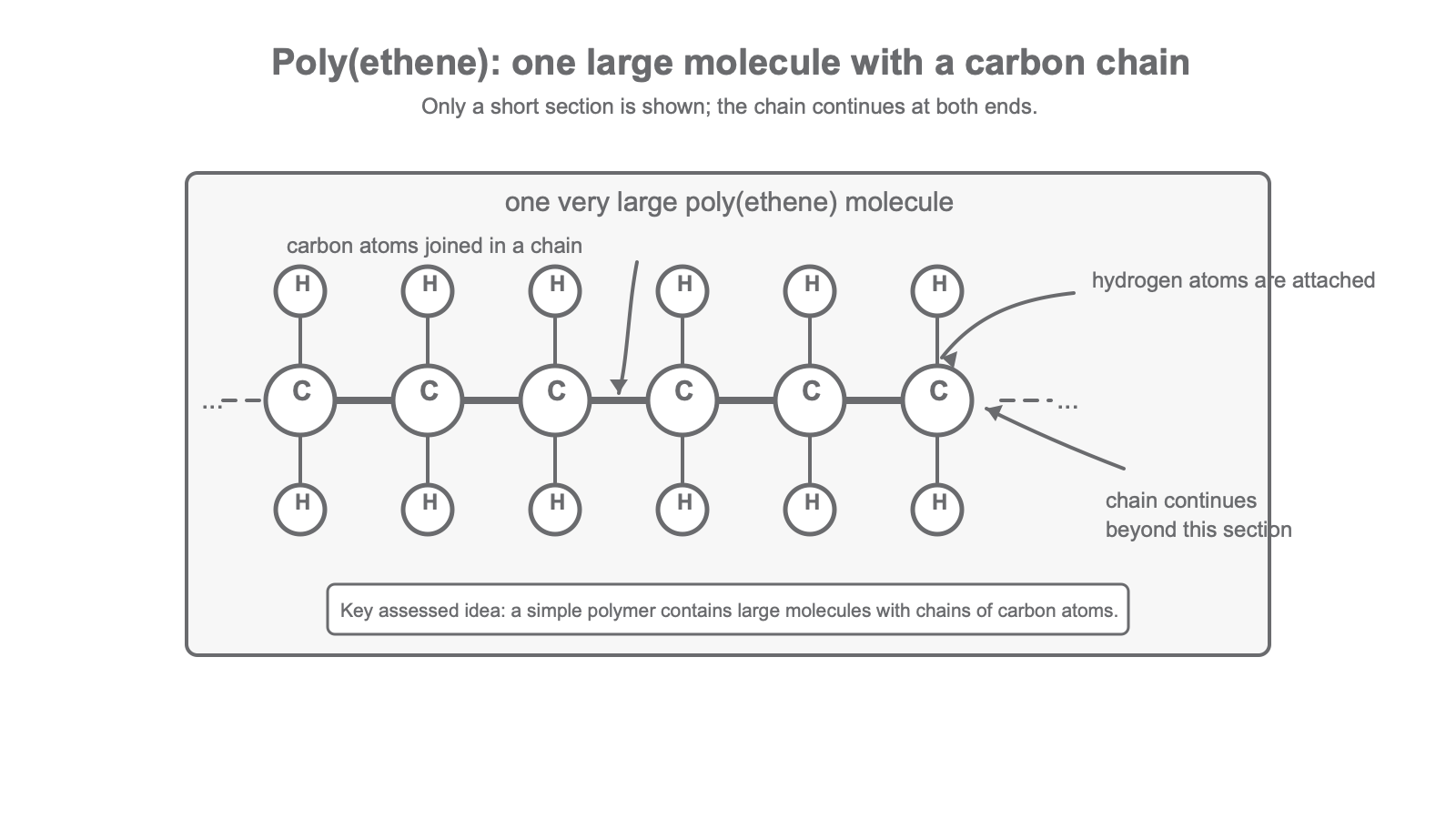
Here each shown carbon atom is connected to two hydrogen atoms and two carbon neighbours, counting the continuing bonds at the ends. Each hydrogen has one bond. The drawing shows which atoms are connected, not the actual three-dimensional angles of the chain.
The continuation marks mean that the molecule extends beyond the picture. They are not extra atoms and do not mark the real ends of the whole molecule. The six drawn carbon atoms are only part of one long chain.