1.33 - Properties of ionic compounds
Learn why ionic compounds usually have high melting and boiling points, and why their electrical conductivity changes when they melt or dissolve. The key ideas are strong attractions and mobile ions.
Strong attractions and high temperatures
An ionic compound contains positive and negative ions. In the solid, they form a regular lattice held together by strong electrostatic attractions between opposite charges. A large amount of energy is needed to overcome these attractions, so ionic compounds usually have high melting and boiling points.
Melting changes a solid into a liquid; boiling changes a liquid into a gas. Melting disrupts the fixed lattice but does not turn the ions into neutral atoms or release a sea of electrons. The explanation is about attractions between ions, rather than saying that the ions themselves are “strong”.
For example, sodium chloride needs a high temperature to melt because strong attractions hold its positive sodium ions and negative chloride ions in the solid lattice.
Why the solid does not conduct
An electric current is a flow of charge. A substance conducts only when charged particles can move through it. Ionic compounds contain charged particles in every state, but in a solid the ions are held in fixed positions. They vibrate without moving through the lattice, so they cannot carry a current.
“Solid sodium chloride has no charged particles” is therefore wrong: the particles are charged, but are not mobile.
Moving ions in liquids and solutions
Molten means melted into the liquid state. In a molten ionic compound, the ions can move through the liquid and carry charge.
An aqueous solution has water as its solvent. When a soluble ionic compound dissolves, its ions separate from the lattice and can move through the water, so the solution conducts. Not every ionic compound dissolves: an insoluble solid does not become an aqueous solution simply by being put in water.
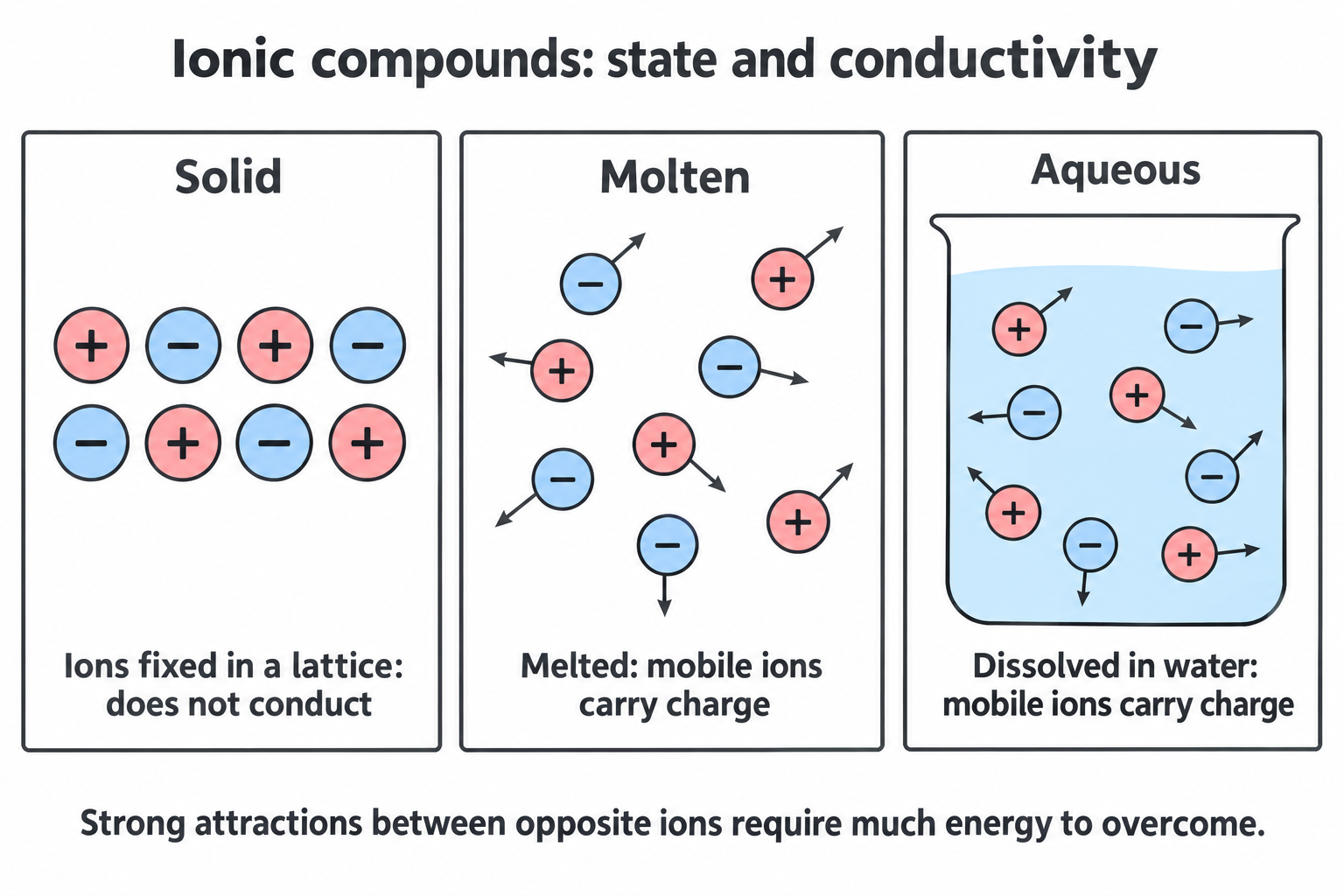
The diagrams compare arrangements, not a reaction: the charged particles remain ions. In both the melt and the solution, ions carry charge; delocalised electrons are the charge carriers in metals, not in these ionic substances.
For sodium chloride, melting uses heat to produce a liquid with no water required. Dissolving produces mobile ions in water. Both processes allow conduction, but they are different processes.