1.17 - Periods, groups and atomic number
The periodic table uses atomic-number order, horizontal periods and vertical groups. You will use a table extract to recognise these patterns and identify elements likely to have similar chemical properties.
Order, rows and columns
Elements are arranged in order of increasing atomic number, the number of protons in an atom's nucleus. Across a row, atomic number increases from left to right.
A period is a horizontal row. A group is a vertical column. Elements in the same group generally have similar chemical properties; they are different elements, so their properties are not identical.
[DIAGRAM: asset_name: periodic-table-layout - diagram 1; asset_slug: 023_1_17_in_the_periodic_table_a_elements_are_arranged_in_order_of_increasing_atomi_diagram1; file: diagram_assets/023_1_17_in_the_periodic_table_a_elements_are_arranged_in_order_of_increasing_atomi_diagram1.png; recommended_method: deterministic_drawn; description: Monochrome simplified periodic table extract showing element boxes with atomic numbers 1-18. One horizontal row is lightly highlighted and labelled "one period = one row"; one vertical column is lightly highlighted and labelled "one group = one vertical column"; an arrow across a row shows increasing atomic number from left to right. The visual is exact for the teaching point and remains limited to layout, order, periods and groups.]
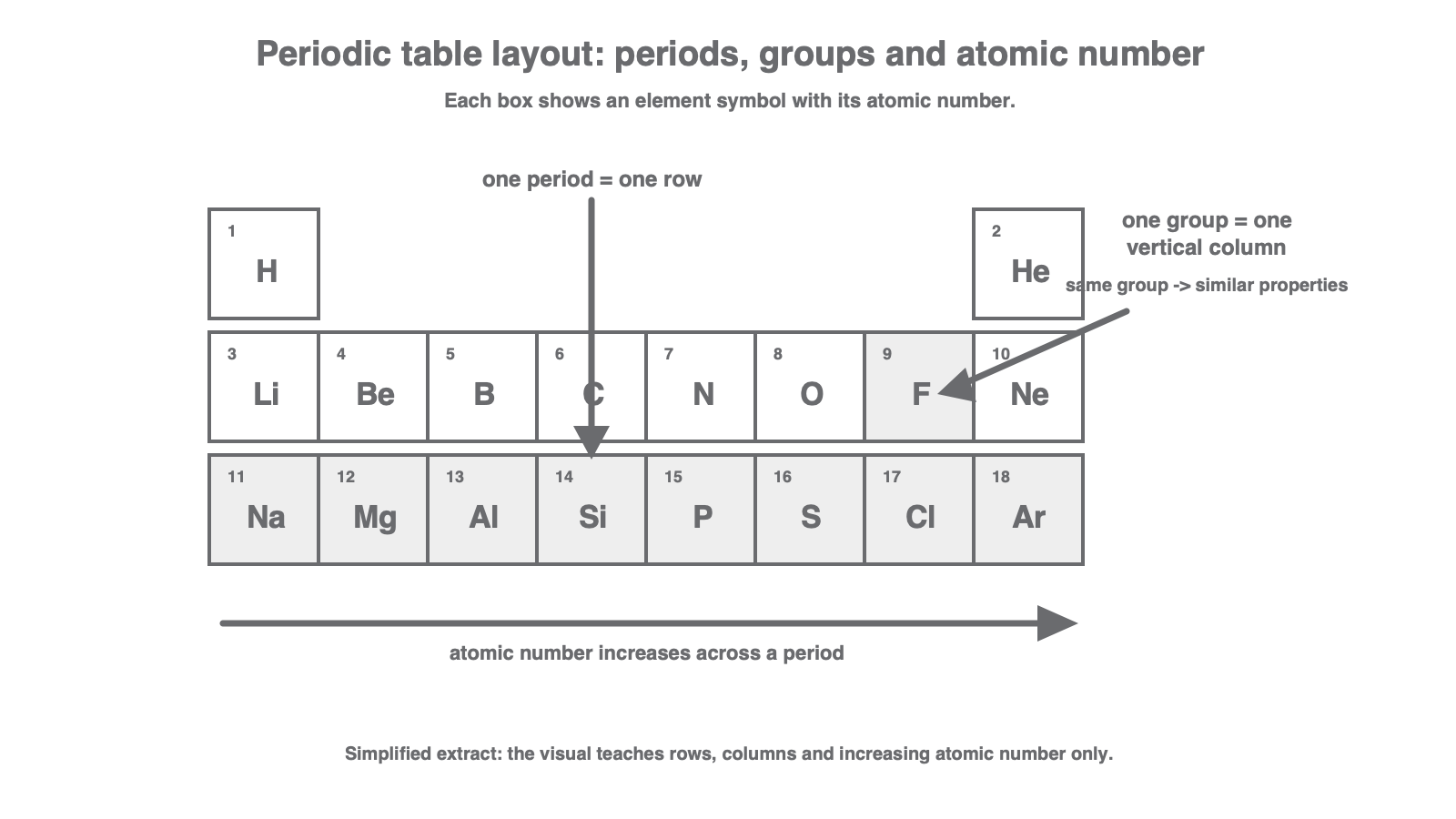
The diagram shows the first three periods with the unused central space removed. Lithium, beryllium, boron, carbon, nitrogen, oxygen, fluorine and neon form Period 2. Fluorine and chlorine lie in the same vertical column, so they form part of the same group. Moving from fluorine to neon stays in the same period but changes group.
Reading an extract
Here is a small extract. Letters stand for elements; the numbers are their atomic numbers. Only three selected columns are shown.
| First selected column | Second selected column | Third selected column |
|---|---|---|
| A: 4 | B: 5 | C: 6 |
| D: 12 | E: 13 | F: 14 |
A, B and C share a period because they occupy one row. B and E share a group because they occupy one column. We therefore expect B and E to have similar chemical properties. Atomic numbers rise across each row, but the numbers in a column need not be consecutive.
When using an extract, read both the layout and the numbers: nearby numbers indicate ordering, while vertical alignment identifies the group.