1.34 - Properties of simple molecular substances
Learn how separate molecules explain low melting and boiling points and poor electrical conduction. Distinguish the strong bonds inside a molecule from the weaker forces between molecules.
Bonds within and forces between molecules
A simple molecular substance contains separate molecules. Strong covalent bonds join atoms inside each molecule. Intermolecular forces are attractions between different molecules; in typical simple molecular compounds these are much weaker than the covalent bonds.
[DIAGRAM: asset_name: simple_molecular_properties: Forces and charges in a simple molecular compound - diagram 1; asset_slug: 040_1_34_properties_of_typical_covalent_simple_molecular_compounds_diagram1; file: diagram_assets/040_1_34_properties_of_typical_covalent_simple_molecular_compounds_diagram1.png; recommended_method: deterministic_drawn; description: Exact monochrome teaching diagram. Shows three separate simple molecules with solid covalent bonds inside each molecule, dashed weak intermolecular forces between molecules, a heating arrow showing molecules separate during melting or boiling while covalent bonds stay intact, and a conductivity panel stating that neutral molecules have no mobile charged particles. Assessed structure-property visual; deterministic drawing is used for exact labels and relationship arrows.]
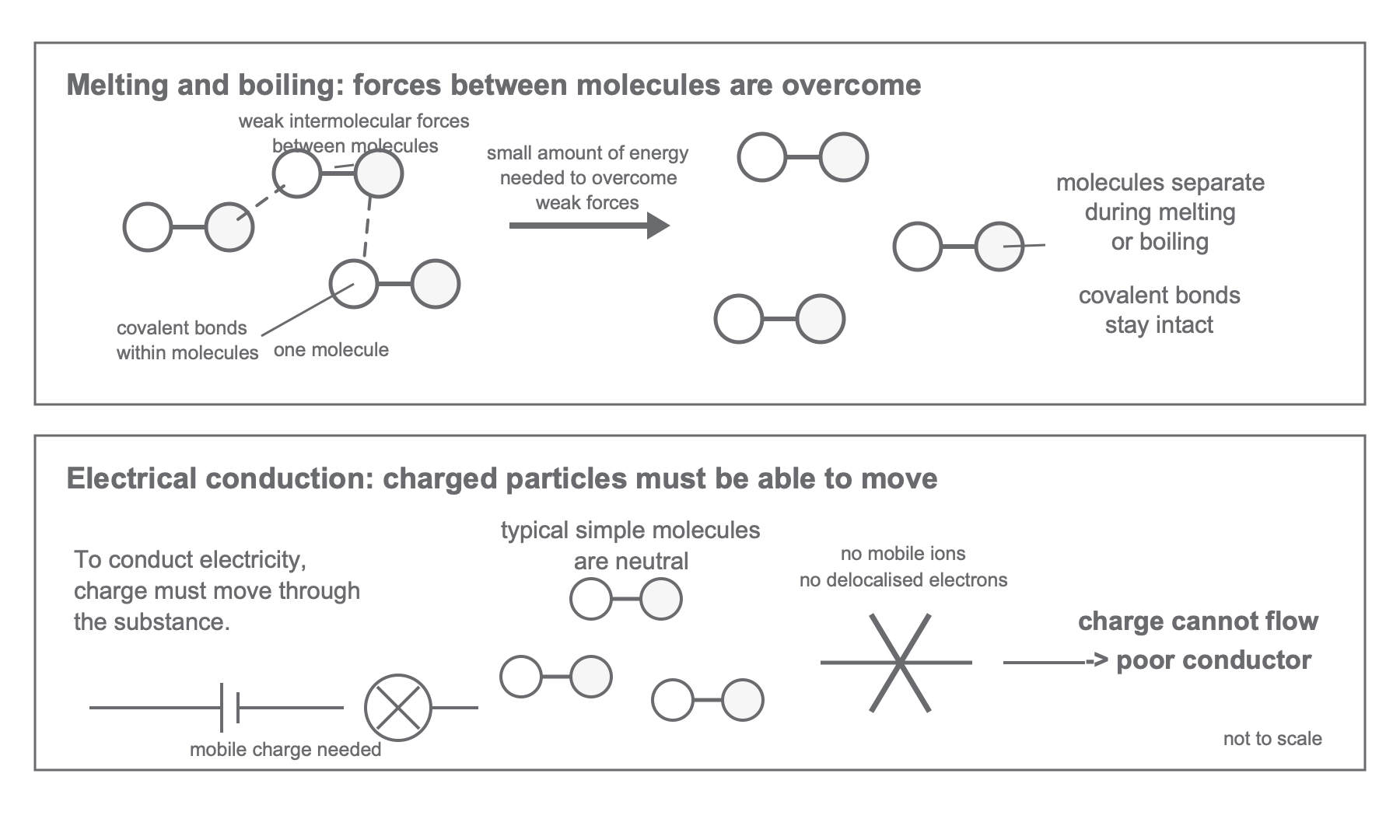
Read the solid lines within each pair as covalent bonds, and the dashed lines between pairs as intermolecular forces. The paired atoms stay together when the molecules separate. The lower panel summarises conductivity; it is not a complete experimental circuit.
What changes during melting and boiling
In an ordinary change of state, the molecules remain intact. Melting disrupts their ordered arrangement; boiling separates them much further. The attractions between molecules are overcome, while the strong covalent bonds inside them remain intact.
Weak intermolecular forces require relatively little energy to overcome. This explains the usually low melting and boiling points. For example, boiling liquid methane separates methane molecules; it does not break the carbon–hydrogen bonds to form separate atoms.
A low boiling point therefore does not mean “weak covalent bonds”. It tells us about the forces between molecules.
Why molecules usually do not carry a current
A current needs mobile charged particles. Typical pure simple molecular substances contain neutral molecules rather than ions. Their electrons are held within atoms and covalent bonds; they are not delocalised throughout the substance. There are therefore no mobile charged particles to carry current, even when the molecules themselves can move in a liquid or gas.
Do not say these substances have no electrons. They have electrons, but these cannot move through the whole substance to carry charge. Weak intermolecular forces explain changes of state, not electrical insulation.
Keep the conditions clear. Pure hydrogen chloride is molecular and a poor conductor; when it dissolves in water it forms ions, so its aqueous solution conducts. This is why “all covalent substances never conduct” is too broad.