1.45 - Empirical and molecular formulae
Empirical and molecular formulae both describe the elements in a compound, but they give different levels of detail. The key move is ratio: simplify a molecular formula to the smallest whole-number ratio, or scale an empirical formula up using relative molecular mass.
What The Two Formulae Show
A molecular formula shows the actual number of atoms of each element in one molecule. For example, a molecule with formula C4H10 contains 4 carbon atoms and 10 hydrogen atoms.
Molecular Formula
The molecular formula gives the actual number of atoms of each element in one molecule.
An empirical formula shows the simplest whole-number ratio of atoms of each element in a compound. For C4H10, the ratio C:H is 4:10. Both numbers can be divided by 2, so the simplest ratio is 2:5 and the empirical formula is C2H5.
Empirical Formula
The empirical formula gives the simplest whole-number ratio of atoms of each element in a compound.
If a subscript is not written, it means 1. The empirical formula of H2O is still H2O because the ratio 2:1 cannot be simplified.
Molecular Formula To Empirical Formula
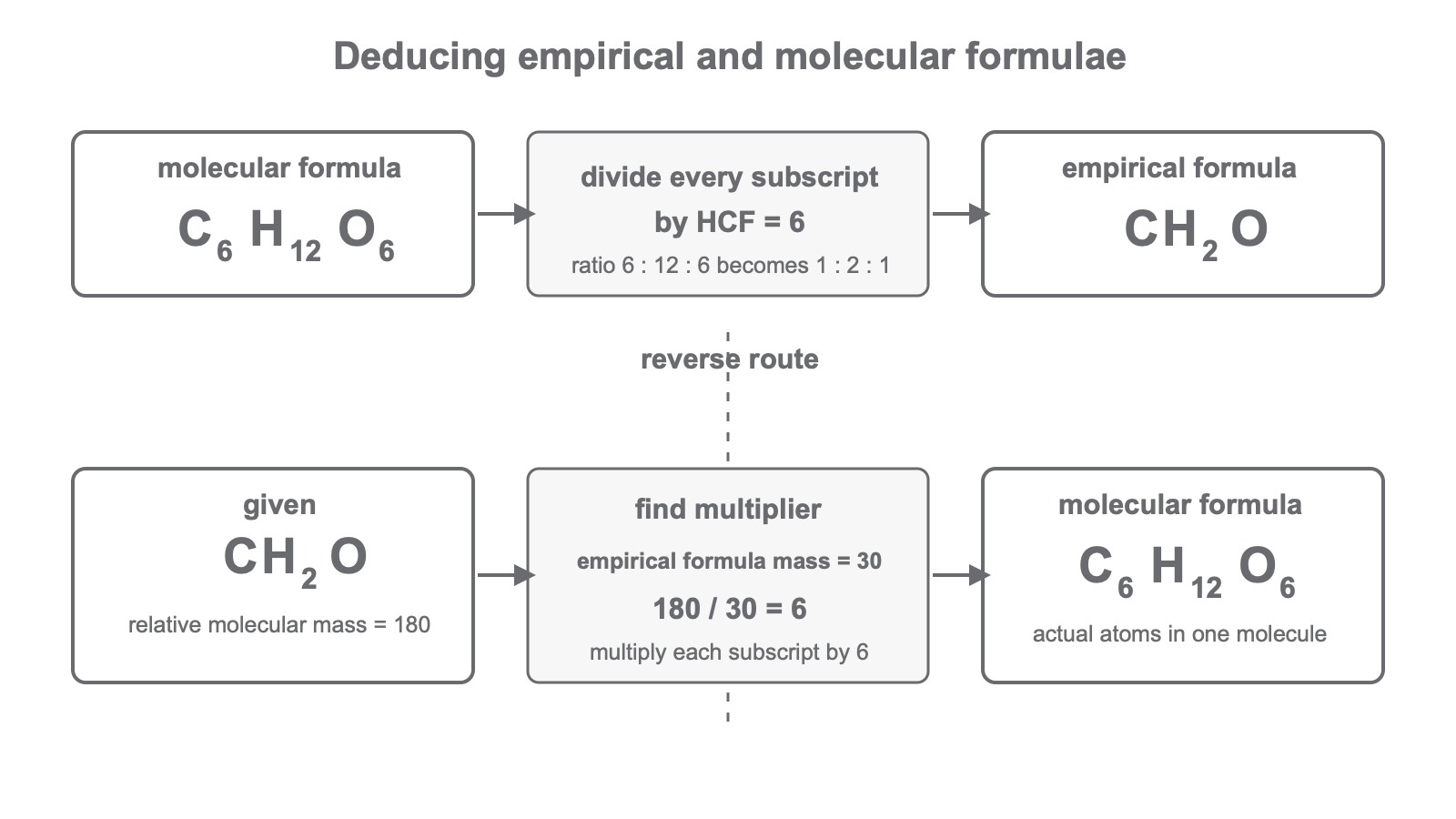
To deduce an empirical formula from a molecular formula, look at all the subscripts and divide them by the highest common factor. You must divide every subscript by the same number.
Worked example:
Deduce the empirical formula of C6H12O6.
The subscripts are 6, 12 and 6. The highest common factor is 6.
So the empirical formula is CH2O.
For C2H6, the subscripts are 2 and 6. Divide both by 2 to get 1 and 3, so the empirical formula is CH3. For CO2, the subscripts are 1 and 2. There is no common factor greater than 1, so the empirical formula is CO2.
[DIAGRAM: asset_name: empirical_molecular_bridge: Empirical and molecular formula deduction routes - diagram 1; asset_slug: 051_1_45_empirical_and_molecular_formulae_diagram1; file: diagram_assets/051_1_45_empirical_and_molecular_formulae_diagram1.png; recommended_method: deterministic_drawn; description: Exact monochrome formula-route diagram. Shows the route from molecular formula C6H12O6 to empirical formula CH2O by dividing subscripts by highest common factor 6, and the reverse route from empirical formula CH2O and relative molecular mass 180 to molecular formula C6H12O6 by calculating empirical formula mass 30, multiplier 180 / 30 = 6, then multiplying each subscript by 6. Assessed calculation visual; deterministic drawn because exact formulae, arrows and arithmetic must be correct.]
Empirical Formula To Molecular Formula
To deduce a molecular formula from an empirical formula, you need the relative molecular mass, usually written as Mr. First find the mass of one empirical formula unit using relative atomic masses. Then find how many times that empirical formula unit fits into the relative molecular mass.
Molecular Formula Multiplier
Use relative atomic masses C = 12, H = 1, O = 16 and N = 14 in the examples below.
Worked example:
A compound has empirical formula CH2O and relative molecular mass 60. Deduce its molecular formula.
Empirical formula mass of CH2O:
Multiplier:
Multiply every subscript in CH2O by 2:
The molecular formula is C2H4O2. Relative molecular mass is a relative value, so it has no unit.
Whole-Number Multipliers
The multiplier should be a whole number because a molecular formula has whole numbers of atoms. A multiplier of 3 means the molecule has three times each atom count in the empirical formula; the empirical formula units are a counting ratio, not separate pieces inside the molecule. A multiplier of 1 means the empirical formula and molecular formula are the same.
Worked example:
A compound has empirical formula HO and relative molecular mass 34. Deduce its molecular formula.
Empirical formula mass of HO:
Multiplier:
Multiply H and O by 2, so the molecular formula is H2O2.
If your multiplier is not close to a whole number in a GCSE question, check the empirical formula mass, the relative molecular mass and whether you have multiplied every element.
Molecular formula = empirical formula scaled by one whole-number multiplier.
Use the multiplier only after you have found the relative mass of the empirical formula.
Exam Method And Traps
Show the ratio or multiplier and the final formula so your reasoning is clear.
Use this method for molecular formula questions:
- Write the empirical formula mass.
- Divide the relative molecular mass by the empirical formula mass.
- Multiply every subscript in the empirical formula by that multiplier.
- Write the molecular formula clearly.
Common traps are:
- dividing only one subscript when simplifying a molecular formula
- forgetting that a missing subscript means 1
- using the relative molecular mass as a subscript
- finding the empirical formula but not scaling it up to the molecular formula
- rounding a multiplier to a whole number when earlier arithmetic is wrong