1.51 - Moles, particles and mass calculations
This Higher-tier calculation lesson links the mass you can measure in the lab to the number of particles too small to count directly. The route is always built from two bridges: mass to moles, then moles to particles. Once those bridges are secure, the reverse calculations use the same relationships in the opposite direction.
The two calculation bridges
A mole is a counting amount. One mole of specified particles contains particles, using the Avogadro constant rounded to three significant figures. The particles might be atoms, molecules, formulae in an ionic compound, or ions, depending on exactly what the question names.
Mole
One mole of particles of a substance contains particles of that substance.
The mass bridge uses the relative particle mass. At GCSE this is the relative atomic mass for atoms, or the relative formula mass/relative molecular mass for compounds and molecules. If a question gives a relative particle mass, use it directly; if it gives relative atomic masses, calculate first and then start this lesson's calculation.
Mass to moles
where n is the amount in mol, m is mass in g, and the numerical value of is used as the molar mass in g mol^-1.
The particle bridge uses Avogadro constant, .
Moles to particles
where N is the number of particles and .
For Edexcel Calculate questions, show the relationship, substitution, working, final answer and unit where there is one. A number of particles has no unit, but it must be labelled as atoms, molecules, formulae or ions.
[DIAGRAM: asset_name: Mass moles and particles conversion map - diagram 1; asset_slug: 057_1_51_moles_particles_and_mass_calculations_diagram1; file: diagram_assets/057_1_51_moles_particles_and_mass_calculations_diagram1.png; recommended_method: deterministic_drawn; description: Exact monochrome calculation map linking mass in g, moles in mol, and number of particles. It labels mass to moles as divide by Mr, moles to mass as multiply by Mr, moles to particles as multiply by 6.02 x 10^23, and particles to moles as divide by 6.02 x 10^23. Assessed calculation visual, generated deterministically in NovaLearn monochrome style.]
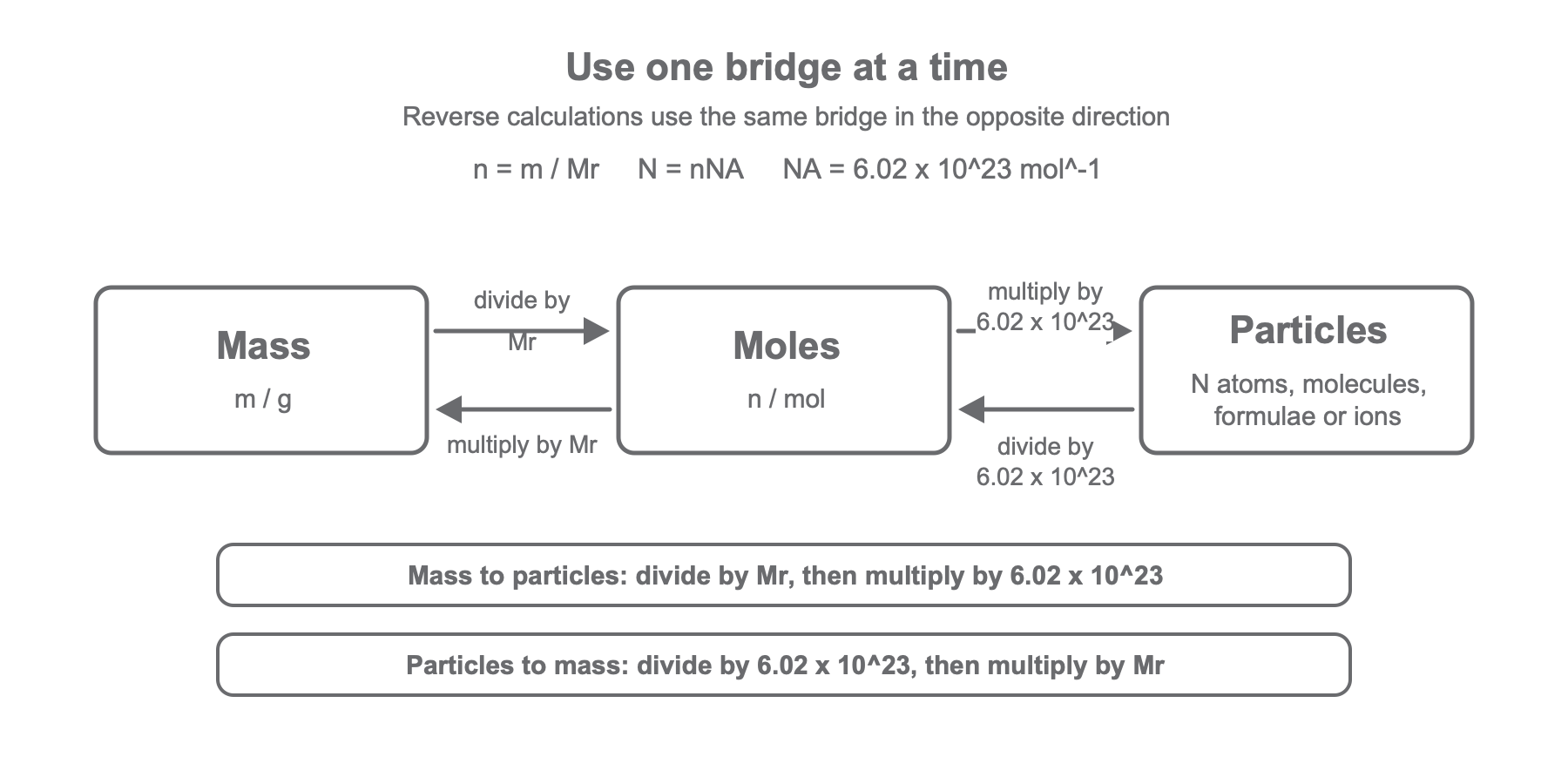
Mass and moles
To calculate moles from mass, divide the mass by the relative particle mass. This works because one mole has a mass equal to the relative particle mass in grams.
Worked example: calculate the amount, in mol, in 5.85 g of sodium chloride. The relative particle mass of sodium chloride is 58.5.
So 5.85 g of sodium chloride is 0.100 mol of sodium chloride formulae.
The reverse calculation uses the same relationship rearranged:
Worked example: calculate the mass of 0.400 mol of carbon dioxide. The relative molecular mass of carbon dioxide is 44.0.
So 0.400 mol of carbon dioxide has a mass of 17.6 g.
Moles and particles
To calculate particles from moles, multiply by the Avogadro constant. Keep the standard form tidy: is a very large multiplier, so the answer will usually stay in standard form.
Worked example: calculate the number of oxygen molecules in 0.250 mol of oxygen molecules.
To three significant figures, this is:
To calculate moles from particles, divide by the Avogadro constant.
Worked example: calculate the amount, in mol, in sulfate ions.
The label matters. 2.00 mol here means 2.00 mol of sulfate ions, not 2.00 mol of sulfate compounds.
Mass and particles
There is no direct weighing scale for particles. So a mass-to-particles calculation has two stages:
- Convert mass to moles.
- Convert moles to particles.
Combined into one relationship:
Mass to particles
Worked example: calculate the number of oxygen molecules in 3.20 g of oxygen, O_2. The relative molecular mass of oxygen is 32.0.
First calculate moles:
Then calculate molecules:
So 3.20 g of oxygen contains oxygen molecules.
The reverse calculation starts with particles:
- Convert particles to moles.
- Convert moles to mass.
Particles to mass
Worked example: calculate the mass of carbon dioxide molecules. The relative molecular mass of carbon dioxide is 44.0.
Reverse calculations and checks
In these questions, the common error is choosing the wrong direction. Ask what the answer is measured in:
- Answer in
mol: finish at moles. - Answer in
g: finish at mass. - Answer as a count of particles: finish at particles and label the particle type.
If the starting mass is not in grams, convert it to grams before using . For example, 0.0120 kg is 12.0 g, and only then can you divide by a relative particle mass.
Use significant figures sensibly. If the data are given to three significant figures, a final answer to three significant figures is usually appropriate unless the question says otherwise. Avoid rounding after the first step in a two-step calculation, because that can move the final answer.
Worked example: calculate the mass of methane molecules. The relative molecular mass of methane is 16.0.
Start with particles, so divide by Avogadro constant:
Finish with mass:
Now apply that reverse route. You may combine the two relationships into one expression if your working shows both conversions.
The strongest answers make the direction visible in the working, so the examiner can see why each multiply or divide step was chosen.
Every 1.51 calculation is a route between three quantities: mass in g, amount in mol, and number of particles. Move one bridge at a time and label the particle you have counted.