3.6.1.1 - Circular Motion
Any object moving along a curved path is being continuously deflected from a straight line. Whether it is a satellite orbiting the Earth, a car rounding a bend, or a capsule on the London Eye, the physics is the same: an inward force must act at every instant to change the direction of the velocity. This lesson develops the language of angles, angular speed, and centripetal force that you need to analyse all such situations quantitatively.
Radian Measure
Before we can describe rotation mathematically, we need a natural unit of angle. Degrees are a historical convention (360 in a full turn has no physical basis). The radian is the SI-coherent unit and simplifies every rotational equation you will meet.
Radian
One radian (rad) is the angle subtended at the centre of a circle by an arc whose length is equal to the radius of the circle.
The sector diagram below shows the defining geometry of one radian, so notice that the arc length and the radius are marked as equal and that this makes the central angle exactly 1 rad.
[DIAGRAM: asset_name: 6.1.1 - Circular Motion - Diagram 1; asset_slug: 6.1.1 - Circular Motion - Diagram 1; recommended_method: retained_png; description: A circle of radius r with a sector marked out. The arc length s equals r, and the angle at the centre is labelled 1 rad. The radius lines and arc are clearly labelled.]
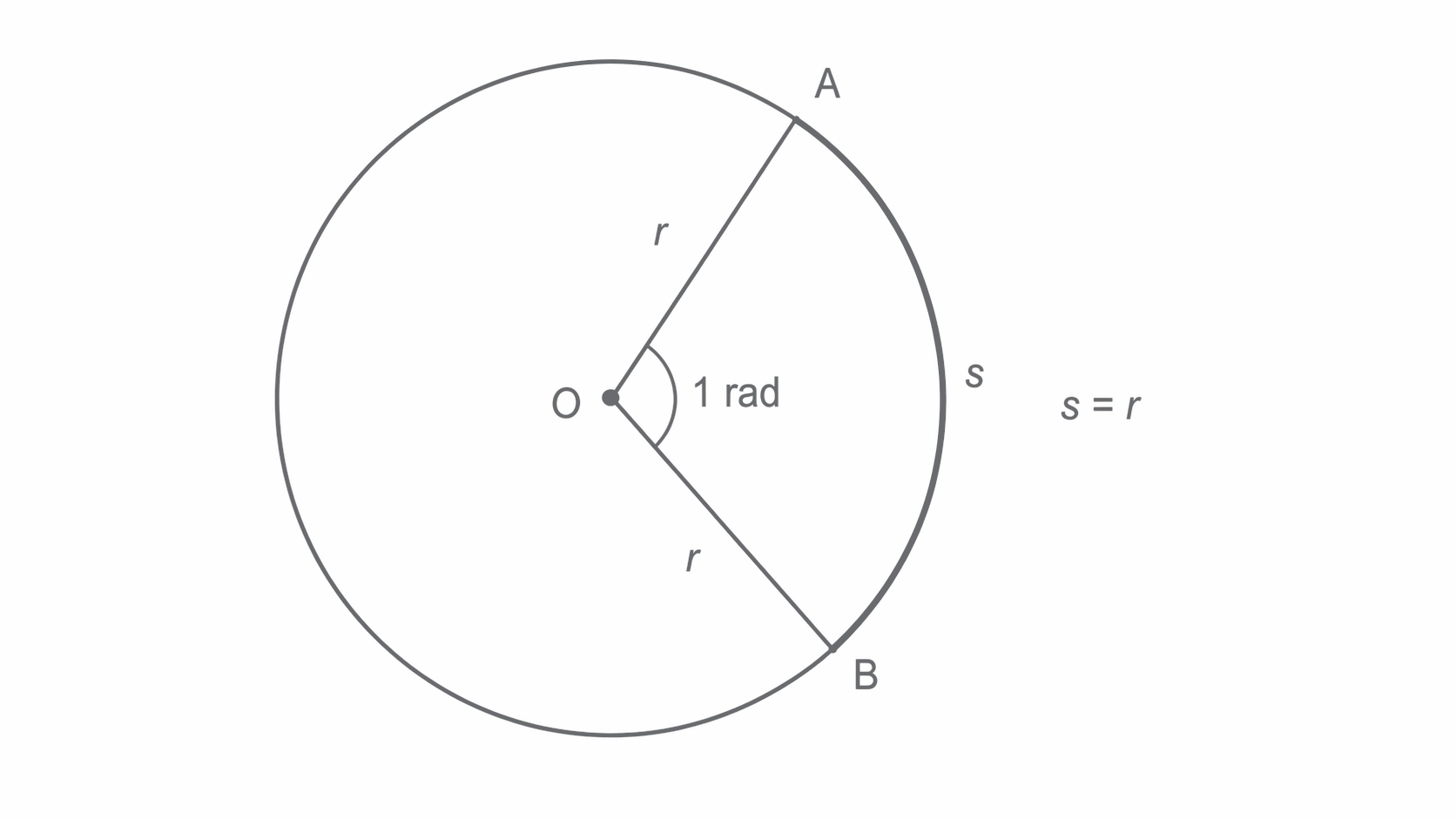
Because the circumference of a circle is , the number of radii that fit around the full circumference is . Therefore a complete revolution corresponds to rad.
Key conversions:
| Degrees | Radians |
|---|---|
To convert degrees to radians, multiply by . To convert radians to degrees, multiply by .
More generally, the angle (in radians) subtended by any arc of length on a circle of radius is:
This relationship is exact and dimensionless -- it is one reason the radian is so useful.
Angular Speed
When an object moves in a circle at a steady rate, we describe how fast it rotates using angular speed.
Angular Speed
Angular speed is the angular displacement per unit time. Its SI unit is rad s.
For one complete revolution the angular displacement is rad and the time taken is the period . Therefore:
Angular Speed
where is the frequency of rotation in Hz, and is the period in seconds.
Linking angular speed to linear speed
Consider a point on the rim of a wheel of radius . In one full revolution it travels a distance equal to the circumference, , in a time . Its linear (tangential) speed is therefore:
Relationship between linear and angular speed
Here is the linear speed in m s, is the angular speed in rad s, and is the radius of the circular path in metres. This equation can also be rearranged to give , which is the form quoted on the specification.
The London Eye has a diameter of 130 m and completes one revolution in 30 minutes. Using rad s, the linear speed of a capsule is m s -- a gentle walking pace, which is why passengers barely notice they are moving.
Now let us put these relationships to work with a calculation.
Centripetal Acceleration
An object moving in a circle at constant speed has a velocity that is continuously changing direction -- the velocity vector is always tangent to the circle. Because velocity is changing, the object is accelerating even though its speed is constant.
Centripetal Acceleration
Centripetal acceleration is the acceleration directed towards the centre of a circular path, arising from the continuous change in direction of the velocity of an object in circular motion. "Centripetal" means "centre-seeking".
In the velocity diagram below, notice that each velocity vector is tangent to the circle while the change in velocity, , points inward towards the centre, which is why the acceleration is centripetal.
[DIAGRAM: asset_name: 6.1.1 - Circular Motion - Diagram 2; asset_slug: 6.1.1 - Circular Motion - Diagram 2; recommended_method: retained_png; description: A circle with centre C. Two positions A and B are shown on the circumference, separated by a small angle. Velocity vectors and are drawn tangent to the circle at A and B respectively. A separate velocity vector triangle shows pointing towards the centre.]
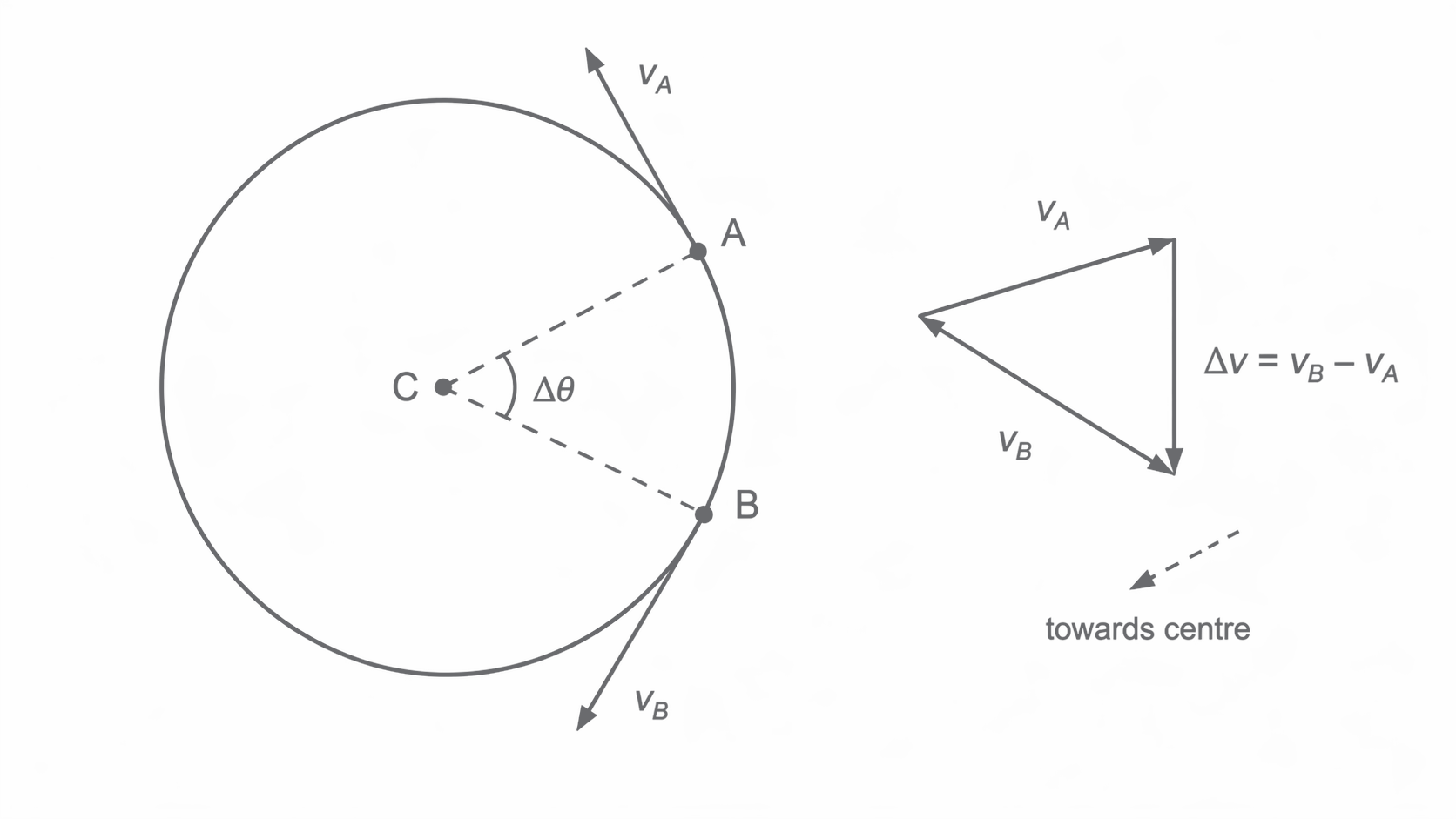
The magnitude of the centripetal acceleration is given by:
Centripetal Acceleration
where is the linear speed, is the radius, and is the angular speed. The two forms are equivalent because : substituting into gives .
Note: the AQA specification states that the derivation of will not be examined. You need to be able to use the formula, not prove it.
An object moving in a circle at constant speed is accelerating because the direction of its velocity is continuously changing. The acceleration is always directed towards the centre of the circle.
The centripetal acceleration of the London Eye capsules is tiny: m s, which is less than one ten-thousandth of . This is why the ride feels so smooth. Compare that with a hammer thrower: a 2.0 kg hammer on a 0.80 m rope completing one revolution in 0.60 s has rad s and m s -- about 9.
Centripetal Force
By Newton's first law, an object will travel in a straight line at constant speed unless acted on by a resultant force. An object moving in a circle is continuously changing direction, so a resultant force must be acting on it. By Newton's second law (), this force is in the same direction as the acceleration -- towards the centre of the circle.
Centripetal Force
The centripetal force is the resultant force acting on an object moving in a circle, directed towards the centre of the circular path. It is not a new type of force; it is provided by whatever force (or combination of forces) acts inward in a given situation.
Applying with gives:
Centripetal Force
where is the mass of the object in kg, is the linear speed in m s, is the radius in m, and is the angular speed in rad s.
It is essential to understand that "centripetal force" is not a separate force of nature. It is the label we give to whatever real force (or net force) provides the inward acceleration:
| Situation | What provides the centripetal force |
|---|---|
| Object on a string (horizontal circle) | Tension in the string |
| Car on a flat roundabout | Friction between tyres and road |
| Satellite orbiting Earth | Gravitational attraction |
| Electron in a magnetic field | Magnetic force |
| Car on a banked track (no friction) | Horizontal component of the normal contact force |
In the Large Hadron Collider at CERN, protons travel at speeds very close to the speed of light around a circular ring of circumference 27 km (radius approximately 4300 m). Superconducting electromagnets provide the magnetic force that acts as the centripetal force, bending the proton beam into its circular path. The faster the protons travel, the stronger the magnetic field must be to maintain the same radius of curvature.
An important consequence follows from the centripetal force being perpendicular to the velocity at every instant: because there is no component of force in the direction of motion, the centripetal force does no work on the object. Therefore the kinetic energy (and hence the speed) of the object remains constant. This is consistent with our starting assumption of uniform circular motion.
Applying Circular Motion
Many exam questions require you to identify the centripetal force in a given scenario and then apply or . The strategy is always the same:
- Draw a free-body diagram showing all real forces on the object.
- Identify the direction towards the centre of the circle.
- Write the resultant force in that direction equal to .
- Solve for the unknown.
Vehicle at the top of a hill
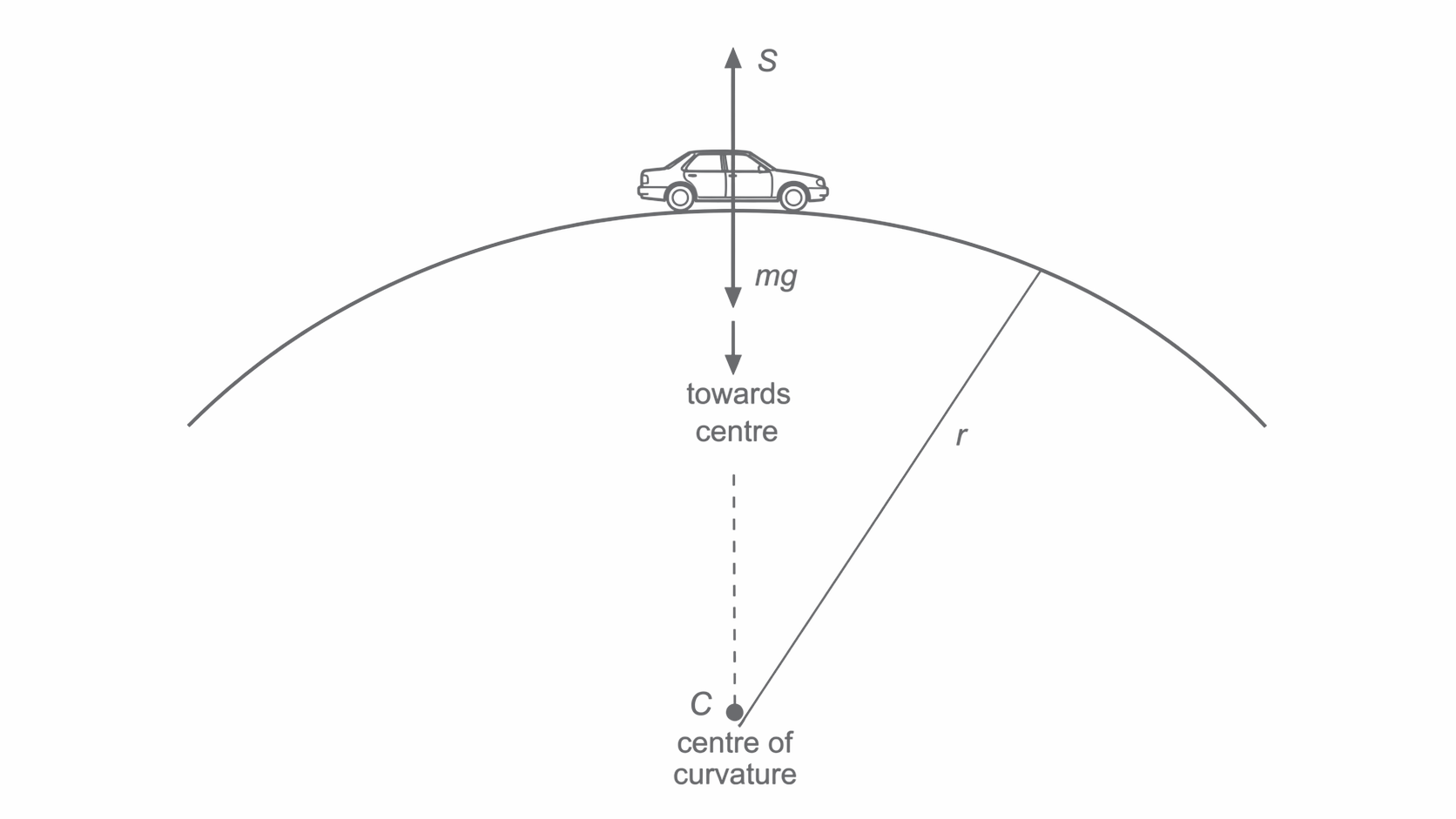
At the top of a hill of radius of curvature , the weight acts downward (towards the centre) and the normal contact force acts upward (away from the centre). The net inward force is:
If the vehicle goes fast enough that , it loses contact with the road. Setting :
The free-body diagram below is worth studying carefully: at the top of the hill the weight acts towards the centre, the support force acts away from it, and the downward resultant force is the centripetal force.
[DIAGRAM: asset_name: 6.1.1 - Circular Motion - Diagram 3; asset_slug: 6.1.1 - Circular Motion - Diagram 3; recommended_method: retained_png; description: A vehicle at the top of a curved hill. Weight acts downward, support force acts upward. An arrow points towards the centre of curvature (downward) labelled "towards centre". The radius of curvature is marked from the centre of the circular arc to the road surface.]
Vehicle on a flat roundabout
On a level roundabout of radius , the centripetal force is provided by the sideways friction between the tyres and the road:
If the speed exceeds the maximum value allowed by friction, the vehicle skids outward.
Object on the inside of a vertical loop (at the top)
At the highest point, both the weight and any contact force act downward (towards the centre):
The object just maintains contact when , giving as the minimum speed at the top of the loop.
These scenarios illustrate the same core method: resolve forces toward the centre, set the resultant equal to , and solve.
Now try an explanation question that tests your conceptual understanding.
Pulling It All Together
The key equations for circular motion are all connected. Starting from the definition of angular speed and the link , every other result follows by substitution and the application of Newton's second law:
| Quantity | Formula | Notes |
|---|---|---|
| Angular speed | Unit: rad s | |
| Linear speed | Unit: m s | |
| Centripetal acceleration | Always towards centre | |
| Centripetal force | Not a new type of force |
Remember: the centripetal force does no work (it is always perpendicular to the displacement), so the kinetic energy of the object remains constant in uniform circular motion.