3.2.1.2 - Stable and Unstable Nuclei
Every atomic nucleus contains protons packed tightly together, and since like charges repel, there must be something powerful enough to overcome this electrostatic repulsion and hold the nucleus together. In this lesson you will learn about the strong nuclear force, understand why some nuclei are stable while others are unstable, and write nuclear equations for alpha decay and beta-minus decay, including the role of the antineutrino.
Part 1 — The Strong Nuclear Force
The nucleus presents a puzzle. Protons are positively charged, so they repel one another electrostatically. Neutrons are uncharged. Yet nuclei hold together, often containing many nucleons in a tiny region only a few femtometres across. The force responsible is the strong nuclear force.
Strong Nuclear Force
The strong nuclear force is the attractive force that acts between all nucleons at short range, holding the nucleus together by overcoming the electrostatic repulsion between protons.
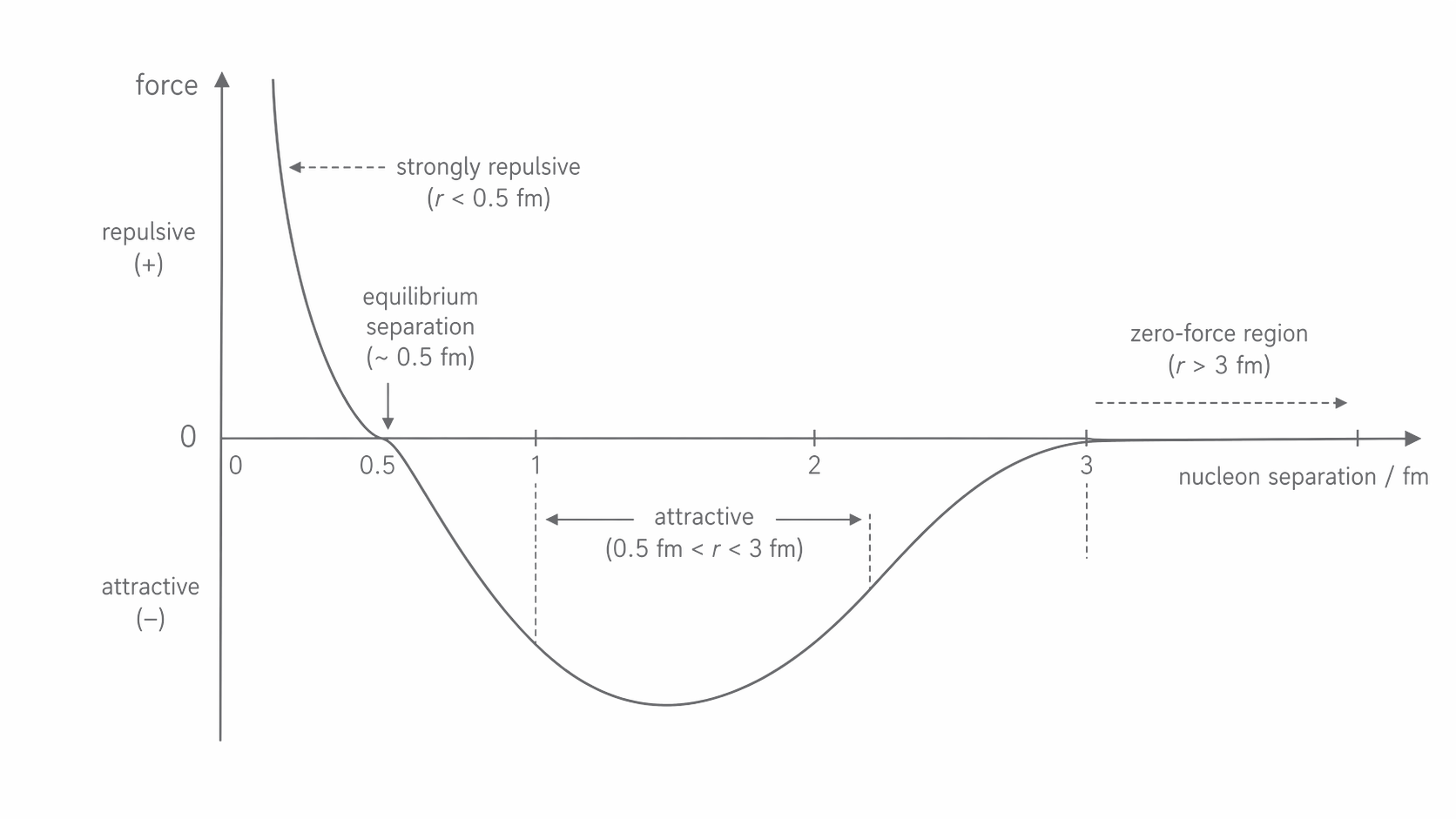
The strong nuclear force acts between proton-proton, proton-neutron, and neutron-neutron pairs. It is attractive for separations up to about 3 fm, but it becomes strongly repulsive when nucleons are pushed closer than about 0.5 fm. Beyond a few femtometres it falls effectively to zero, unlike the electrostatic force, which has infinite range. In the graph, notice the attractive region over typical nuclear separations, the steep repulsion at very short range, and the point where the force crosses zero.
[DIAGRAM: asset_name: 2.1.2 - Stable and Unstable Nuclei - Diagram 1; asset_slug: 2.1.2 - Stable and Unstable Nuclei - Diagram 1; recommended_method: retained_png; description: Graph of force against nucleon separation. Below about 0.5 fm the force is strongly repulsive, between about 0.5 fm and 3 fm it is attractive, and beyond about 3 fm it falls to zero. Mark an equilibrium separation where the curve crosses the axis.]
Part 2 — Why Some Nuclei Are Unstable
A stable nucleus is one that does not spontaneously disintegrate. For stability, the attractive strong nuclear force must be sufficient to balance the electrostatic repulsion between the protons.
Stable Nucleus
A stable nucleus is one that does not spontaneously decay because the strong nuclear force between its nucleons is sufficient to hold it together.
Large nuclei can become unstable because the strong nuclear force acts only over short distances, so each nucleon mainly interacts with nearby neighbours. The electrostatic repulsion between protons, however, acts across the whole nucleus. As the number of protons rises, the total repulsion can become too great.
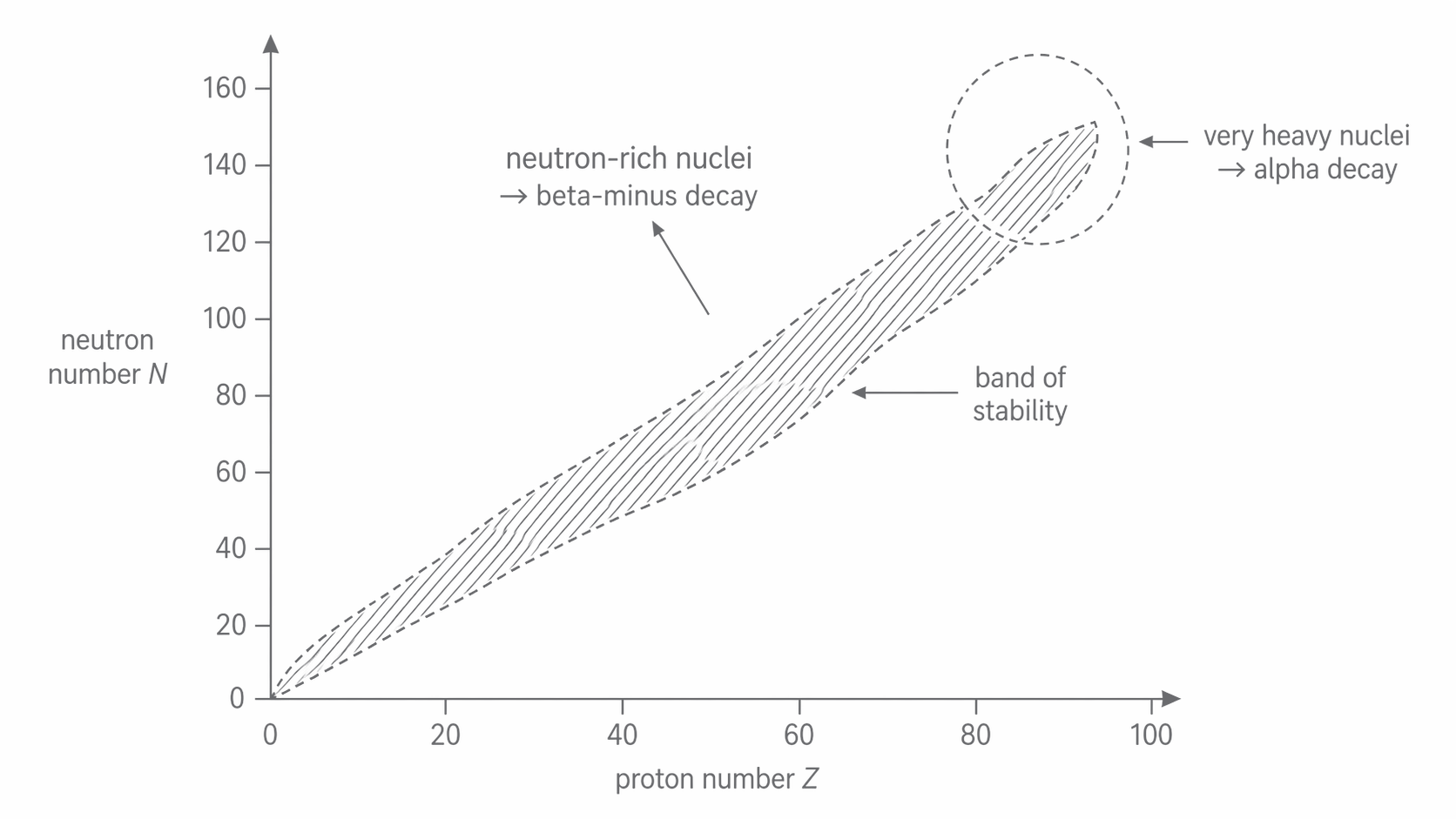
Nuclei can also become unstable if they have the wrong neutron-to-proton ratio. Neutron-rich nuclei often undergo beta-minus decay, while very large nuclei with too many nucleons often undergo alpha decay. In the figure, notice the central band of stable nuclei, the neutron-rich region above it, and the very heavy nuclei where alpha decay becomes common.
[DIAGRAM: asset_name: 2.1.2 - Stable and Unstable Nuclei - Diagram 2; asset_slug: 2.1.2 - Stable and Unstable Nuclei - Diagram 2; recommended_method: retained_png; description: A simplified neutron number against proton number plot. Show a band of stability, nuclei above the band labelled neutron-rich leading to beta-minus decay, and very heavy nuclei labelled alpha decay.]
Part 3 — Alpha Decay
Alpha decay occurs in large, heavy nuclei. The nucleus emits an alpha particle, which consists of two protons and two neutrons.
Alpha Particle
An alpha particle is a particle consisting of two protons and two neutrons, identical to a helium-4 nucleus, emitted from an unstable nucleus during alpha decay.
When a nucleus undergoes alpha decay, both its nucleon number and its proton number decrease.
Alpha Decay Equation
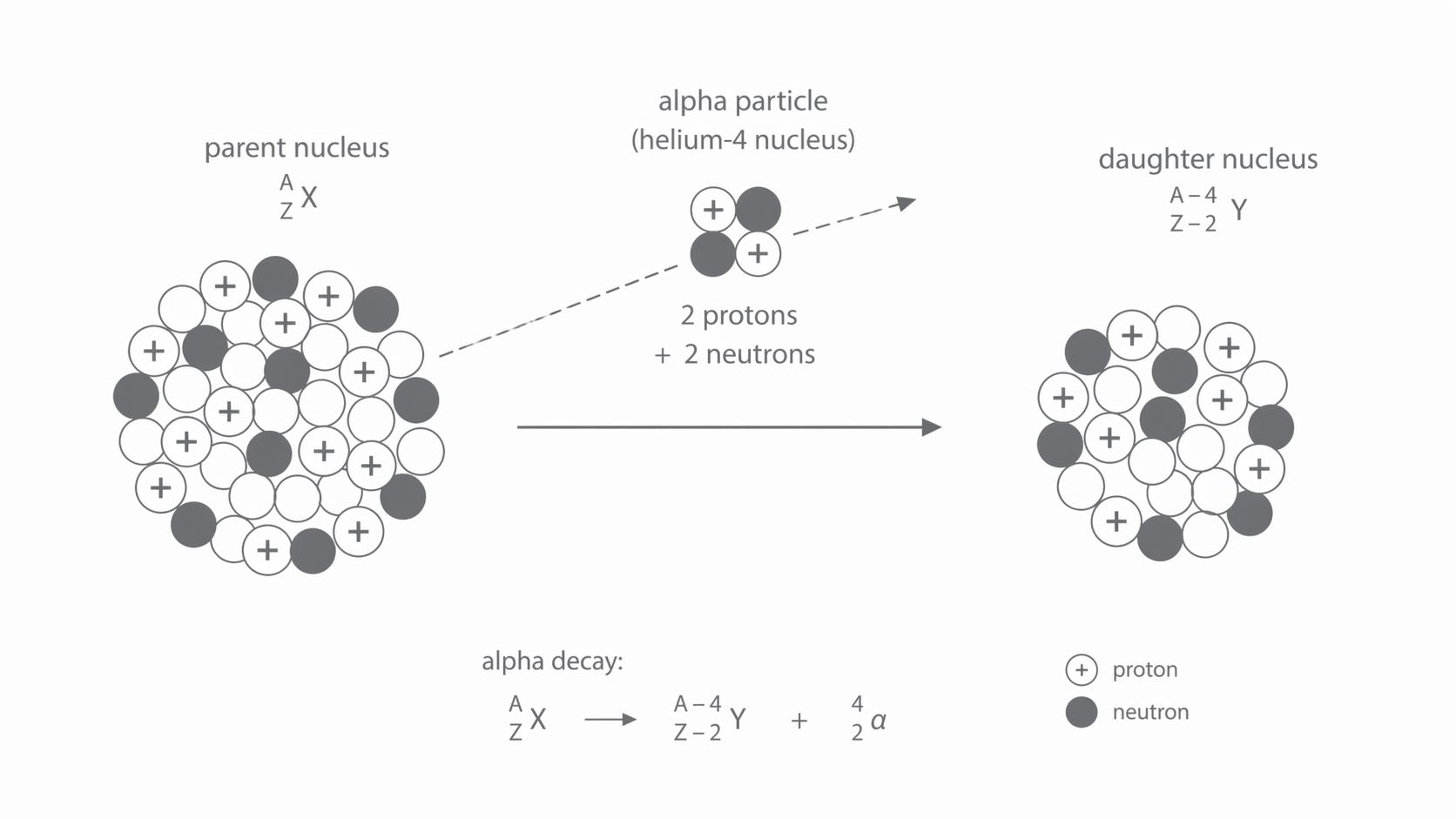
This means the daughter nucleus has four fewer nucleons and two fewer protons than the parent nucleus. Charge and nucleon number are both conserved across the equation. In the figure, notice the alpha particle leaving as a cluster of two protons and two neutrons, leaving the daughter nucleus with and .
[DIAGRAM: asset_name: 2.1.2 - Stable and Unstable Nuclei - Diagram 3; asset_slug: 2.1.2 - Stable and Unstable Nuclei - Diagram 3; recommended_method: retained_png; description: A parent nucleus emitting a cluster of two protons and two neutrons, leaving a daughter nucleus with nucleon number and proton number .]
Part 4 — Beta-Minus Decay and the Antineutrino
Beta-minus decay occurs in nuclei that are neutron-rich. In this process, a neutron in the nucleus changes into a proton and an electron is emitted. That emitted electron is called the beta-minus particle.
Beta-Minus Particle
A beta-minus particle is a fast-moving electron emitted from an unstable nucleus when a neutron changes into a proton.
At the nucleon level, the change is:
Neutron-Level Beta-Minus Decay
So a neutron becomes a proton, and the nucleus gains one proton while keeping the same total number of nucleons.
For a whole nucleus, the general beta-minus decay equation is:
Beta-Minus Decay Equation
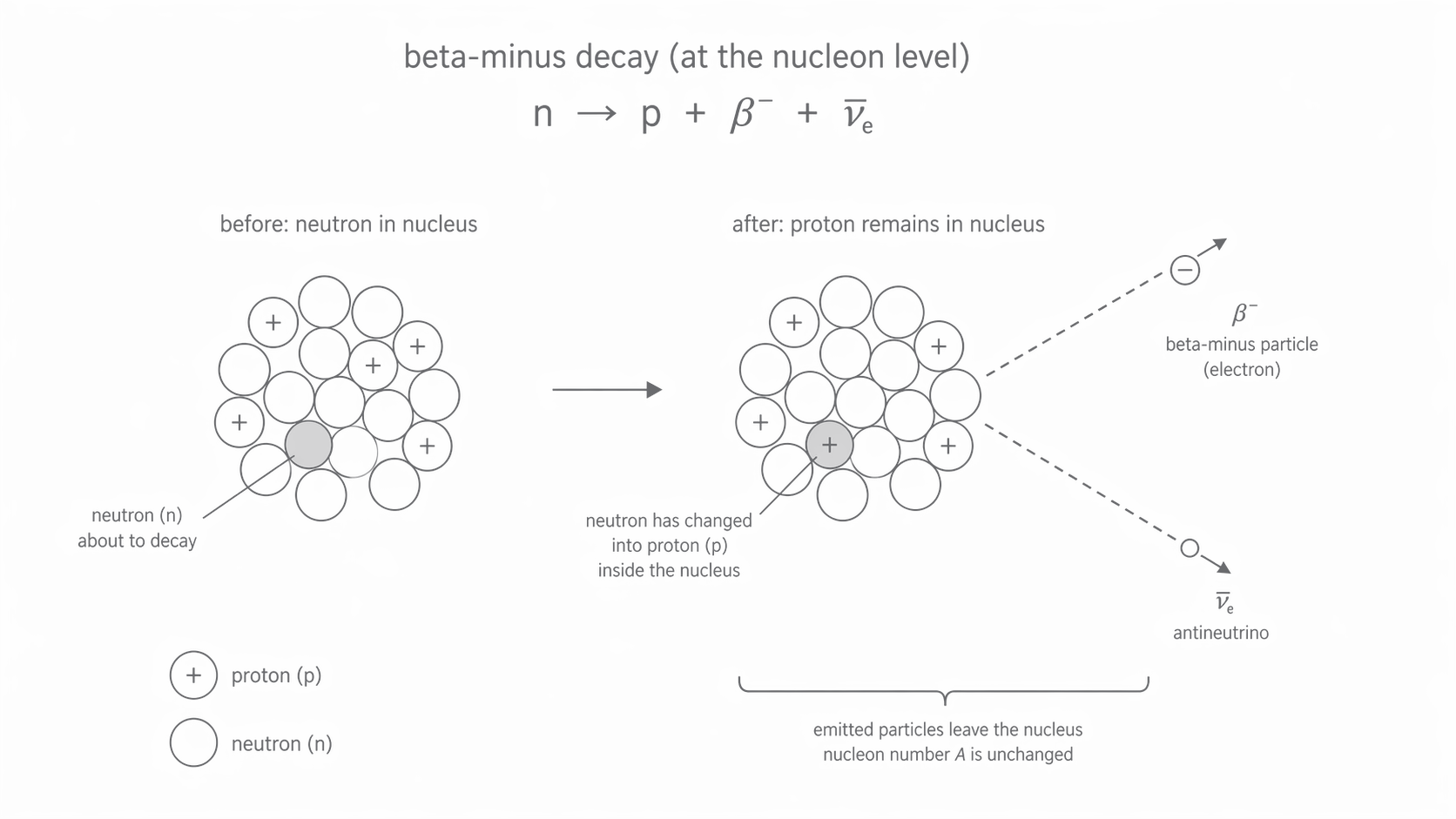
In beta-minus decay, the nucleon number stays the same, the proton number increases by 1, and the daughter nucleus is a different element. Charge is conserved because the extra proton in the nucleus is balanced by the emitted beta-minus particle. In the figure, notice that the neutron changes into a proton inside the nucleus while the electron and antineutrino leave, so the nucleon number stays the same.
[DIAGRAM: asset_name: 2.1.2 - Stable and Unstable Nuclei - Diagram 4; asset_slug: 2.1.2 - Stable and Unstable Nuclei - Diagram 4; recommended_method: retained_png; description: A nucleus with one neutron highlighted. The neutron turns into a proton that remains in the nucleus while an electron and an antineutrino are emitted away from the nucleus.]
When beta decay was first studied, scientists expected the emitted beta particle to carry a single fixed kinetic energy. Instead, they found a continuous range of energies. If only the electron were emitted, energy would not be conserved in most decays.
Wolfgang Pauli proposed that another particle must be emitted and must carry away some of the missing energy. This particle had to be electrically neutral and extremely difficult to detect.
Antineutrino
The antineutrino is an uncharged, nearly massless particle emitted in beta-minus decay. It was proposed to explain how energy is conserved when beta particles are emitted with a range of kinetic energies.
The antineutrino was later detected experimentally, confirming that beta-minus decay conserves energy after all.
Part 5 — Conservation Rules and Decay Equations in Practice
When writing any nuclear decay equation, two conservation rules must always be satisfied. The total nucleon number must be the same on both sides of the equation, and the total charge must also be the same on both sides.
Smoke detectors use americium-241, which undergoes alpha decay. The emitted alpha particles ionise the air inside the detector. If smoke enters, it reduces the ionisation and changes the current, triggering the alarm.
These same conservation ideas let you work through longer decay chains one step at a time.
Each step works because you are balancing nucleon number and charge, not because you are memorising isolated examples.
Part 6 — Comparing Alpha and Beta-Minus Decay
It is useful to summarise the main differences between the two decay types in this lesson.
| Property | Alpha Decay | Beta-Minus Decay |
|---|---|---|
| Emitted particle | and | |
| Change in nucleon number | Decreases by 4 | No change |
| Change in proton number | Decreases by 2 | Increases by 1 |
| Typical cause of instability | Very large nucleus | Too many neutrons |
| Underlying process | A helium-4 nucleus leaves the parent nucleus | A neutron changes into a proton |
The strong nuclear force keeps nuclei stable only over very short distances. If the balance between that force and electrostatic repulsion becomes unfavorable, the nucleus can decay. Alpha decay lowers both nucleon number and proton number, while beta-minus decay keeps the nucleon number the same but increases the proton number by 1 and includes an antineutrino to conserve energy.
Once you know which quantities are conserved and how and change, decay equations become a structured problem rather than something to memorise.