3.3.1.3 - Principle of Superposition of Waves and Formation of Stationary Waves
When two waves overlap, they do not stop being waves. They pass through each other, and at every point the displacements combine. That simple rule explains the formation of stationary waves on strings, with microwaves, and with sound, and it leads directly to the harmonic patterns and frequency equations used in this topic.
Part 1 — The Principle of Superposition
The starting point is the principle of superposition. If two waves meet at the same place at the same time, the resultant displacement is found by adding the individual displacements.
Principle of Superposition
When two or more waves overlap, the resultant displacement at any point is the vector sum of the individual displacements at that point.
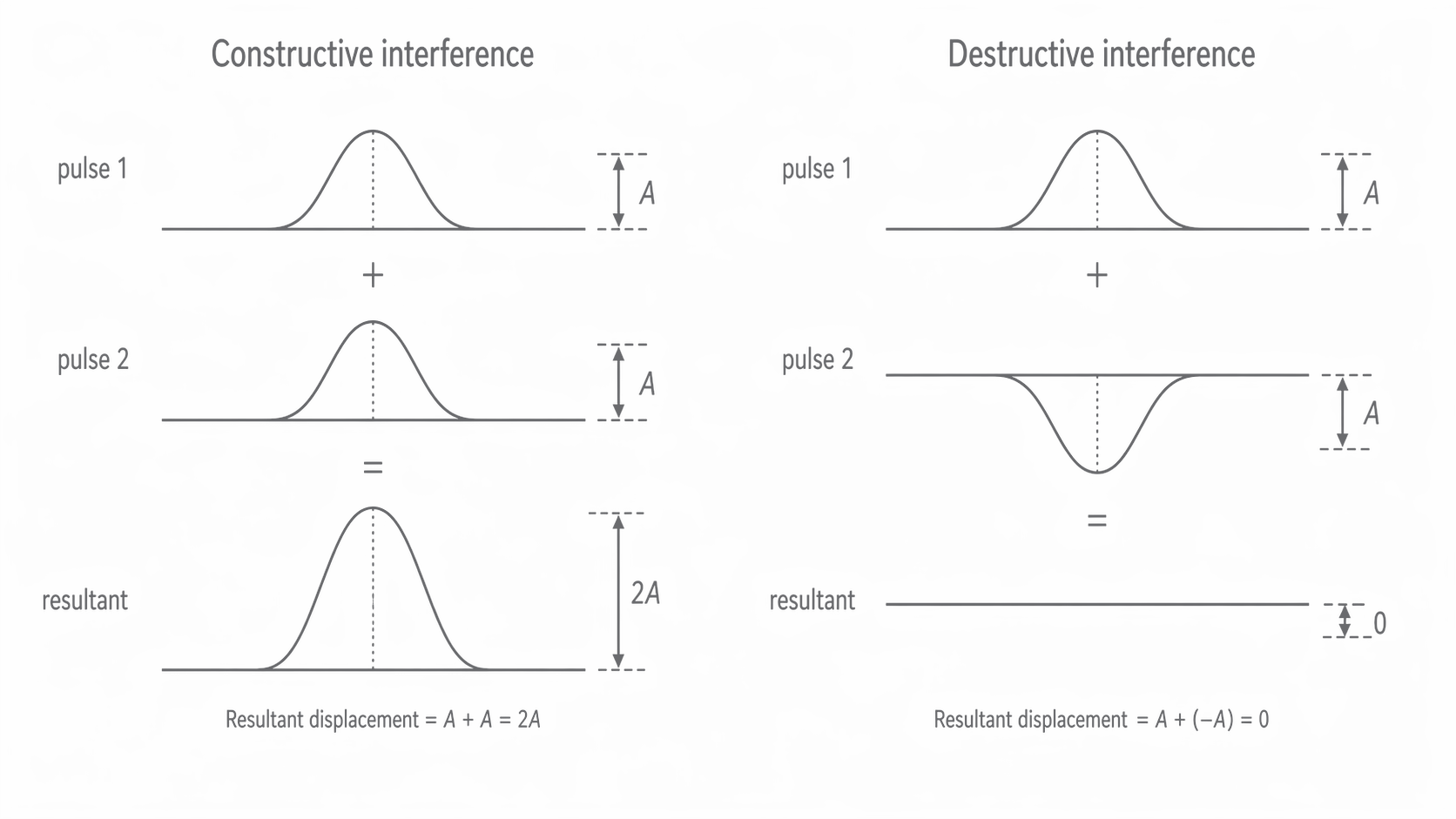
If the two displacements are in the same direction, the waves reinforce each other and the resultant displacement is larger. This is constructive interference. If the displacements are in opposite directions, the waves partially or completely cancel. This is destructive interference.
In the figure, notice that the resultant pulse at the overlap is the sum of the individual displacements at that instant.
[DIAGRAM: asset_name: 3.1.3 - Principle of Superposition of Waves and Formation of Stationary Waves - Diagram 1; asset_slug: 3.1.3 - Principle of Superposition of Waves and Formation of Stationary Waves - Diagram 1; recommended_method: retained_png; description: Two snapshots of overlapping pulses. First: two upward pulses meeting to form a larger upward pulse, labelled constructive interference. Second: an upward pulse and an equal downward pulse meeting to give zero resultant displacement, labelled destructive interference.]
This idea applies to every kind of wave. Stationary waves are just a particularly important case where the same interference pattern repeats in fixed positions.
Part 2 — How Stationary Waves Form
A stationary wave is formed when two progressive waves of the same frequency, wavelength, and amplitude travel in opposite directions through the same region. On a stretched string, one wave is usually the incident wave and the other is the reflected wave.
Stationary Wave
A wave pattern formed by the superposition of two progressive waves of the same frequency, wavelength, and amplitude travelling in opposite directions.
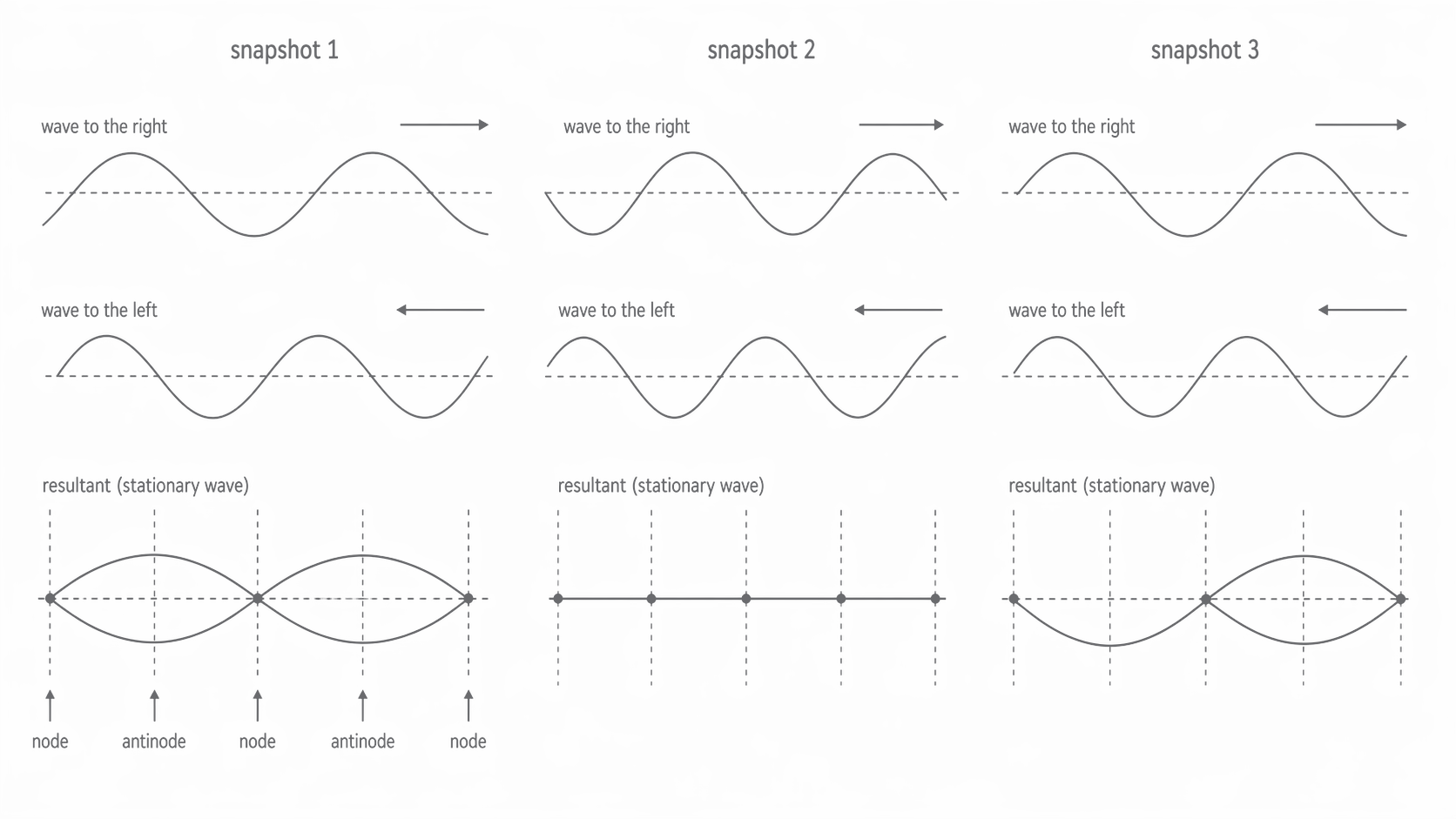
The graphical explanation is important. At some instants, the two waves are in phase and reinforce. A quarter of a cycle later, they are in antiphase and cancel. Because this happens in a regular way, fixed points of zero displacement and fixed points of maximum displacement appear along the medium.
Node
A point on a stationary wave that always has zero displacement.
The points of maximum oscillation are called antinodes.
Antinode
A point on a stationary wave where the amplitude of oscillation is maximum.
Adjacent nodes are separated by , and the same is true for adjacent antinodes. All particles between a given pair of adjacent nodes oscillate in phase, but particles separated by an odd number of nodes are in antiphase.
In the figure, follow how the two travelling waves combine at different instants to leave fixed nodes and antinodes in the resultant stationary pattern.
[DIAGRAM: asset_name: 3.1.3 - Principle of Superposition of Waves and Formation of Stationary Waves - Diagram 2; asset_slug: 3.1.3 - Principle of Superposition of Waves and Formation of Stationary Waves - Diagram 2; recommended_method: retained_png; description: Three snapshots of two equal progressive waves travelling in opposite directions on a string. Show the individual waves and the resultant stationary wave. Mark nodes at fixed positions and antinodes midway between them.]
The two progressive waves carry energy in opposite directions at equal average rates, so their energy transfers cancel and there is no net energy transfer along the stationary pattern. Energy is still present in the oscillating medium; a stationary wave is not a wave with no energy.
This is one of the clearest differences between stationary waves and progressive waves, which do transfer energy from place to place.
Part 3 — Harmonics on Strings
For a string fixed at both ends, there must always be a node at each end. That restriction means only certain wavelengths fit on the string, so stationary waves appear only at certain frequencies.
In the first harmonic, the string contains one loop, with an antinode in the middle and a node at each end. Since the string length is half a wavelength, and the frequency is .
In the second harmonic, the string contains two loops, so . In the third harmonic, there are three loops, and so on. In this course, you should describe these patterns as first harmonic, second harmonic, third harmonic, and so forth.
Harmonics on a String Fixed at Both Ends
Here, is the harmonic number, is the wave speed on the string, and is the vibrating length of the string.
In the figure, notice how each higher harmonic fits an extra half-wavelength into the same string length while keeping nodes at both fixed ends.
[DIAGRAM: asset_name: 3.1.3 - Principle of Superposition of Waves and Formation of Stationary Waves - Diagram 3; asset_slug: 3.1.3 - Principle of Superposition of Waves and Formation of Stationary Waves - Diagram 3; recommended_method: retained_png; description: Three strings of equal length fixed at both ends. First harmonic with one loop, second harmonic with two loops, third harmonic with three loops. Mark nodes and antinodes, and label the wavelength relationship for each pattern.]
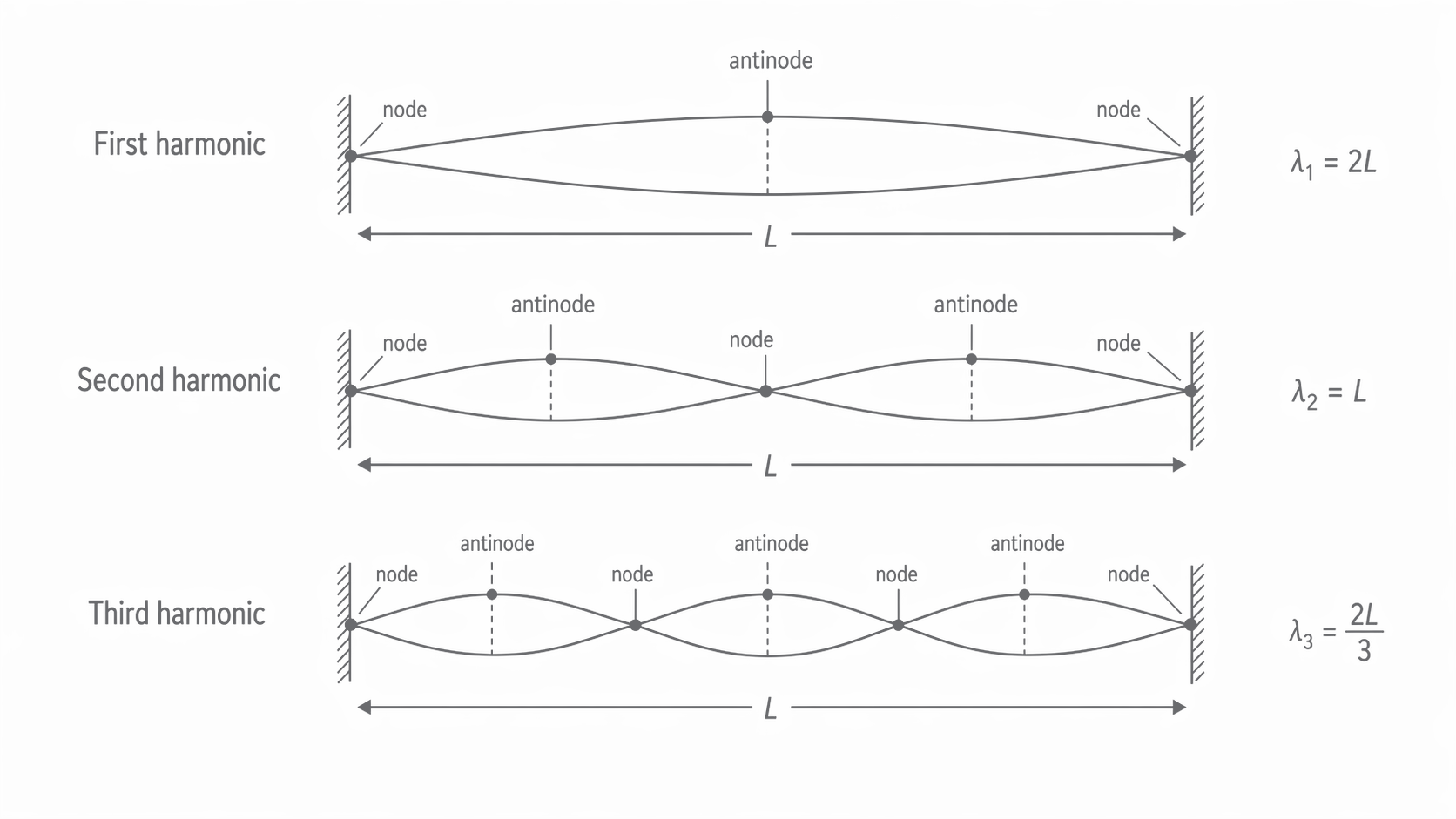
As the harmonic number increases, more loops fit onto the string, the wavelength becomes shorter, and the frequency becomes higher.
Part 4 — The First Harmonic Frequency Formula
The wave speed on a stretched string depends on the tension and the mass per unit length of the string. A larger tension increases the speed, while a larger mass per unit length decreases it.
Wave Speed on a String
Substituting this into the first-harmonic expression gives the formula required by the specification.
First Harmonic Frequency of a Vibrating String
In this equation, is the first harmonic frequency, is the vibrating length of the string, is the tension, and is the mass per unit length.
This equation explains why tightening a string raises the pitch, while using a heavier string lowers it.
Part 5 — Stationary Waves with Microwaves and Sound
Stationary waves are not confined to strings. If microwaves are directed at a metal reflector, the reflected microwaves superpose with the incident microwaves and form a stationary pattern. A detector moved along the line of the beam finds equally spaced minima and maxima. The spacing between adjacent minima, or adjacent maxima, is .
For sound, a loudspeaker and a reflecting surface can produce a stationary sound wave. In a tube, fine powder collects at the nodes because the air motion there is minimal, while the powder is disturbed near antinodes where the air motion is largest.
Stationary sound waves can be used to measure the speed of sound. If the distance between adjacent nodes is measured, the wavelength is twice that distance, and then the speed can be found from using the known frequency from the signal generator.
These examples matter because they show that stationary waves are a general consequence of superposition, not a special trick that only works on strings.
A moving detector or a line of powder turns the stationary-wave pattern into something you can observe directly, which is why these setups appear so often in practical questions.
If you can explain stationary waves as repeated superposition under fixed boundary conditions, then the harmonic formulas become much easier to remember and use.