3.4.1.6 - Momentum
Momentum links mass, velocity, force, and collisions in one framework. In this lesson, you will calculate momentum, use Newton's second law in momentum form, find impulse from force-time information, apply conservation of momentum in one dimension, and connect impact physics to safer and more ethical transport design.
Momentum as a Vector
Momentum tells you how much motion an object carries. It depends on both mass and velocity, which is why a slow heavy object can have the same momentum as a fast light one.
Momentum
Momentum is the product of mass and velocity.
The equation below is the compact form you will use in calculations.
Momentum
In this equation, is momentum in (or ), is mass in kilograms, and is velocity in . Momentum is a vector, so its direction is the same as the direction of motion.
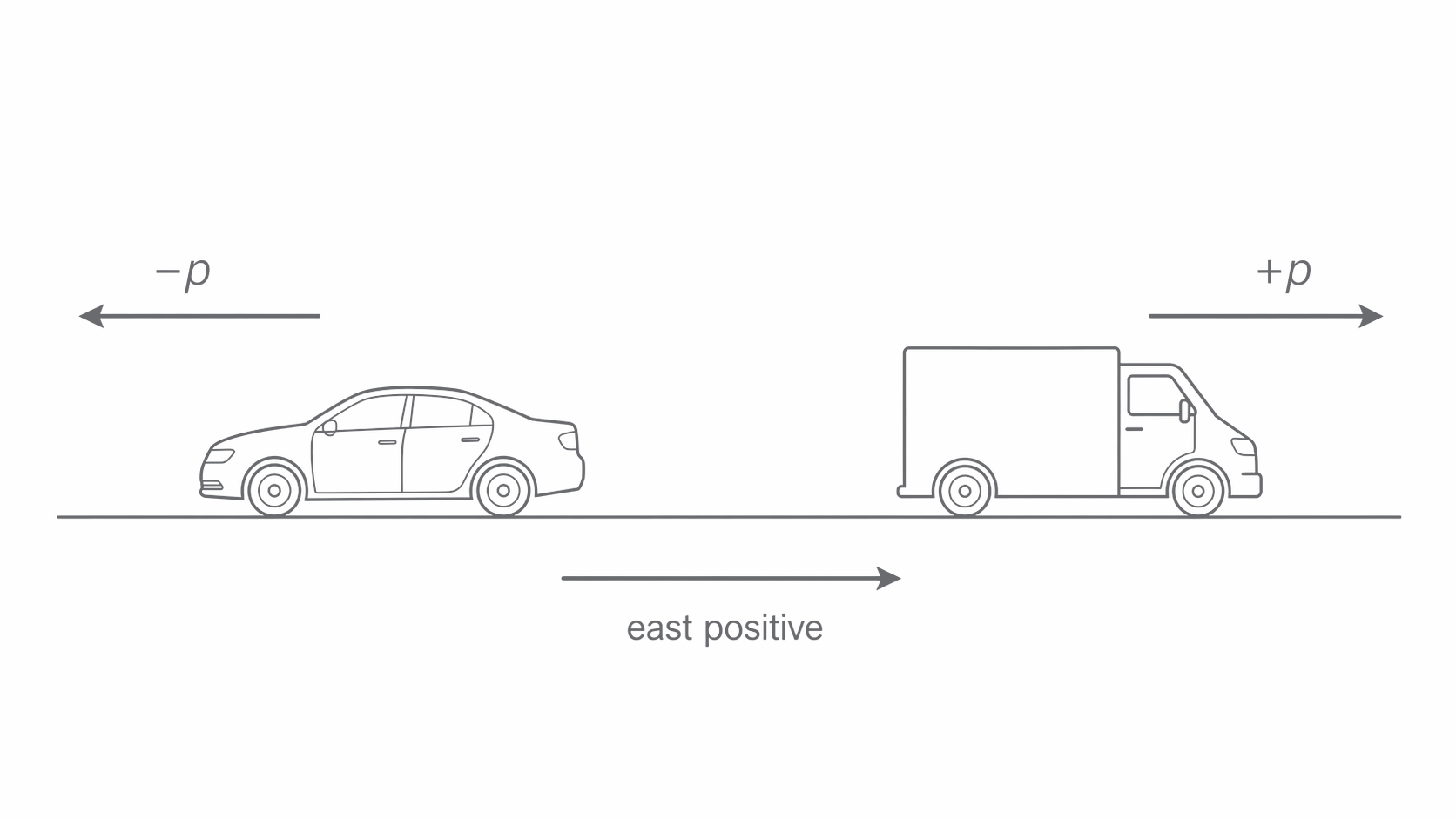
That means signs matter in one-dimensional questions. If you choose east as positive, an object travelling west has negative velocity and therefore negative momentum. Using signs consistently is what makes conservation of momentum calculations work cleanly. In the diagram below, notice that the rightward momentum is positive and the leftward momentum is negative because the sign comes from the chosen direction, not from the size of the momentum.
[DIAGRAM: asset_name: 4.1.6 - Momentum - Diagram 1; asset_slug: 4.1.6 - Momentum - Diagram 1; recommended_method: retained_png; description: Two vehicles on a straight road. One travels east and one west. Label east as positive and show one momentum arrow to the right and one to the left, with opposite signs.]
Force as the Rate of Change of Momentum
Newton's second law can be written in a more general way than . Instead of focusing first on acceleration, it treats force as the rate at which momentum changes.
Newton's Second Law in Momentum Form
If the mass stays constant, , so the equation becomes . That is why is a special case of the more general momentum form.
This form is especially useful when you want to connect a force directly to a stopping time, a take-off time, or any situation where the change in momentum is easier to calculate than the acceleration.
Because force depends on how quickly the momentum changes, a large change in momentum can still produce a modest force if it happens over a long enough time.
Impulse and Force-Time Graphs
Rearranging the momentum form of Newton's second law gives the impulse equation. It is useful whenever a force acts over a short time interval, such as in a kick, catch, or collision.
Impulse
Impulse is the product of force and the time for which it acts, and it is equal to the change in momentum.
For a constant force, that relationship is written as:
Impulse
If the force is constant, impulse is just force multiplied by time. If the force varies, you must find the area under the force-time graph instead. That area still represents the change in momentum.
So for a varying force, the graph itself becomes the calculation tool:
Area Under a Force-Time Graph
The graph below shows this area method in action. Notice that the impulse comes from the entire shaded region, including both triangular sections and the rectangular middle section.
[DIAGRAM: asset_name: 4.1.6 - Momentum - Diagram 2; asset_slug: 4.1.6 - Momentum - Diagram 2; recommended_method: retained_png; description: A force-time graph for a bat striking a ball. Force rises linearly from 0 N at 0 ms to 600 N at 4 ms, stays at 600 N until 6 ms, then falls linearly to 0 N at 10 ms. Shade the whole area under the graph.]
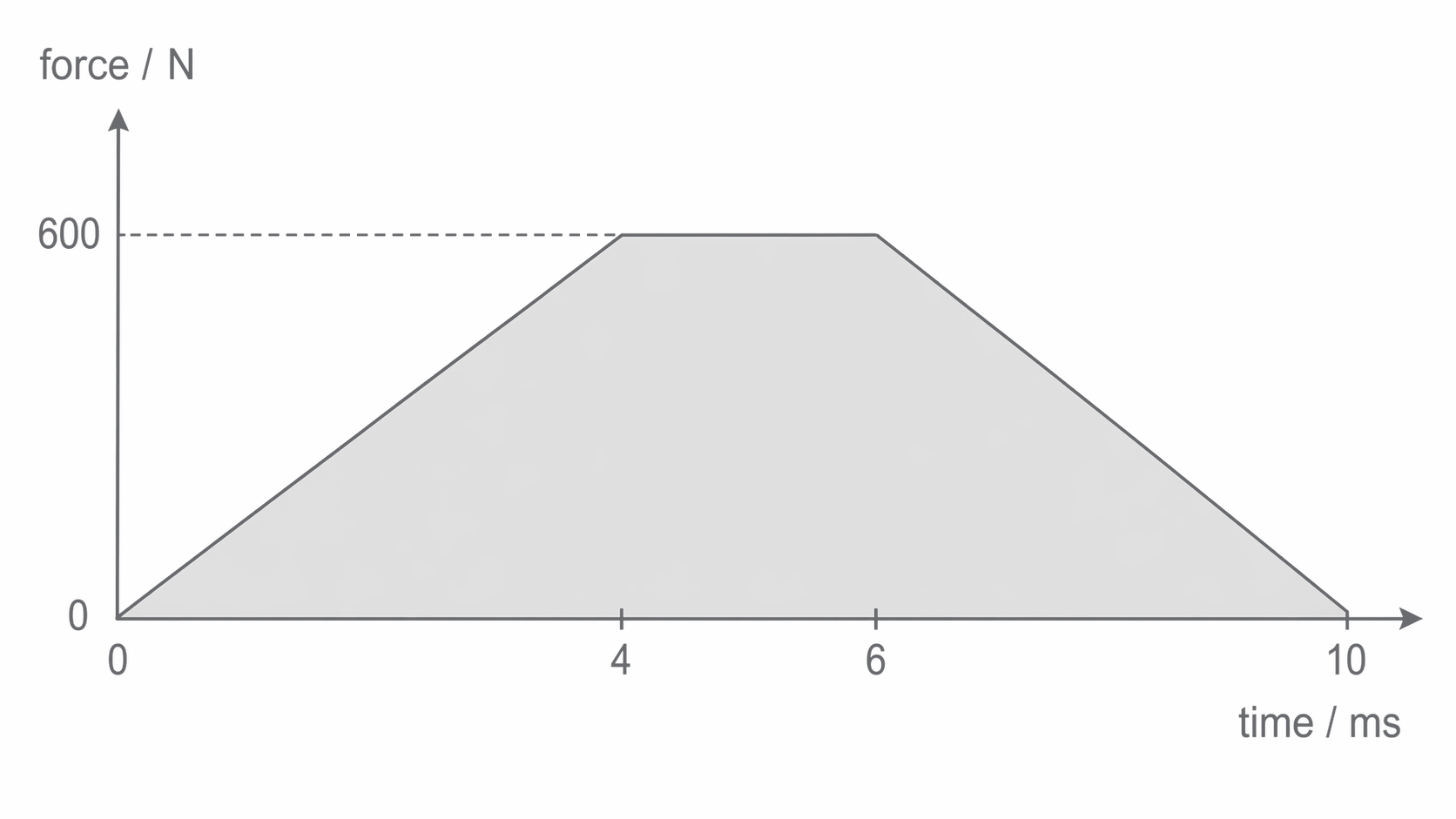
This matters because real impacts rarely have perfectly constant force. In practice, the force builds up, reaches a peak, and then falls away again, so the area method is the reliable way to find impulse.
When an object rebounds, be careful with direction. If the object reverses, the final momentum has the opposite sign, so the change in momentum is larger than if the object had simply stopped.
Conservation of Linear Momentum
If no external resultant force acts on a system, the total momentum of that system stays constant during an interaction. This is true for collisions, explosions, and recoil problems.
Conservation of Linear Momentum
The total momentum of a system remains constant provided no external resultant force acts on the system.
In one dimension, you usually apply it using the equation below.
Conservation of Momentum in One Dimension
This works best when you choose one positive direction at the start and keep it throughout. If two objects stick together after colliding, they share one common final velocity. If an object explodes from rest, the total momentum before is zero, so the momenta after must add to zero as well.
Momentum is always conserved in these interactions, but kinetic energy is not always conserved. In elastic collisions, both momentum and kinetic energy are conserved. In inelastic collisions, momentum is conserved but some kinetic energy is transferred to other forms such as heating, sound, or deformation.
Explosions follow the same rule in reverse. If a shell and gun start at rest, the momentum of the shell forward must be balanced by equal and opposite recoil momentum of the gun backward.
Impact Forces, Contact Time, and Safer Design
For a fixed change in momentum, increasing the time taken for the change reduces the average force. That is the central idea behind crumple zones, airbags, helmets, and protective packaging.
Elastic and Inelastic Collisions
In an elastic collision, both momentum and kinetic energy are conserved. In an inelastic collision, momentum is conserved but kinetic energy is not conserved.
If a passenger is brought to rest in a crash, their change in momentum is set by their mass and the change in velocity. Engineers cannot remove that change in momentum, but they can reduce the force on the passenger by making the stopping time longer and by spreading the force more safely across the body.
Ethical transport design uses momentum physics to reduce harm for everyone affected by a collision, not just the occupants of one vehicle. Crumple zones, seat belts, airbags, deformable bonnets, and side guards are all design choices that lengthen stopping time or redirect forces so pedestrians, cyclists, and passengers experience smaller impact forces.
The physics is simple but powerful: the same momentum change spread over a longer interval means a smaller force and usually a better chance of avoiding serious injury.