3.5.1.1 - Basics of Electricity
Electric current, potential difference, and resistance are the three foundation quantities for circuit physics. In this lesson, you will meet each quantity as a precise definition, learn the equation linked to it, and see how the three ideas connect when you solve simple circuit problems.
1. Electric Current
An electric current exists when charge carriers move through a complete circuit. In metals, the charge carriers are delocalised electrons. In electrolytes, the charge carriers are positive and negative ions.
Electric Current
Electric current is the rate of flow of charge. It is measured in amperes (A).
Current tells you how quickly charge passes a point. If a large amount of charge passes each second, the current is large. If only a small amount passes each second, the current is small.
Current-Charge Equation
Here, is current in amperes, is charge in coulombs, and is time in seconds. Rearranging gives . A charge of 1 coulomb passing each second is a current of 1 ampere.
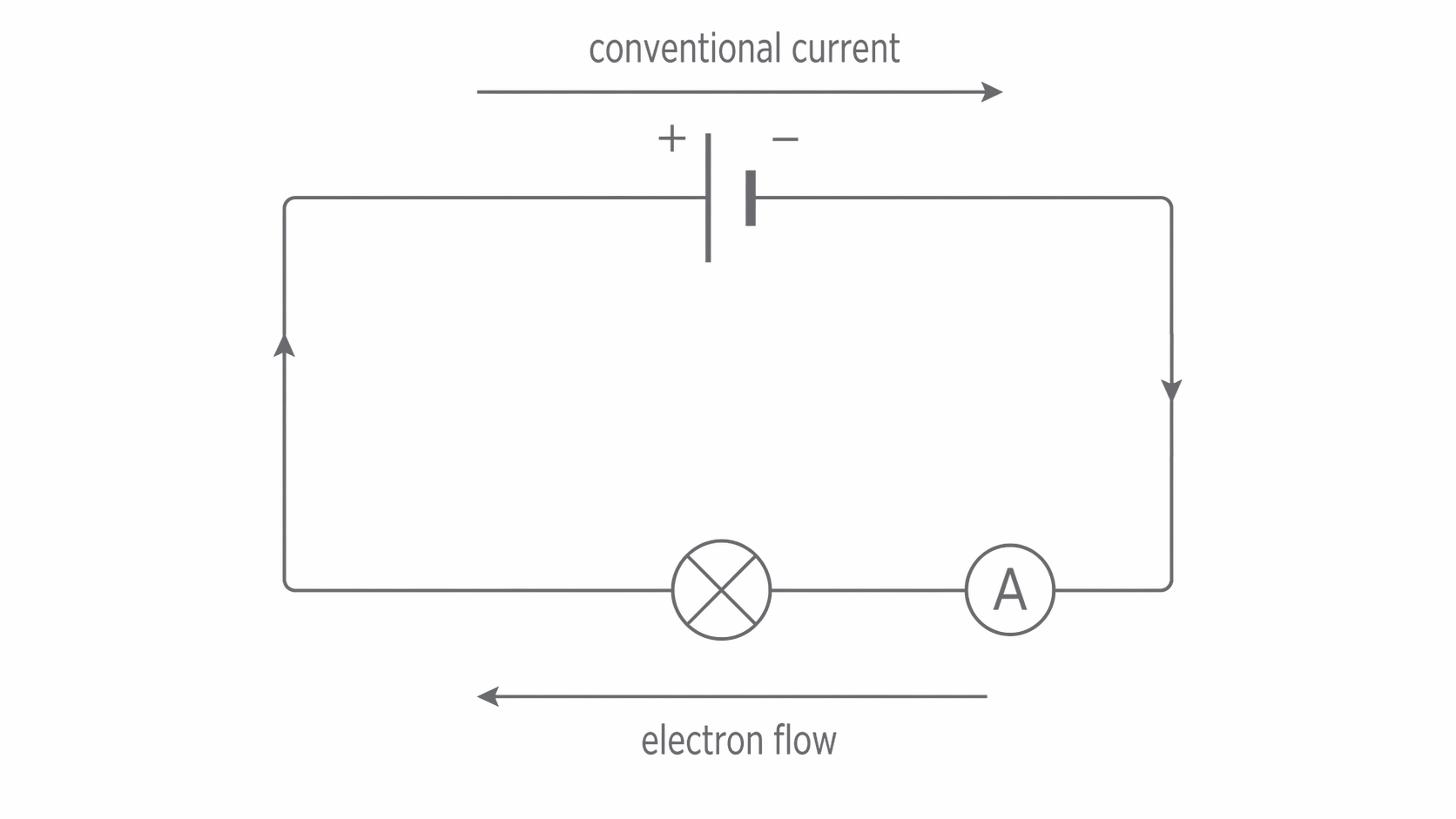
The direction of conventional current is defined as from positive to negative around the circuit. In a metal wire, the electrons actually move in the opposite direction, but exam questions use conventional current unless they explicitly ask about electron flow.
The circuit below makes that contrast clear; notice that the conventional current arrow runs from the positive terminal round the loop while the electron-flow arrow points the other way through the metal wire.
[DIAGRAM: asset_name: 5.1.1 - Basics of Electricity - Diagram 1; asset_slug: 5.1.1 - Basics of Electricity - Diagram 1; recommended_method: retained_png; description: A simple series circuit containing a cell, a lamp, and an ammeter. Show conventional current flowing from the positive terminal to the negative terminal, and electron flow in the opposite direction through the wire.]
2. Potential Difference
A source such as a battery transfers energy to charge carriers. As those charge carriers move through a component, they transfer energy to it. Potential difference tells you how much energy is transferred for each coulomb of charge.
Potential Difference
Potential difference is the work done or energy transferred per unit charge between two points in a circuit. It is measured in volts (V).
The volt is equivalent to one joule per coulomb, so . A larger potential difference means more energy is transferred to each coulomb of charge passing through the component.
Potential Difference Equation
In this equation, is potential difference in volts, is work done or energy transferred in joules, and is charge in coulombs. Rearranging gives , which is useful when you need the energy transferred by a known charge.
For example, if 3.0 C of charge passes through a lamp with a potential difference of 12 V across it, the energy transferred is J.
3. Resistance
When charge carriers move through a component, they collide with particles in the material. These collisions oppose the movement of charge and transfer energy to the material. Resistance is the quantity that measures this opposition to current.
Resistance
The resistance of a component is the potential difference across it divided by the current through it. It is measured in ohms ().
This is a definition, not a special law. It applies to any component, whether or not its resistance stays constant.
Resistance Equation
Here, is resistance in ohms, is potential difference in volts, and is current in amperes. Rearranging gives and .
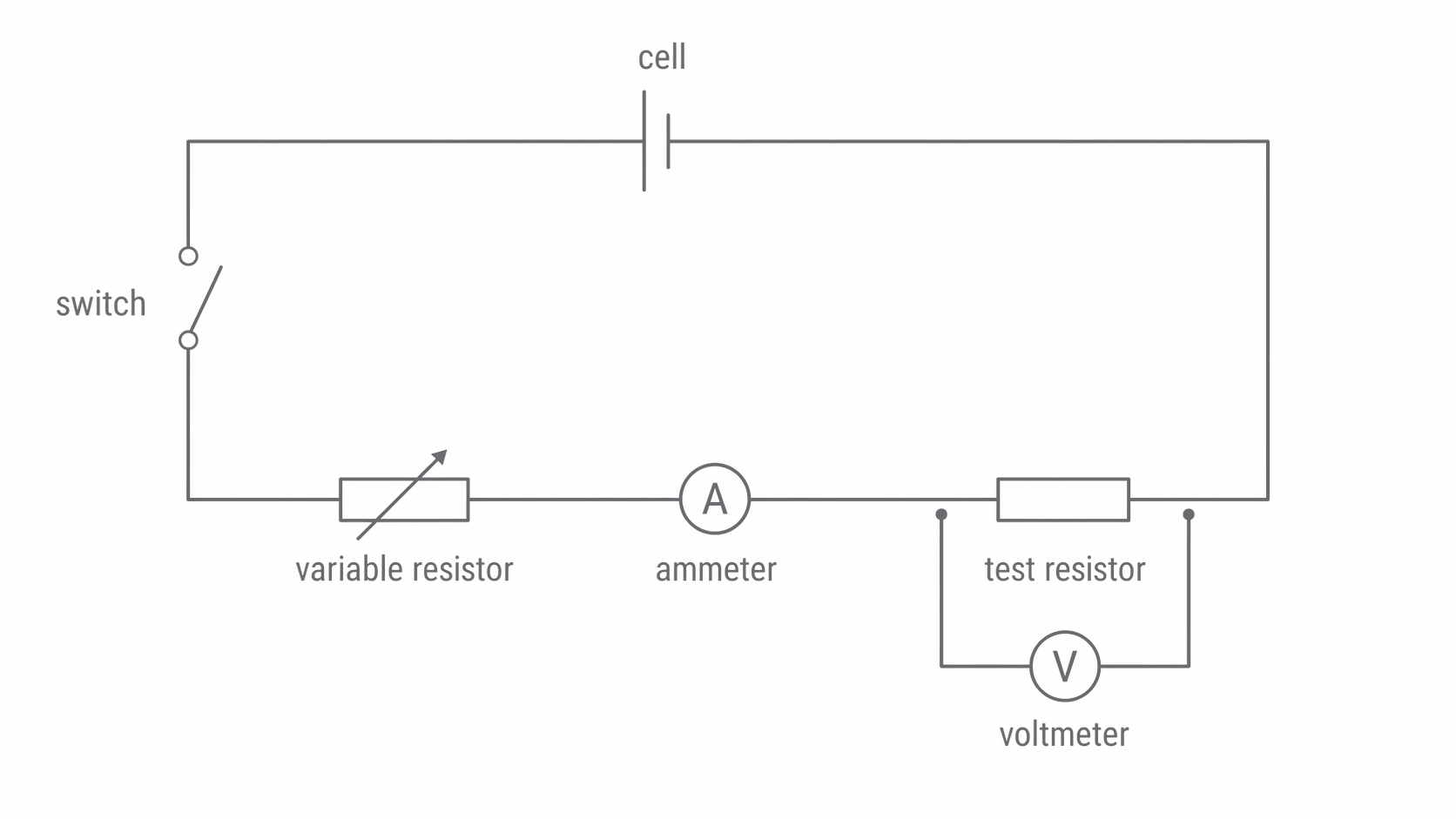
To measure the resistance of a component, place an ammeter in series with the component to measure the current through it, and place a voltmeter in parallel across the component to measure the potential difference across it.
In the circuit below, notice that the ammeter sits in series with the whole loop while the voltmeter is connected in parallel across the test resistor only.
[DIAGRAM: asset_name: 5.1.1 - Basics of Electricity - Diagram 2; asset_slug: 5.1.1 - Basics of Electricity - Diagram 2; recommended_method: retained_png; description: A circuit with a cell, switch, variable resistor, ammeter, and test resistor all in series. A voltmeter is connected in parallel across the test resistor.]
4. Connecting the Three Quantities
These three equations are often used together. Current tells you how quickly charge moves, potential difference tells you how much energy each coulomb transfers, and resistance compares the potential difference across a component with the current through it.
| Quantity | Definition equation | Unit |
|---|---|---|
| Current | ampere (A) | |
| Potential difference | volt (V) | |
| Resistance | ohm () |
In a multi-step problem, it helps to decide which quantity you can calculate first. For example, if you know current and time you can find charge, then use that charge with potential difference to find energy transferred.
If you can move confidently between these three equations, you have the core language needed for the rest of the electricity topic.