3.4.1.1 - Scalars and Vectors
Understanding the difference between scalar and vector quantities is fundamental to physics. Many physical quantities — such as force, velocity, and displacement — require both a magnitude and a direction to be fully described. In this lesson, you will learn to distinguish scalars from vectors, add vectors by calculation and scale drawing, resolve vectors into perpendicular components, and apply these skills to analyse equilibrium conditions.
Part 1 — Scalars and Vectors: Definitions and Examples
A physical quantity is something that can be measured. These quantities fall into two categories depending on whether direction matters.
Scalar and Vector Quantities
Scalar: A physical quantity that has magnitude only.
Vector: A physical quantity that has both magnitude and direction.
Knowing whether a quantity is a scalar or a vector changes how you work with it mathematically. You can add scalars using ordinary arithmetic, but vectors must be added using methods that account for direction.
The table below shows standard examples you should be comfortable recognising:
| Scalar | Vector |
|---|---|
| Distance | Displacement |
| Speed | Velocity |
| Mass | Force / Weight |
| Temperature | Acceleration |
| Energy | Momentum |
Notice how several scalar–vector pairs are closely related. Speed is the magnitude of velocity. Distance is the magnitude of displacement. Mass is a scalar, but weight (the gravitational force on a mass) is a vector because it acts downwards.
Every vector has a corresponding scalar magnitude — for example, the magnitude of a velocity vector is its speed. However, a scalar never has an associated direction.
Any vector can be represented by an arrow. The length of the arrow is proportional to the magnitude, and the arrow points in the direction of the vector.
Part 2 — Adding Vectors by Calculation (Perpendicular Vectors)
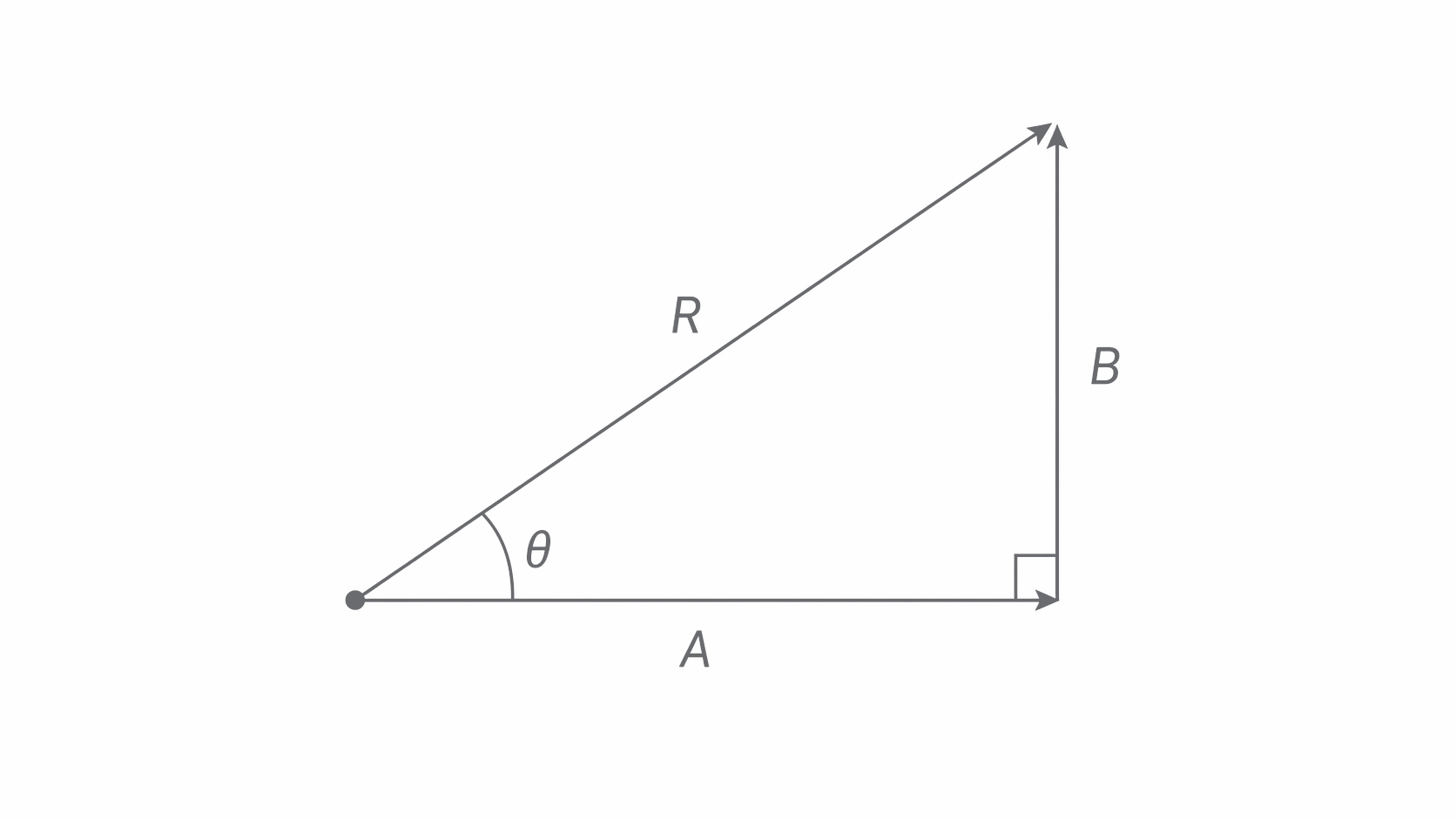
When two vectors act at right angles to each other, you can find their resultant using Pythagoras' theorem and trigonometry. This is the standard method for perpendicular vectors.
Resultant of Two Perpendicular Vectors
For two perpendicular vectors and , the resultant is:
The angle between the resultant and vector is:
The resultant is the single vector that has the same effect as the two original vectors combined. It forms the hypotenuse of the right-angled triangle whose other two sides are the original vectors.
In the figure below, notice how the two perpendicular component vectors make the shorter sides of the triangle and the resultant becomes the diagonal between them.
[DIAGRAM: asset_name: 4.1.1 - Scalars and Vectors - Diagram 1; asset_slug: 4.1.1 - Scalars and Vectors - Diagram 1; recommended_method: retained_png; description: A right-angled vector triangle with horizontal vector A, vertical vector B, and hypotenuse R. The angle theta is marked between R and A.]
Worked Example: Two forces act on an object at right angles — a horizontal force of 12 N and a vertical force of 5 N. Find the magnitude and direction of the resultant force.
Step 1: Sketch the vector triangle. The two forces form the shorter sides of a right-angled triangle.
Step 2: Use Pythagoras' theorem to find the magnitude:
Step 3: Use trigonometry to find the direction:
Step 4: State the direction clearly — the resultant is 13 N at 22.6° above the horizontal.
Always state the angle relative to a reference direction (e.g. "from the horizontal" or "from the 12 N force"). A bare angle without a reference is meaningless.
Note that when two vectors act along the same line, the resultant is simply their sum (if in the same direction) or their difference (if in opposite directions). For example, forces of 6.0 N and 4.0 N in the same direction give a resultant of 10.0 N, while in opposite directions they give 2.0 N in the direction of the larger force.
Part 3 — Adding Vectors by Scale Drawing
When two vectors are not at right angles, you cannot simply use Pythagoras' theorem. Instead, the standard approach is to use a scale drawing with a ruler and protractor.
The method uses the tip-to-tail rule:
- Choose a suitable scale (e.g. 1 cm = 10 N or 1 cm = 5 m).
- Draw the first vector as an arrow to scale, in the correct direction.
- From the tip of the first arrow, draw the second vector to scale at the correct angle.
- The resultant is the arrow drawn from the tail of the first vector to the tip of the second vector.
- Measure the length of the resultant arrow and convert using your scale. Measure the angle with a protractor.
In the figure below, focus on the tip-to-tail construction and on the way the resultant links the very start of the first vector to the very end of the second.
[DIAGRAM: asset_name: 4.1.1 - Scalars and Vectors - Diagram 2; asset_slug: 4.1.1 - Scalars and Vectors - Diagram 2; recommended_method: retained_png; description: Tip-to-tail vector addition showing vector OA followed by vector AB, with resultant OB drawn from start of first to end of second, forming a triangle.]
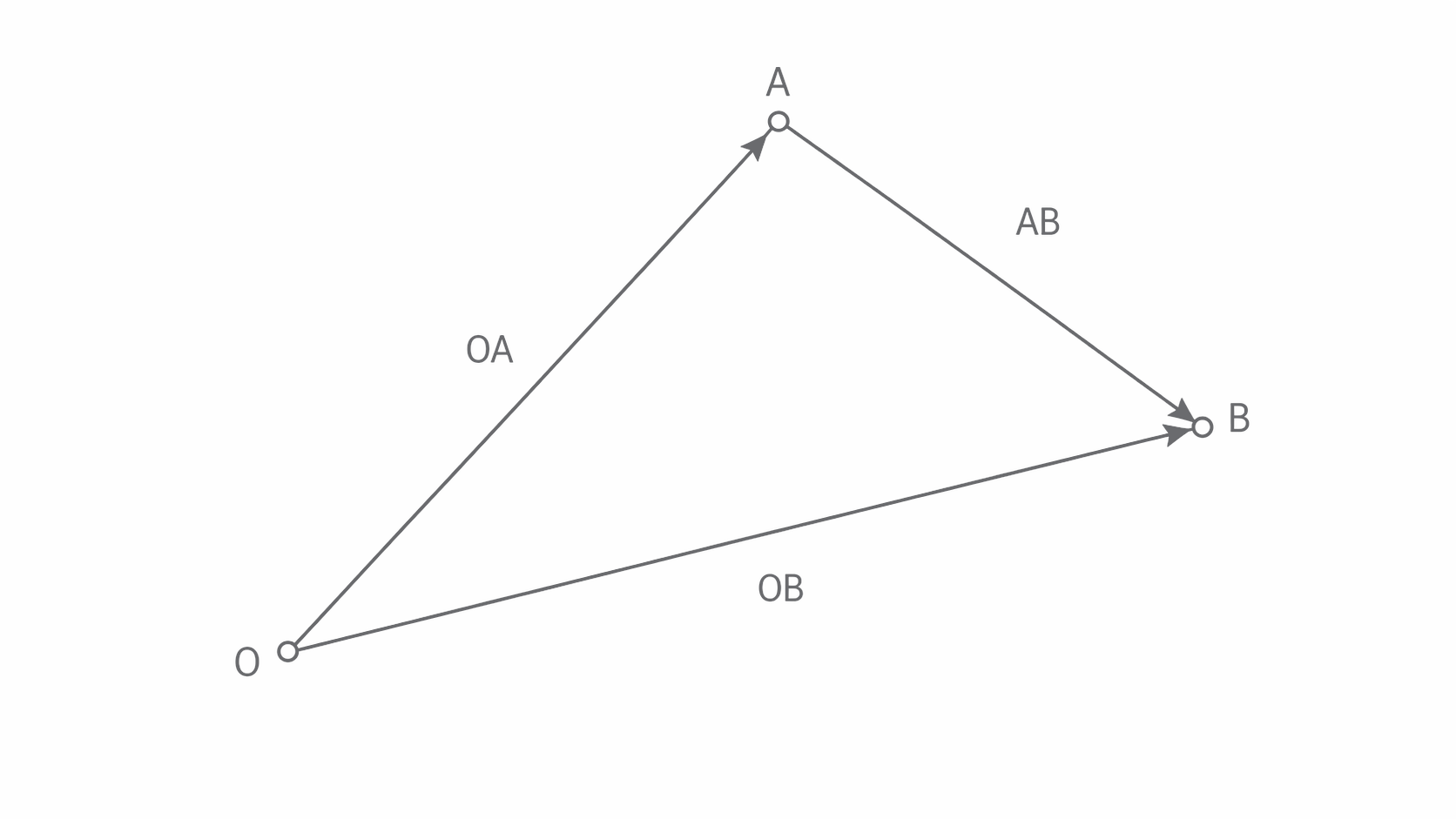
This triangle of vectors is sometimes drawn as a parallelogram — place both vectors tail-to-tail, complete the parallelogram, and the diagonal from the common tail gives the resultant. Both methods give the same answer.
Example: A ship travels 30 m on a bearing of 060°, then 20 m due east. Using a scale drawing (e.g. 1 cm = 10 m), you would draw the first displacement at 060° to north, then from its tip draw 20 m due east. Measuring the resultant gives approximately 49 m on a bearing of 072°.
Scale drawings in practice: Always write down your chosen scale, use a sharp pencil, and measure carefully. The accuracy of your answer depends on the precision of your drawing.
For the closed triangle test of equilibrium (covered in Part 5), the same drawing technique is used — if three force vectors placed tip-to-tail form a closed triangle, the forces are in equilibrium.
Part 4 — Resolving Vectors into Perpendicular Components
Resolving is the reverse of adding — you split a single vector into two perpendicular components. This is extremely powerful because perpendicular components act independently of each other.
Resolving a Vector into Perpendicular Components
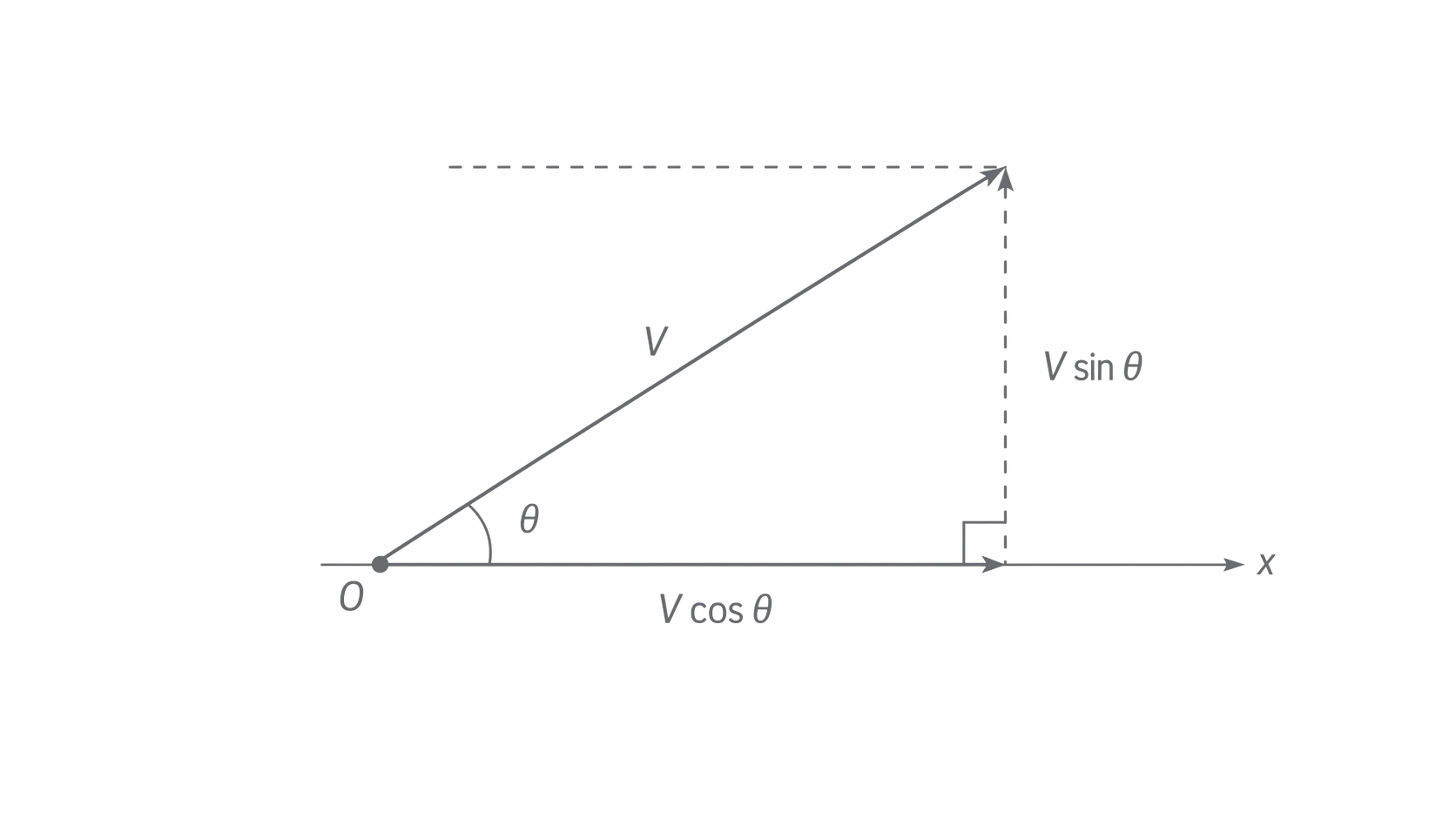
For a vector at angle to the horizontal:
Horizontal component:
Vertical component:
The angle is always measured between the vector and the component you are finding with cosine.
The rule is straightforward: the component adjacent to the angle uses cosine, and the component opposite the angle uses sine. This follows directly from the definitions of sine and cosine in a right-angled triangle.
In the figure below, notice that the original vector and its two components form a right-angled triangle, which is why cosine gives the horizontal side and sine gives the vertical side.
[DIAGRAM: asset_name: 4.1.1 - Scalars and Vectors - Diagram 3; asset_slug: 4.1.1 - Scalars and Vectors - Diagram 3; recommended_method: retained_png; description: A vector V at angle theta to the horizontal. The horizontal component V cos theta runs along the x-axis, and the vertical component V sin theta runs up the y-axis. A dashed right-angled triangle connects them.]
Worked Example: A ball is launched at 10 m s at 30° above the horizontal. Find the horizontal and vertical components of its velocity.
The ball moves at 8.7 m s horizontally and 5.0 m s vertically upward.
A helpful tip: if you move through the angle from the original vector to reach the component, use . If you move away from the angle to reach the component, use .
Now consider a harder scenario — forces on an inclined plane.
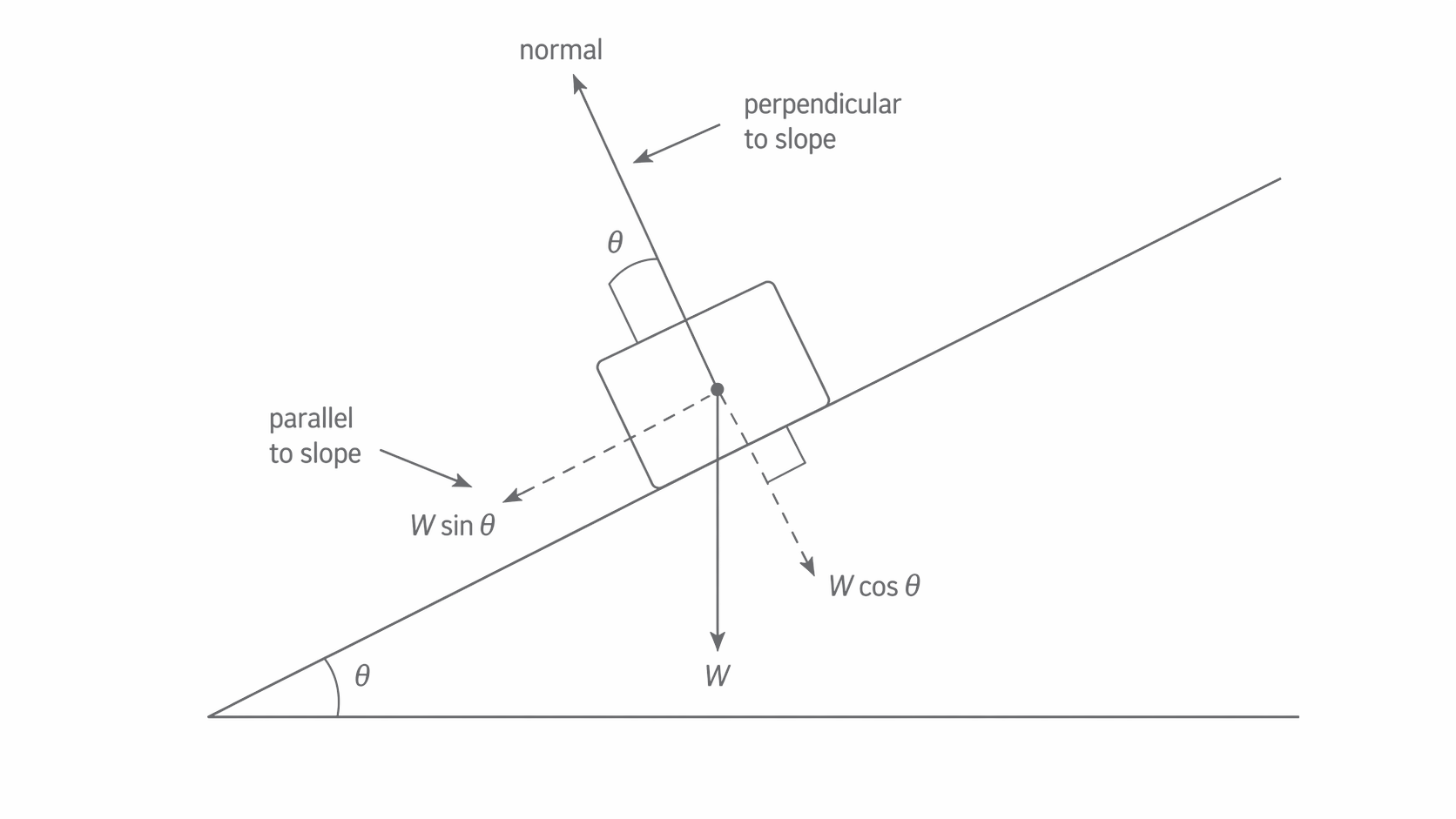
Forces on an Inclined Plane: When an object of weight sits on a slope at angle to the horizontal, you resolve the weight into two components:
- Parallel to the slope (pulling the object down the slope):
- Perpendicular to the slope (pushing into the surface):
Note: the angle between the weight vector and the line perpendicular to the slope equals the angle of incline . This is a key geometric result you should be able to derive.
The figure below is worth studying carefully because it shows the equal angle and makes clear why the weight resolves into one component parallel to the slope and one perpendicular to it.
[DIAGRAM: asset_name: 4.1.1 - Scalars and Vectors - Diagram 4; asset_slug: 4.1.1 - Scalars and Vectors - Diagram 4; recommended_method: retained_png; description: A block resting on a plane inclined at angle to the horizontal. Show the weight acting vertically downward from the centre of the block. Resolve into a component parallel to the slope acting down the plane and a component perpendicular to the slope acting into the plane. Draw the normal to the plane, mark the equal angle between the weight vector and the normal, and label the axes parallel and perpendicular to the slope.]
Worked Example: A block of weight 50 N rests on a plane inclined at 15° to the horizontal. Find the components of the weight parallel and perpendicular to the slope.
The angle between the weight (vertically downward) and the perpendicular to the slope is 15°.
The component pulling the block down the slope is 12.9 N, and the component pushing into the surface is 48.3 N.
Resolving vectors is essential for projectile motion, inclined plane problems, and equilibrium analysis — it reappears throughout mechanics.
Part 5 — Conditions for Equilibrium
In this lesson, the equilibrium condition is being applied to two or three coplanar forces acting at a point. For a point object, equilibrium means there is no resultant force, so the object is either at rest or moving with constant velocity. For extended bodies, balanced moments matter as well, but that is a separate condition studied later.
Equilibrium
Equilibrium: For a point object, equilibrium means the vector sum of all forces acting on it is zero.
There are two methods to show that coplanar forces acting at a point are in equilibrium:
Method 1 — Resolving forces: Resolve all forces into horizontal and vertical components. For equilibrium:
If the sum of all horizontal components is zero AND the sum of all vertical components is zero, the object is in equilibrium.
Method 2 — Closed triangle of forces: If exactly three coplanar forces act at a point, draw them tip-to-tail as a scale diagram. If the three vectors form a closed triangle (the tip of the third arrow meets the tail of the first), the forces are in equilibrium.
In the figure below, notice that the last vector ends exactly where the first began, showing that the three forces add to zero overall.
[DIAGRAM: asset_name: 4.1.1 - Scalars and Vectors - Diagram 5; asset_slug: 4.1.1 - Scalars and Vectors - Diagram 5; recommended_method: retained_png; description: A closed triangle of forces with three vectors F1, F2, and F3 arranged tip-to-tail forming a closed triangle, with arrows showing the direction around the triangle.]
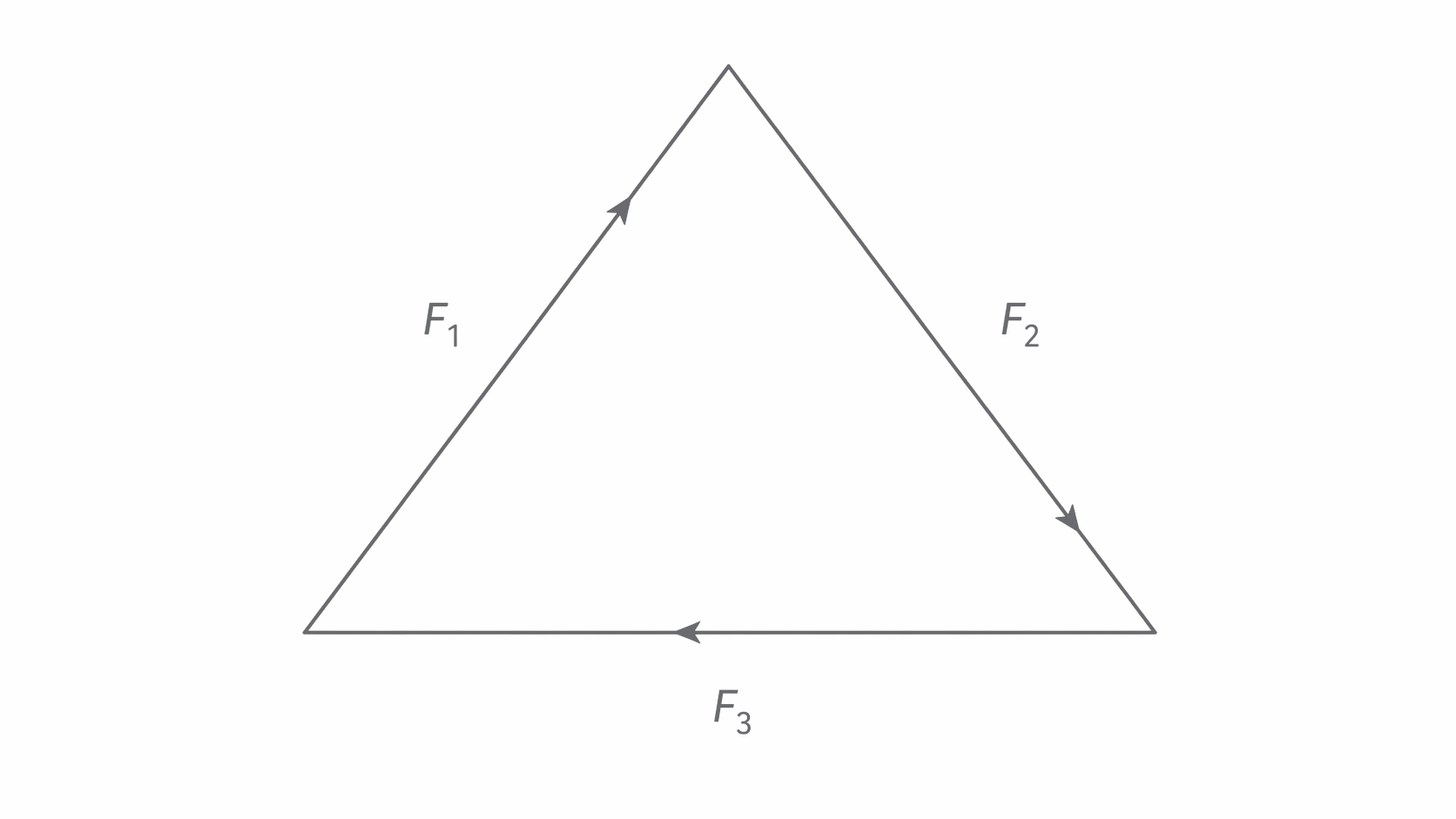
This closed-triangle test is a zero-resultant check for three forces acting at a point. It should not be over-interpreted as a complete equilibrium test for an extended body, where turning effects can matter too.
Worked Example (Two forces): An object resting on a horizontal surface has weight acting downward and a support force acting upward. For equilibrium: . The two forces are equal in magnitude and opposite in direction.
Worked Example (Three forces — resolving): A child of weight sits on a swing held at angle to the vertical by a horizontal force . The tension in the rope is .
Resolving horizontally:
Resolving vertically:
From these two equations:
Worked Example (Inclined plane equilibrium): An object of weight rests on a rough slope at angle . The friction force acts up the slope and the normal reaction acts perpendicular to the slope.
Resolving parallel to the slope:
Resolving perpendicular to the slope:
Equilibrium on an Inclined Plane
Equilibrium on an inclined plane:
Also: and
These results are worth memorising because they reappear throughout mechanics.
Understanding equilibrium by resolving forces is one of the most important mechanics skills in the course. Always draw a clear force diagram before attempting any calculation.
Part 6 — Problem-Solving Strategy
Vector problems can look very different from one another, but the underlying techniques are always the same. Here is a general strategy:
- Draw a diagram. Label all vectors with their magnitudes and directions. This is the single most important step.
- Identify the type of problem. Are you adding vectors, resolving them, or checking equilibrium?
- Choose the right method. Two perpendicular vectors — use Pythagoras and trigonometry. Vectors at other angles — use a scale drawing. Equilibrium — resolve into components or use the closed triangle method.
- Resolve where needed. For inclined planes, resolve parallel and perpendicular to the slope. For equilibrium, resolve horizontally and vertically (or along and perpendicular to a surface).
- State directions clearly. Always say what your angle is measured from.
Key skills for this topic:
- Classify quantities as scalar or vector.
- Add two perpendicular vectors using Pythagoras and trigonometry.
- Add non-perpendicular vectors using a tip-to-tail scale drawing.
- Resolve a vector into two perpendicular components using and .
- Resolve weight on an inclined plane into components parallel () and perpendicular () to the slope.
- Test for equilibrium by showing resolved components sum to zero, or by constructing a closed triangle of forces.
That same component-by-component method is what turns a complicated force diagram into a set of simple equations you can solve.