3.2.2.4 - Wave-Particle Duality
Everything you have studied so far in quantum physics points to a strange conclusion: the universe does not draw a clean line between waves and particles. Light, which you have seen diffract and interfere like a wave, can also knock electrons out of metals like a stream of particles. Electrons, which you have always treated as particles with mass and charge, can produce diffraction patterns that only waves should be able to create. This lesson brings these two threads together under the heading of wave-particle duality and introduces the de Broglie equation that links a particle's momentum to a wavelength.
Part 1 — The Dual Nature of Light
Light was the first entity for which duality was established. On one hand, phenomena such as diffraction and interference (Young's double slit, single-slit diffraction) can only be explained by treating light as a wave with a wavelength and frequency. On the other hand, the photoelectric effect — where light ejects electrons from a metal surface — can only be explained by treating light as a stream of particles (photons), each carrying a discrete packet of energy .
Neither the wave model alone nor the particle model alone can account for everything light does. We say that light exhibits wave-particle duality: it behaves as a wave in some experiments and as a particle in others.
Wave-Particle Duality
The idea that both matter and electromagnetic radiation show wave-like and particle-like behaviour, with the observed behaviour depending on the experiment being performed.
The key AQA evidence sits on each side of the divide:
| Wave behaviour of light | Particle behaviour of light |
|---|---|
| Diffraction and interference | Photoelectric effect |
The photoelectric effect was particularly decisive. Classical wave theory predicted that any frequency of light should eventually eject electrons if the intensity were high enough, but experiment showed a sharp threshold frequency below which no electrons are emitted regardless of intensity. Einstein's photon model explained this perfectly — each photon delivers energy , and if (the work function), no single photon can free an electron.
Part 2 — de Broglie's Hypothesis
In 1924, Louis de Broglie made a bold proposal: if waves (light) can behave as particles, then particles should also behave as waves. He hypothesised that every moving particle has an associated wavelength — now called its de Broglie wavelength — that depends on the particle's momentum.
de Broglie Wavelength
where:
- = de Broglie wavelength (m)
- = Planck constant ( J s)
- = mass of the particle (kg)
- = velocity of the particle (m s)
- = momentum of the particle (kg m s)
Notice the inverse relationship: a particle with greater momentum has a shorter wavelength. This is why everyday objects (large mass, even at low speed) have wavelengths so incredibly small that their wave nature is undetectable. Only particles with very small mass — such as electrons — have de Broglie wavelengths large enough to produce observable wave effects.
For example, a tennis ball of mass 0.058 kg travelling at 50 m s has a de Broglie wavelength of roughly m. This is many orders of magnitude smaller than any detector could ever resolve. An electron, however, accelerated through a modest potential difference, can have a wavelength comparable to the spacing between atoms in a crystal — on the order of m — making diffraction effects clearly visible.
The de Broglie wavelength of a particle can be changed by altering its velocity. Increasing the speed increases the momentum and therefore decreases the wavelength. Decreasing the speed has the opposite effect.
Part 3 — Electron Diffraction: Experimental Evidence
Three years after de Broglie's hypothesis, Davisson and Germer (1927) provided the first experimental confirmation by showing that a beam of electrons could be diffracted. In the figure below, notice the thin graphite foil and the concentric bright rings on the fluorescent screen, because the ring pattern is the evidence that electrons are behaving as waves.
[DIAGRAM: asset_name: 2.2.4 - Wave-Particle Duality - Diagram 1; asset_slug: 2.2.4 - Wave-Particle Duality - Diagram 1; recommended_method: retained_png; description: Electron diffraction tube. A beam of electrons travels through a vacuum toward a thin graphite foil and then reaches a fluorescent screen. The screen shows concentric bright rings around a central bright spot. Add a caption: "Ring pattern = diffraction, so electrons show wave behaviour."]
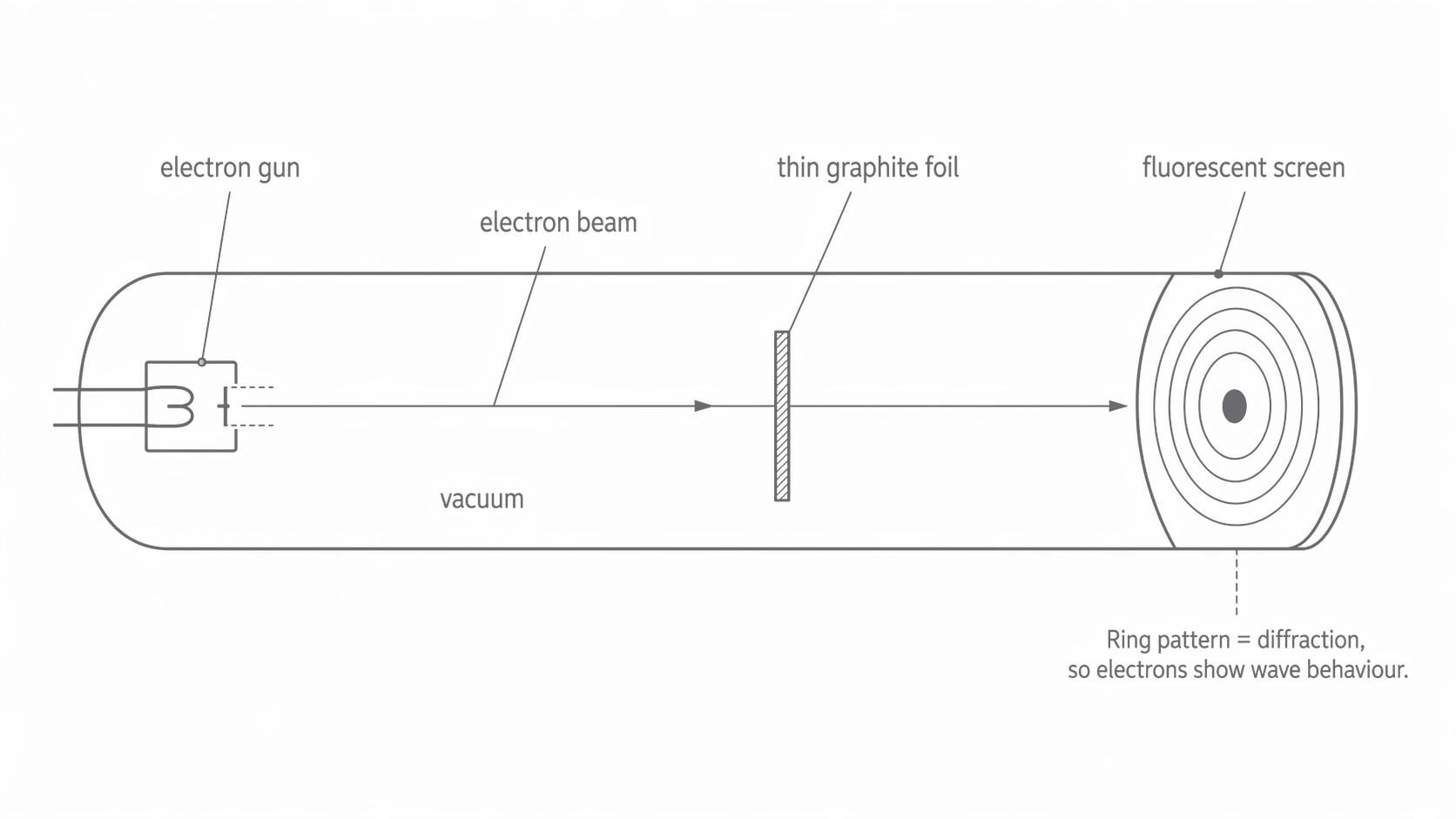
For AQA, you do not need a detailed apparatus method. The key observation is that electrons are directed at a thin crystalline material and produce a ring pattern on a screen. That ring pattern is a diffraction pattern, so it is evidence that electrons behave as waves.
Electron Diffraction
The diffraction of electrons by a thin crystalline material, producing an interference pattern that demonstrates the wave nature of electrons.
When the electrons have greater momentum, the de Broglie equation says their wavelength is smaller. A smaller wavelength diffracts less, so the rings are less spread out. When the momentum is smaller, the wavelength is larger and the diffraction pattern spreads out more. In the comparison diagram below, notice that lower momentum produces a wider ring pattern, whereas higher momentum pulls the rings closer to the centre.
[DIAGRAM: asset_name: 2.2.4 - Wave-Particle Duality - Diagram 2; asset_slug: 2.2.4 - Wave-Particle Duality - Diagram 2; recommended_method: retained_png; description: Two diffraction patterns side by side. Left panel labelled "lower momentum, larger wavelength" shows a larger ring pattern spreading further from the centre. Right panel labelled "higher momentum, smaller wavelength" shows rings closer to the centre. Add a central arrow chain: "momentum up -> wavelength down -> diffraction down".]
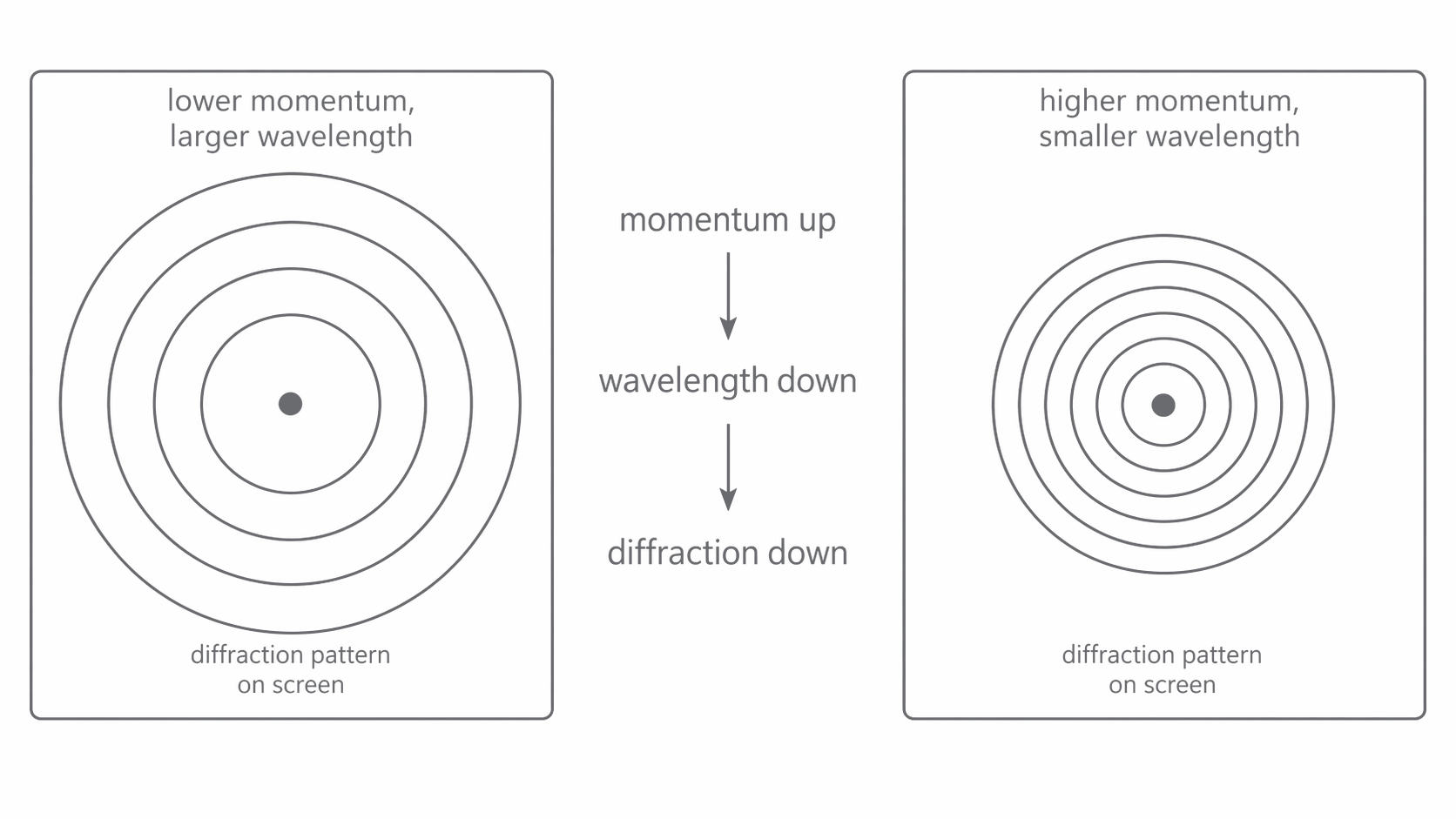
This direct, observable link between momentum and diffraction pattern provides powerful quantitative confirmation of .
Part 4 — Calculations with the de Broglie Equation
At this level, the core calculation is usually a direct substitution into or . The important physics is the same as in the diffraction experiment: larger momentum means smaller wavelength.
Worked example
An electron moving at m s has de Broglie wavelength:
That wavelength is small, but still comparable with atomic spacing, so electron diffraction can be observed.
Part 5 — The Complete Picture: Wave-Particle Duality of Matter
De Broglie's hypothesis has been confirmed not just for electrons but for neutrons, atoms, and even large molecules such as C (buckminsterfullerene). The principle is universal: all matter exhibits wave-particle duality.
However, in practice, the wave nature is only detectable for particles of very small mass moving at appropriate speeds such that their de Broglie wavelength is comparable to the size of the structures they interact with. For macroscopic objects, the wavelength is so vanishingly small that no diffraction or interference can ever be observed.
Transmission Electron Microscope (TEM) — Electrons are accelerated to very high speeds so that their de Broglie wavelength is much smaller than that of visible light. This allows the TEM to resolve structural details far smaller than any optical microscope can see. The resolving power of a microscope is limited by the wavelength it uses, so shorter wavelength means finer detail.
It is important to understand that wave-particle duality is not a matter of a particle "switching" between being a wave and a particle. Rather, these are two complementary descriptions. The experimental setup determines which aspect of behaviour is observed: a diffraction grating reveals wave behaviour; a particle detector reveals particle behaviour.
A useful summary:
| Wave evidence | Particle evidence | |
|---|---|---|
| Light (photons) | Diffraction, interference | Photoelectric effect |
| Electrons | Electron diffraction | Deflection in electric/magnetic fields, tracks in cloud chambers |
Both electromagnetic radiation and matter particles exhibit wave-particle duality. The photoelectric effect demonstrates the particle nature of light. Electron diffraction demonstrates the wave nature of matter. The de Broglie equation links a particle's wavelength to its momentum.
Part 6 — How Scientific Understanding Evolves
The AQA specification explicitly asks you to appreciate how our understanding of the nature of matter has changed over time, and how new ideas are validated through peer review.
Before the 20th century, the prevailing view was that light was purely a wave (supported by Young's double-slit experiment in 1801 and Maxwell's electromagnetic theory in the 1860s). Simultaneously, matter was regarded as purely particulate. The photoelectric effect (explained by Einstein in 1905) and electron diffraction (demonstrated by Davisson and Germer in 1927) shattered this neat divide.
These discoveries did not gain immediate universal acceptance. The process of scientific validation requires:
- Publication — New findings and hypotheses are published in scientific journals.
- Peer review — Other scientists scrutinise the methodology, data, and conclusions. They attempt to identify errors, biases, or alternative explanations.
- Replication — Independent groups attempt to reproduce the results. If the results are reproducible, confidence in the findings grows.
- Acceptance — Over time, if the evidence consistently supports the new model, the scientific community adopts it.
De Broglie's hypothesis was initially met with scepticism — it was a purely theoretical proposal with no experimental evidence at the time. It was only after Davisson and Germer's electron diffraction experiment confirmed the predicted wavelength that the hypothesis gained acceptance and de Broglie was awarded the Nobel Prize in Physics (1929).
Peer Review
The process in which scientific work is evaluated by other experts in the field to check its validity, significance, and originality before wider acceptance.
This historical example illustrates a key principle: scientific knowledge is not fixed. Models are updated or replaced when new experimental evidence demands it, and this process is governed by the rigorous standards of the scientific community.
If you can now link the photoelectric effect, electron diffraction, and the role of peer review, you have the whole story of how wave-particle duality became accepted.