3.2.1.4 - Particle Interactions
When particles attract, repel, or change identity, physicists describe the process as an interaction. This lesson focuses on the four fundamental interactions, the idea of exchange particles, and the simple electromagnetic and weak-interaction diagrams you need to recognise for A-Level Physics.
Part 1 - Four Fundamental Interactions
There are four fundamental interactions in nature: gravity, electromagnetic, strong nuclear, and weak nuclear. Every other force you meet in everyday physics can be traced back to one of these.
Fundamental interaction
A fundamental interaction is one of the four basic forces of nature: gravity, electromagnetic, strong nuclear, or weak nuclear.
The key features are summarised below.
| Interaction | What it does | Typical range | Exchange particle you need here |
|---|---|---|---|
| Gravity | Acts between particles with mass and is always attractive | Infinite | Not required |
| Electromagnetic | Acts between charged particles and can attract or repel | Infinite | Virtual photon |
| Strong nuclear | Acts between hadrons and binds nucleons in nuclei | About | Not required |
| Weak nuclear | Changes one particle into another in beta processes | About | and bosons |
The names gluon, , and graviton are not required knowledge for this specification point. The learner-facing names you do need are the virtual photon for the electromagnetic interaction and the and bosons for the weak interaction.
Part 2 - Exchange Particles and the Electromagnetic Interaction
Forces between particles are explained using exchange particles. One particle emits an exchange particle and another absorbs it, so energy and momentum are transferred between them.
Exchange particle
An exchange particle is a particle passed between interacting particles to transfer energy and momentum and so mediate a force.
For the electromagnetic interaction, the exchange particle is a virtual photon. A virtual photon is not a real detected photon travelling to a detector. It is the exchange particle used in the interaction model.
In the three diagrams below, notice that the particles keep the same identity before and after the interaction while the virtual photon is the exchanged particle in every case.
[DIAGRAM: asset_name: 2.1.4 - Particle Interactions - Diagram 1; asset_slug: 2.1.4 - Particle Interactions - Diagram 1; recommended_method: retained_png; description: Three simple interaction diagrams shown side by side: proton-proton repulsion with a wavy line labelled gamma between the particle lines, proton-electron attraction with a wavy gamma between them, and electron-electron repulsion with a wavy gamma between the lines]
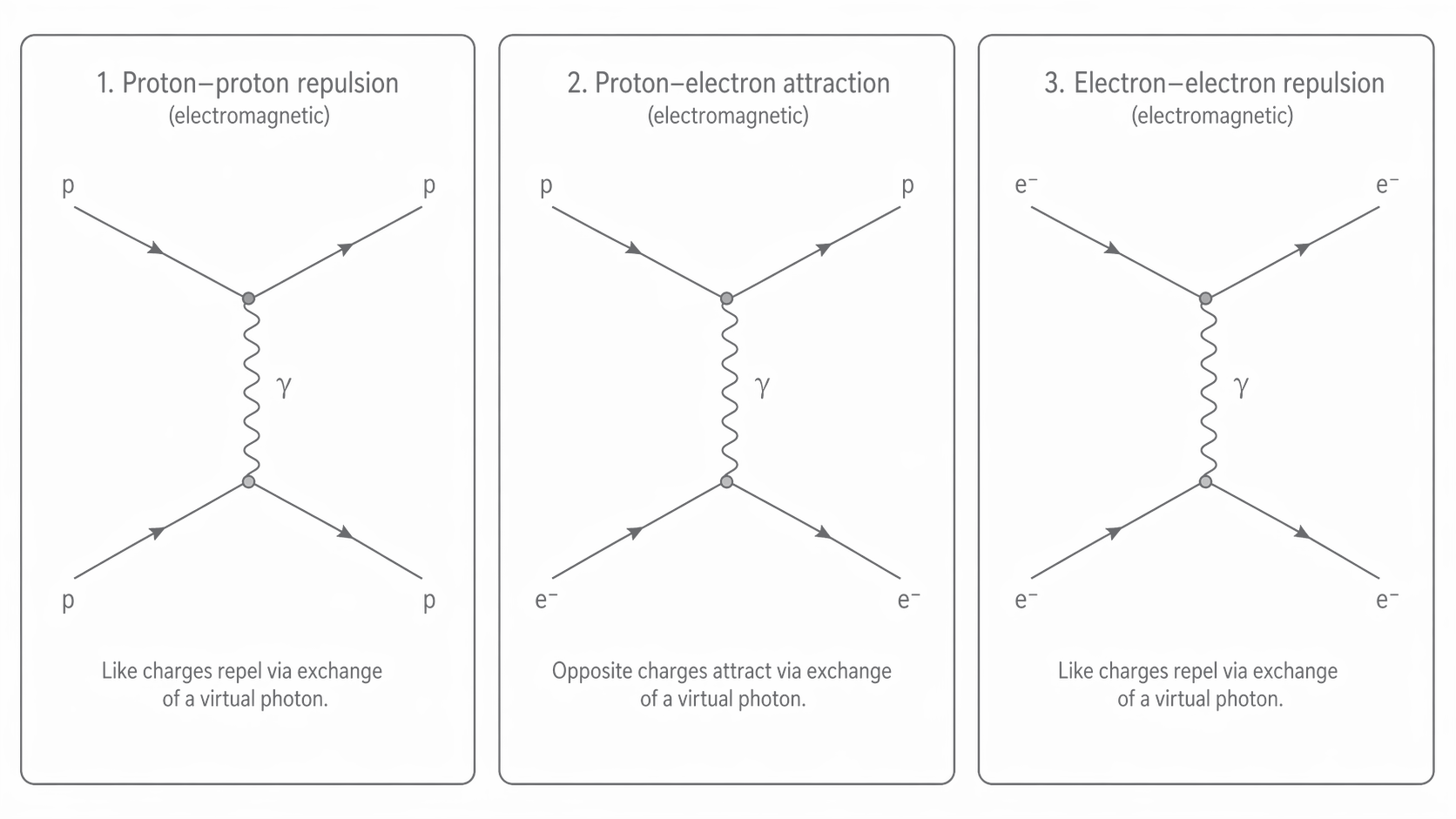
In an electromagnetic interaction diagram, the particles entering and leaving are the same particles. A proton remains a proton, an electron remains an electron, and only their momenta change. The direction of the lines shows incoming and outgoing particles, while the wavy line shows the virtual photon being exchanged.
Electromagnetic interaction diagrams show the same charged particles before and after the interaction. The exchanged particle is always a virtual photon.
Part 3 - The Weak Interaction and Beta Decay
The weak interaction is different because it can change one particle into another. This is why it is responsible for beta decay. The exchange particles are the charged bosons, so the weak interaction is much shorter range than the electromagnetic interaction.
The two beta-decay processes you need are:
Beta-minus decay
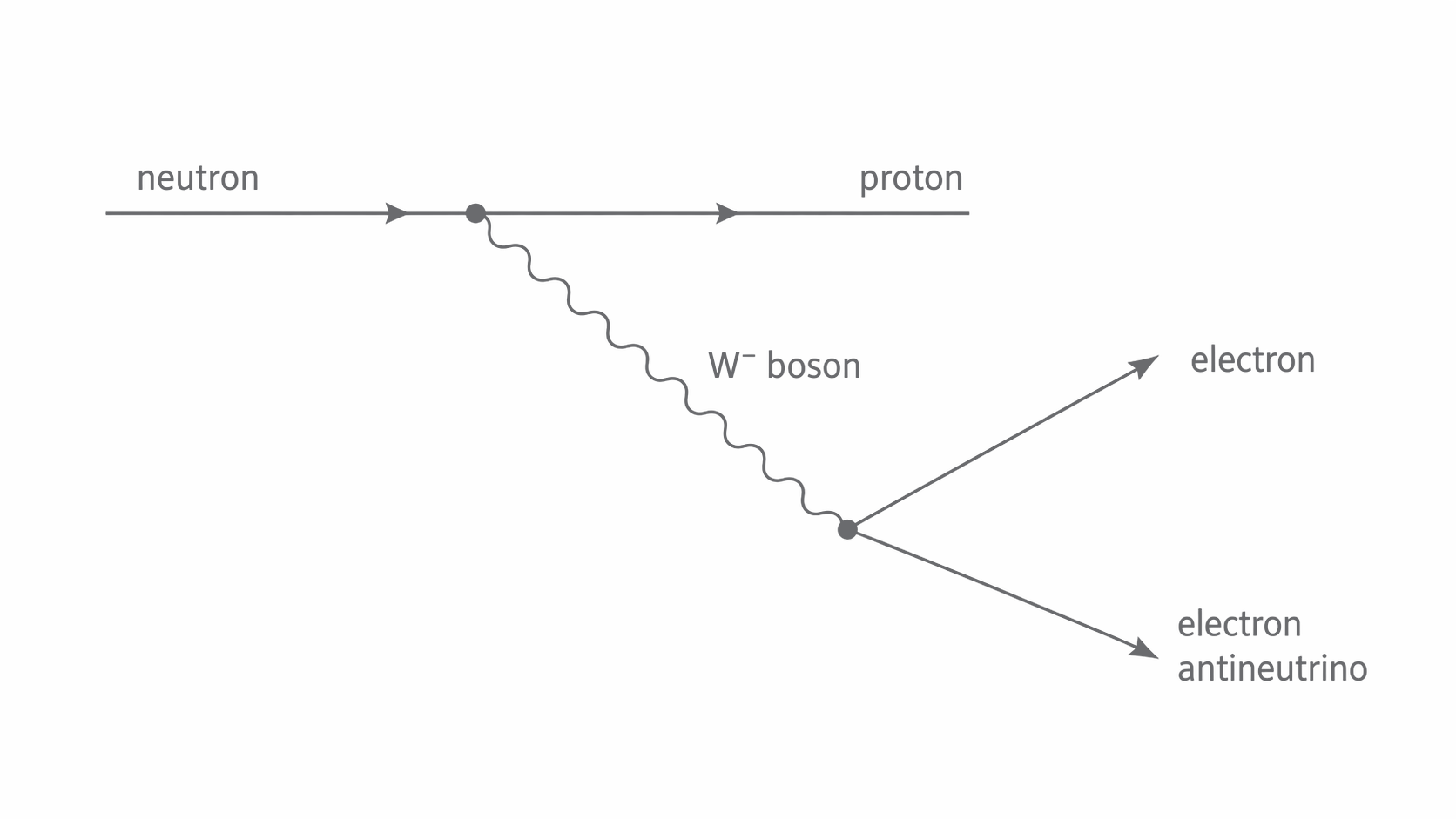
In beta-minus decay, a neutron becomes a proton and emits a boson at the first vertex. The then produces the electron and the electron antineutrino at the second vertex.
In the beta-minus diagram below, notice the two vertices: the neutron changes into a proton first, and the emitted then creates the electron and electron antineutrino.
[DIAGRAM: asset_name: 2.1.4 - Particle Interactions - Diagram 2; asset_slug: 2.1.4 - Particle Interactions - Diagram 2; recommended_method: retained_png; description: A simple beta-minus interaction diagram with a neutron line entering, a proton line leaving from the first vertex, a wavy line labelled W- heading to a second vertex, and electron plus electron antineutrino lines leaving that second vertex]
Beta-plus decay
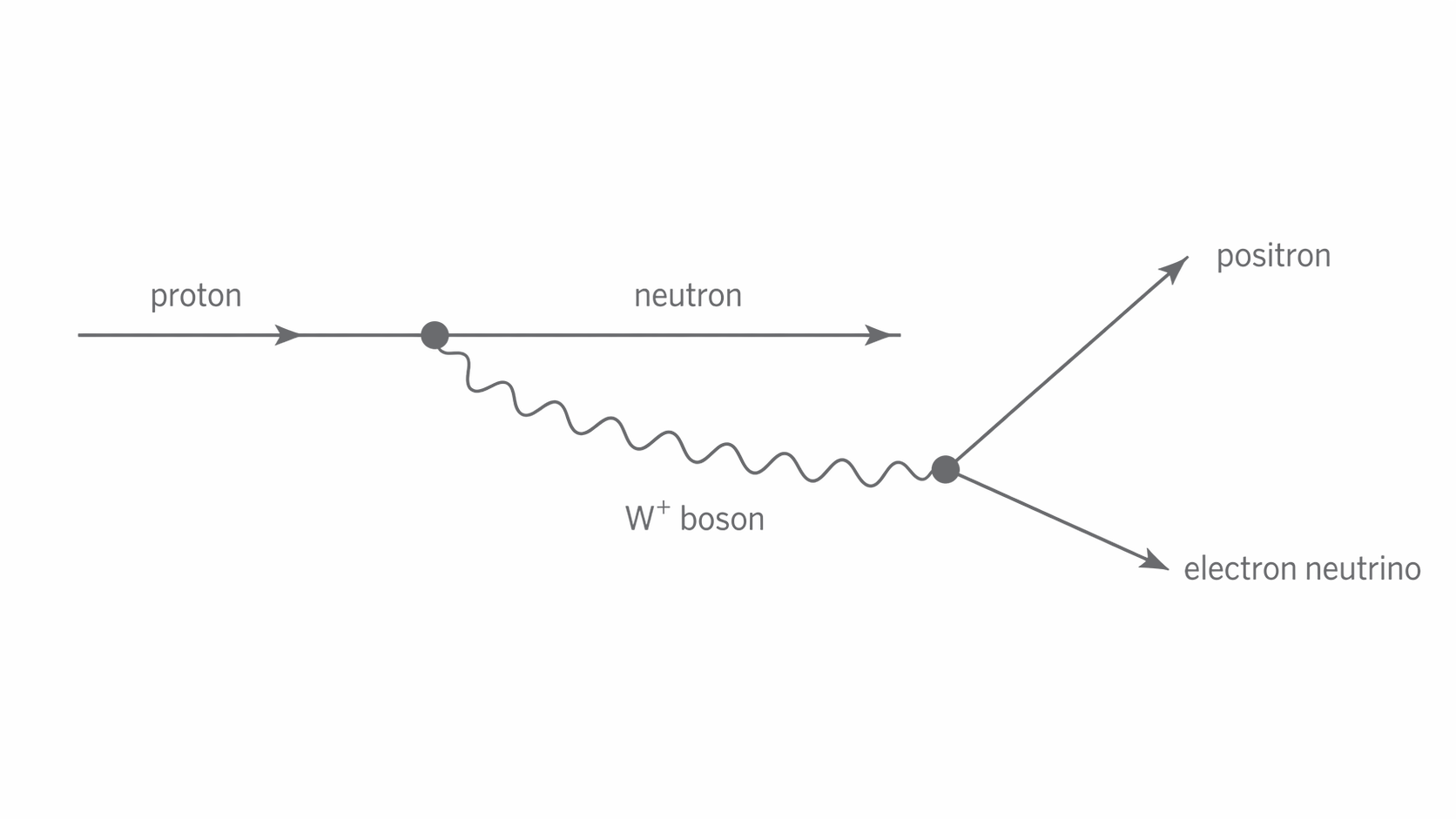
In beta-plus decay, a proton becomes a neutron and emits a boson. The then produces the positron and the electron neutrino.
In the beta-plus diagram below, notice the same two-vertex structure, but this time the proton changes into a neutron and the exchanged particle is a instead of a .
[DIAGRAM: asset_name: 2.1.4 - Particle Interactions - Diagram 3; asset_slug: 2.1.4 - Particle Interactions - Diagram 3; recommended_method: retained_png; description: A simple beta-plus interaction diagram with a proton line entering, a neutron line leaving from the first vertex, a wavy line labelled W+ heading to a second vertex, and positron plus electron neutrino lines leaving that second vertex]
Because the bosons are charged and have non-zero rest mass, they behave very differently from virtual photons.
Reading Beta-Minus Interaction Diagrams
Those differences are exactly why a weak-interaction diagram is usually easy to spot. The next question checks whether you can read the particle changes in the beta-minus diagram itself.
Part 4 - Electron Capture and Electron-Proton Collisions
The weak interaction is also responsible for electron capture and electron-proton collisions. In both cases the overall equation is the same:
Electron capture and electron-proton collision
However, the diagrams are not the same because the exchange particle is different.
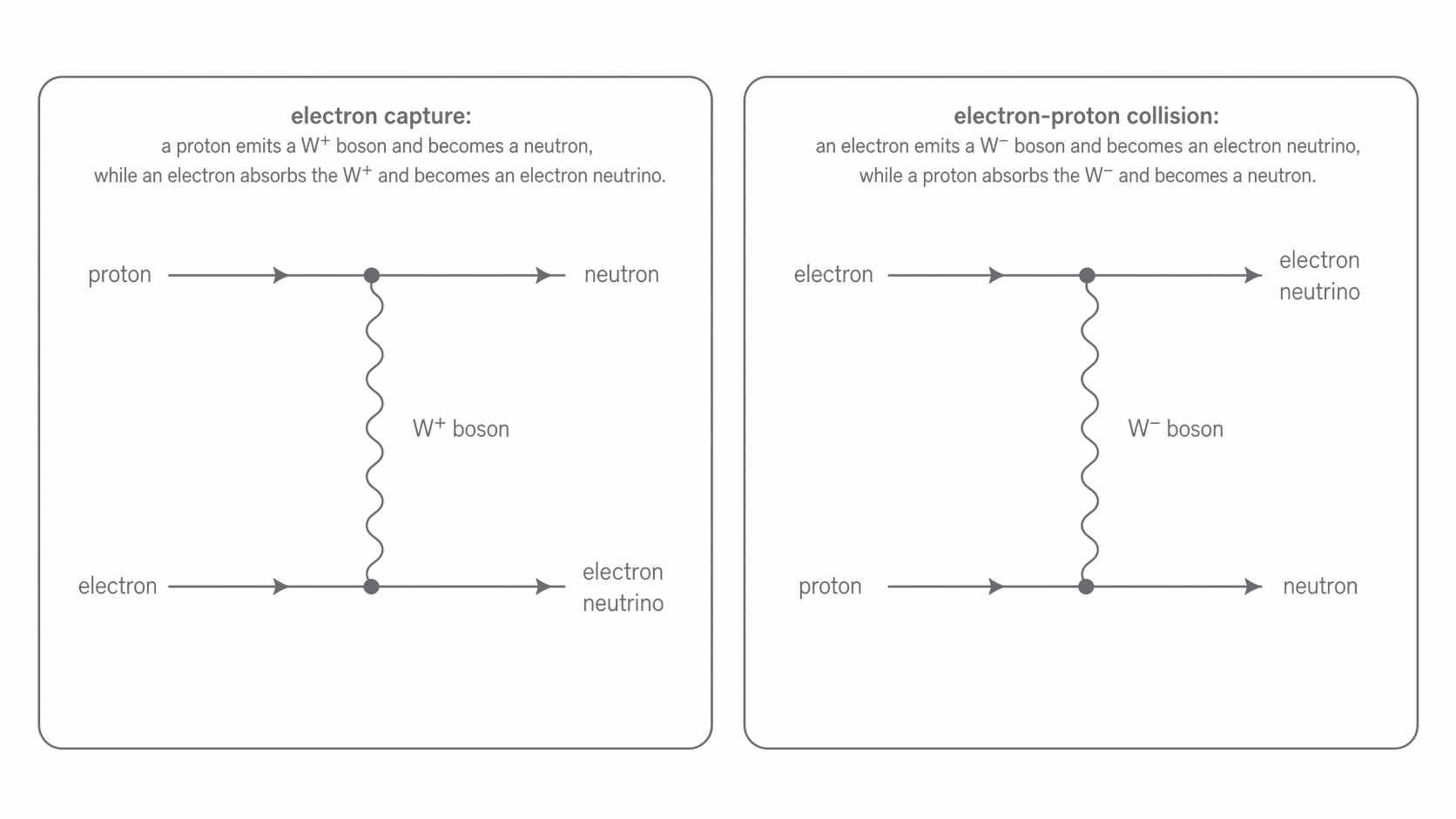
In electron capture, the proton emits a boson and becomes a neutron. The electron absorbs the and becomes an electron neutrino.
In an electron-proton collision, the electron emits a boson and becomes an electron neutrino. The proton absorbs the and becomes a neutron.
Compare the two diagrams below and notice that the overall reaction is the same in both cases, but the boson has opposite charge and is emitted by a different particle.
[DIAGRAM: asset_name: 2.1.4 - Particle Interactions - Diagram 4; asset_slug: 2.1.4 - Particle Interactions - Diagram 4; recommended_method: retained_png; description: Two simple diagrams side by side. Left: electron capture with a proton line changing to a neutron and sending W+ to an electron line that changes to a neutrino. Right: electron-proton collision with an electron line changing to a neutrino and sending W- to a proton line that changes to a neutron]
PET scanning depends on the weak interaction. A proton-rich tracer undergoes beta-plus decay inside the body, using a boson to change a proton into a neutron and emit a positron. That positron later annihilates with an electron, producing the photons detected by the scanner.
The important exam point is that the overall reaction can look identical while the exchange particle and its direction are different.
Part 5 - Reading Interaction Diagrams
To read a simple interaction diagram well, always ask three questions. Which particles go in? Which particles come out? Which exchange particle is shown between the vertices? For this topic, that is enough to identify the process cleanly.
The weak-interaction processes you need are summarised here:
| Process | Overall equation | Exchange particle |
|---|---|---|
| Beta-minus decay | ||
| Beta-plus decay | ||
| Electron capture | ||
| Electron-proton collision |
Electromagnetic diagrams are easier because the particles do not change identity and the exchange particle is always the virtual photon. Weak-interaction diagrams need more care because the same overall reaction can be drawn in different ways depending on which particle emits the exchange particle.