3.1.3 - Estimation of Physical Quantities
Physicists routinely need to judge whether a calculated answer is reasonable, compare the scales of different phenomena, or make quick predictions without precise data. This lesson develops your ability to work with orders of magnitude and to produce sensible estimates of physical quantities and derived quantities.
Part 1 — Orders of Magnitude
An order of magnitude is a way of expressing the approximate size of a quantity using powers of ten. Rather than quoting an exact value, we round to the nearest power of ten to capture the overall scale.
Order of Magnitude
The order of magnitude of a quantity is the power of ten closest to its value. It is used to express or compare the scale of physical quantities.
For example, the diameter of an atomic nucleus is approximately m, while the diameter of an atom is approximately m. We say the atom is five orders of magnitude larger than the nucleus because it is roughly times bigger.
To find the order of magnitude of a number, first write it in standard form as , where . On a logarithmic scale the boundary between and is . Therefore, if , the order of magnitude is ; if , it is .
For instance, the speed of light is m s, so its order of magnitude is m s. A value of has order of magnitude because is closer to than to .
The table below gives some important orders of magnitude that are useful reference points across physics:
| Quantity | Approximate Value | Order of Magnitude |
|---|---|---|
| Diameter of a proton | m | m |
| Diameter of an atom | m | m |
| Thickness of a sheet of paper | m | m |
| Height of a person | m | m |
| Diameter of the Earth | m | m |
| Distance to the Sun | m | m |
| Mass of an electron | kg | kg |
| Mass of a person | kg | kg |
| Mass of the Earth | kg | kg |
Being familiar with values like these makes it much easier to decide whether an estimate is sensible before you trust a detailed calculation.
Part 2 — Estimation as a Skill
Estimation
Estimation is the process of making an approximate calculation or judgement of a physical quantity using reasonable assumptions, sensible rounding, and known reference values, typically to the nearest order of magnitude.
Estimation is not guessing. It is a structured process in which you identify the relevant physics, choose sensible approximate values, calculate with simplified numbers, and then round the result to the nearest power of ten.
The key is that each assumption must be physically reasonable. Estimating the height of a door as 2 m is sensible. Estimating it as 20 m is not. Good estimates are built from experience, known physical values, and equations you already trust. A useful routine is to follow the same sequence each time: identify the quantity, choose a relevant equation, estimate the inputs with sensible assumptions, calculate, and then round the final answer to the nearest order of magnitude.
Checking calculator results is one of the most useful applications of estimation. If a detailed calculation gives the density of a metal cylinder as kg m, you can quickly estimate the volume and confirm that a density of order kg m is plausible rather than wildly wrong.
Part 3 — Worked Examples: Direct Estimates
Direct estimates use approximate measurements of one quantity to estimate another quantity of the same object, such as an area or a volume.
Worked Example 1: Area of a hydrogen atom
The diameter of a hydrogen atom is approximately m. Estimate the cross-sectional area of the atom to the nearest order of magnitude, assuming it is spherical.
Area of a Circle
Here is the area and is the radius of the circular cross-section. The radius is half the diameter, so m.
Substituting gives
Since , the nearest order of magnitude is m.
Worked Example 2: Volume of the Earth
The diameter of the Earth is approximately m. Estimate the volume of the Earth to the nearest order of magnitude.
Volume of a Sphere
Here is the volume and is the radius. The radius is approximately m, which is of order m.
Using the rounded value gives
A more careful calculation gives m, so the order of magnitude is still m.
Round inputs to one significant figure, or directly to a nearby power of ten, before calculating. This keeps the arithmetic manageable while preserving the correct scale of the answer.
Part 4 — Derived Estimates
A derived estimate uses estimated input values together with an equation to calculate a new quantity that was not given directly.
Worked Example 3: Mass of air in a classroom
Estimate the mass of air in a typical classroom.
Start by estimating the dimensions: length m, width m, and height m. This gives a classroom volume of about m, which is of order m.
Mass from Density and Volume
Here is the mass, is the density, and is the volume. Taking the density of air as about kg m gives
So the mass of air in the room has order of magnitude kg. Estimation often reveals results that feel surprising at first, which is one reason it is such a good reality check.
This sort of estimate is useful because it links a familiar everyday process to a surprisingly large total, showing how quickly repeated small events accumulate.
Engineers use this kind of back-of-the-envelope reasoning before doing a full design calculation. A quick estimate of the energy available in the wind, or the mass of material needed for a structure, can show whether a design idea is realistic before time is spent refining it.
Part 5 — Comparing Orders of Magnitude
Sometimes the important result is not the value itself but how many orders of magnitude separate two quantities.
Comparing Orders of Magnitude
In practice, it is often quicker to write both quantities as powers of ten and subtract the exponents. For example, the mass of the Earth is of order kg and the mass of a person is of order kg, so the Earth is about 23 orders of magnitude more massive.
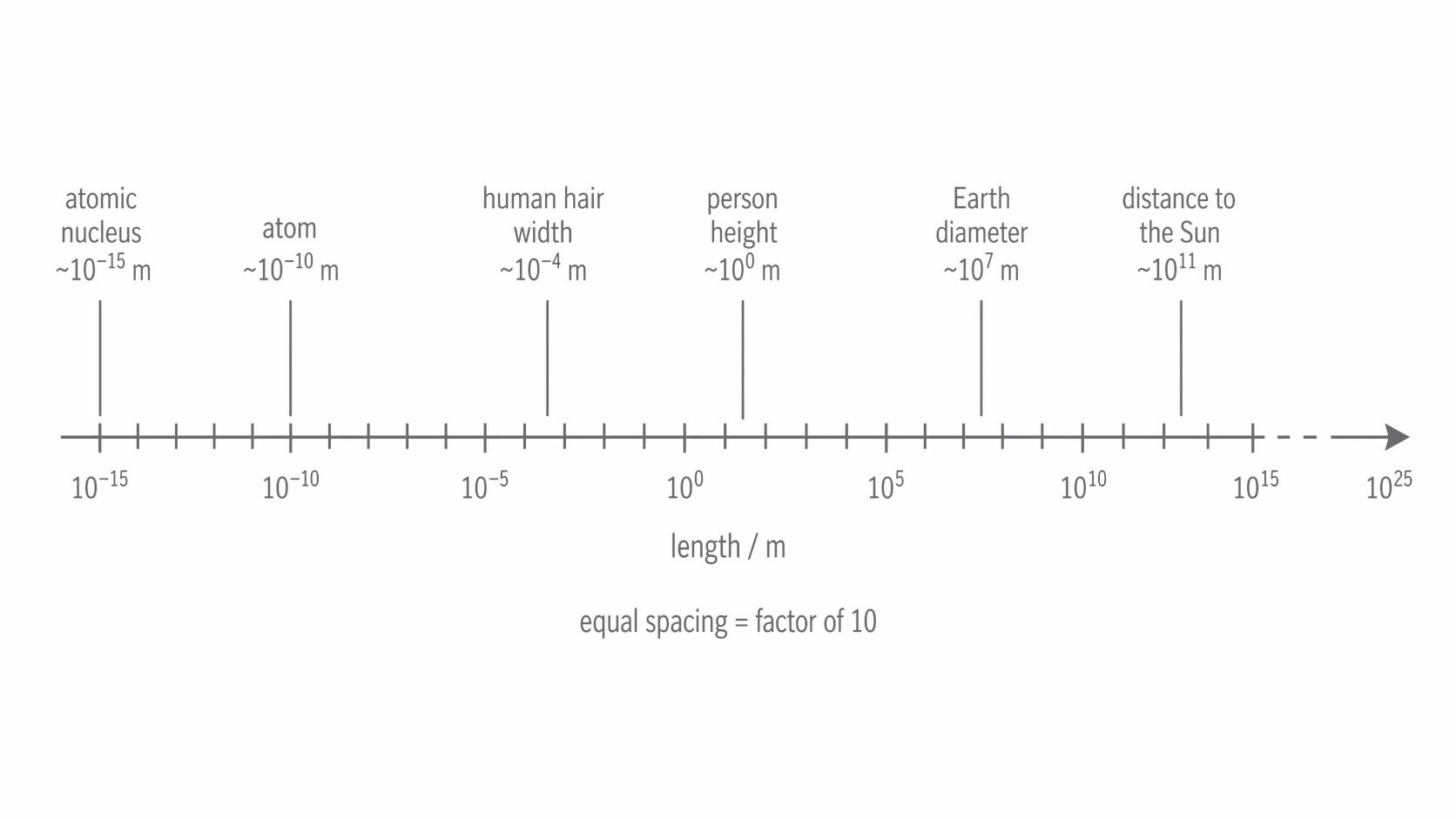
The logarithmic scale below helps you see what "orders of magnitude apart" means in practice: notice that equal spacing represents multiplying by ten each step, not adding a fixed amount.
[DIAGRAM: asset_name: 1.3 - Estimation of Physical Quantities - Diagram 1; asset_slug: 1.3 - Estimation of Physical Quantities - Diagram 1; recommended_method: retained_png; description: A logarithmic number line from to , marking the approximate sizes of an atomic nucleus, an atom, the width of a human hair, the height of a person, the diameter of the Earth, and the distance to the Sun.]
Being comfortable moving between very large and very small scales is a hallmark of physical thinking. Estimation gives you a way to navigate that range without needing exact data for every step.