3.2.1.6 - Quarks and Antiquarks
The hadrons in this part of the course are not fundamental particles. They are made from quarks and antiquarks, and their charge, baryon number, and strangeness can be found by adding the properties of those constituent particles. In this lesson you will use only the quarks named in the specification and apply the model to protons, neutrons, pions, kaons, and neutron decay.
Part 1 - Quark and Antiquark Properties
At A-Level you only need three quarks: up (), down (), and strange (). Each quark has a fractional charge, baryon number , and a strangeness value.
Quark
A quark is a fundamental particle that combines with other quarks to form hadrons. Quarks have fractional charge and baryon number .
| Quark | Charge () | Baryon number | Strangeness |
|---|---|---|---|
| 0 | |||
| 0 | |||
Every quark has a corresponding antiquark with the opposite values of the additive quantities.
Antiquark
An antiquark is the antiparticle of a quark. It has the same mass as the corresponding quark, but opposite charge, baryon number, and strangeness.
| Antiquark | Charge () | Baryon number | Strangeness |
|---|---|---|---|
| 0 | |||
| 0 | |||
The strange quark is the only one of the three that carries strangeness. This is why kaons are strange mesons and pions are not.
Part 2 - Baryons and Antibaryons
Baryons are made of three quarks, so their total baryon number is . Antibaryons are made of three antiquarks, so their total baryon number is .
Baryon
A baryon is a hadron made of three quarks. An antibaryon is a hadron made of three antiquarks.
The only baryons you need here are the proton and neutron, together with their antiparticles.
| Particle | Quark content | Charge | Baryon number | Strangeness |
|---|---|---|---|---|
| Proton | 0 | |||
| Neutron | 0 | 0 | ||
| Antiproton | 0 | |||
| Antineutron | 0 | 0 |
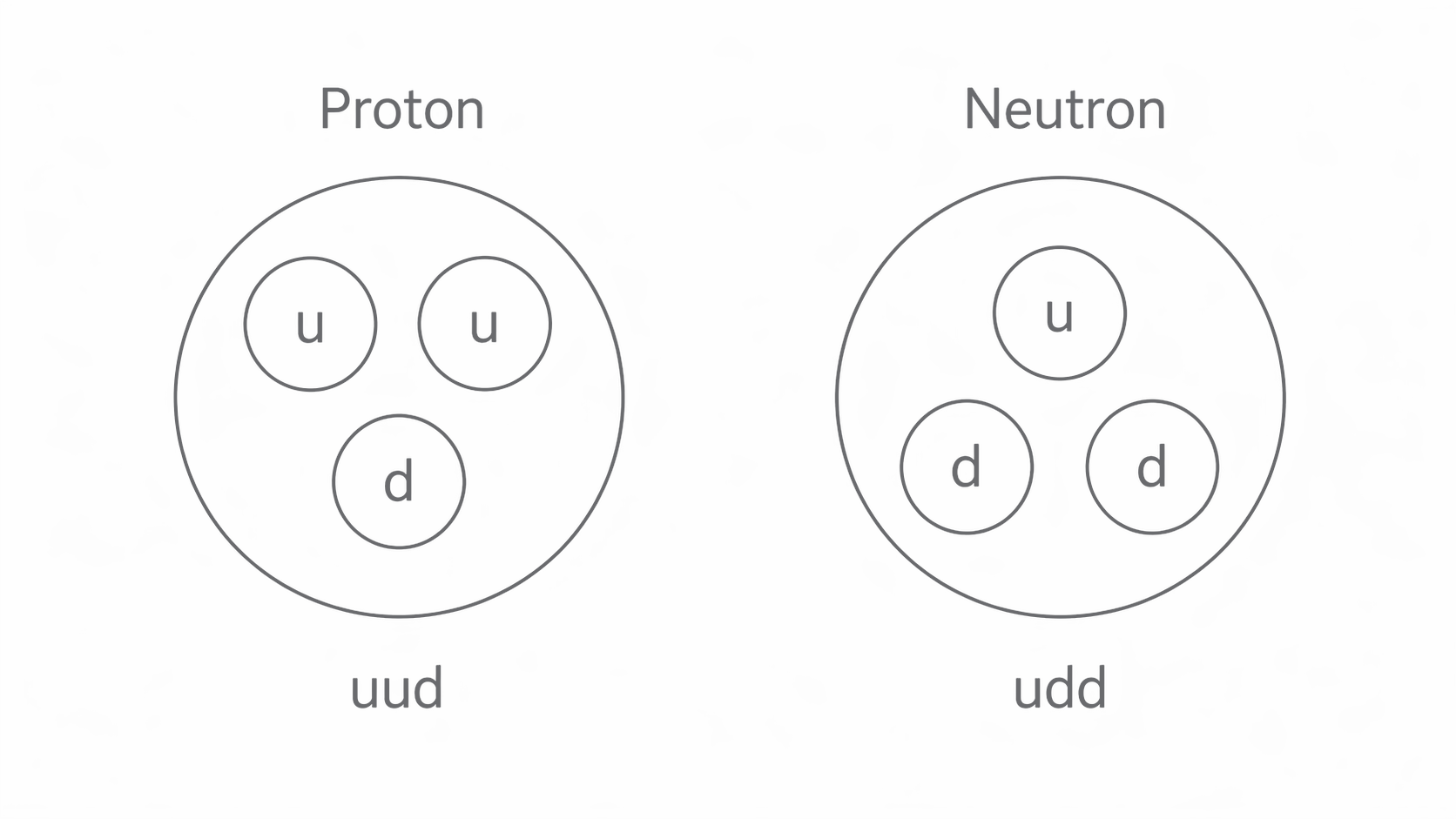
For example, the proton is , so its charge is and its baryon number is . The neutron is , so its charge is zero and its baryon number is still . The comparison diagram below shows the quark make-up of the two nucleons, so notice that both are three-quark baryons and that changing just one quark swaps the proton and neutron identities.
[DIAGRAM: asset_name: 2.1.6 - Quarks and Antiquarks - Diagram 1; asset_slug: 2.1.6 - Quarks and Antiquarks - Diagram 1; recommended_method: retained_png; description: A proton shown as three quark circles labelled u, u, d, and a neutron shown as three quark circles labelled u, d, d]
Part 3 - Mesons - Pions and Kaons
Mesons are made from one quark and one antiquark. Their baryon number is therefore zero because .
Meson
A meson is a hadron made of one quark and one antiquark. Mesons have baryon number 0.
The only mesons you need in this specification point are pions and kaons.
| Particle | Quark content | Charge | Strangeness |
|---|---|---|---|
| 0 | |||
| 0 | |||
| or | 0 | 0 | |
| 0 | |||
| 0 |
Pions contain only up and down quarks, so they have zero strangeness. Kaons contain a strange quark or a strange antiquark, so they have non-zero strangeness. The antiparticle of a meson is still a meson because replacing each quark by its antiquark still gives one quark partner and one antiquark partner overall. The table above is the key exam summary here: mesons are quark-antiquark pairs, and kaons differ from pions because one constituent is strange.
At CERN and other particle accelerators, detectors identify short-lived hadrons by combining track information with the quark model. For example, a positively charged meson with strangeness is identified as a because the quark combination gives exactly those properties.
The same property-based reasoning lets you work backwards from a kaon's charge and strangeness to its quark content.
Part 4 - Neutron Decay
The neutron is not stable when it is free. It decays into a proton, an electron, and an electron antineutrino.
Neutron decay
In quark terms, the neutron is and the proton is , so one down quark changes into an up quark during the decay. This is why the overall baryon changes from neutron to proton. The diagram below shows this weak decay in quark terms, so notice that only one quark changes while the electron and electron antineutrino are emitted.
[DIAGRAM: asset_name: 2.1.6 - Quarks and Antiquarks - Diagram 2; asset_slug: 2.1.6 - Quarks and Antiquarks - Diagram 2; recommended_method: retained_png; description: A neutron labelled udd changing into a proton labelled uud, with an electron and an electron antineutrino emitted]
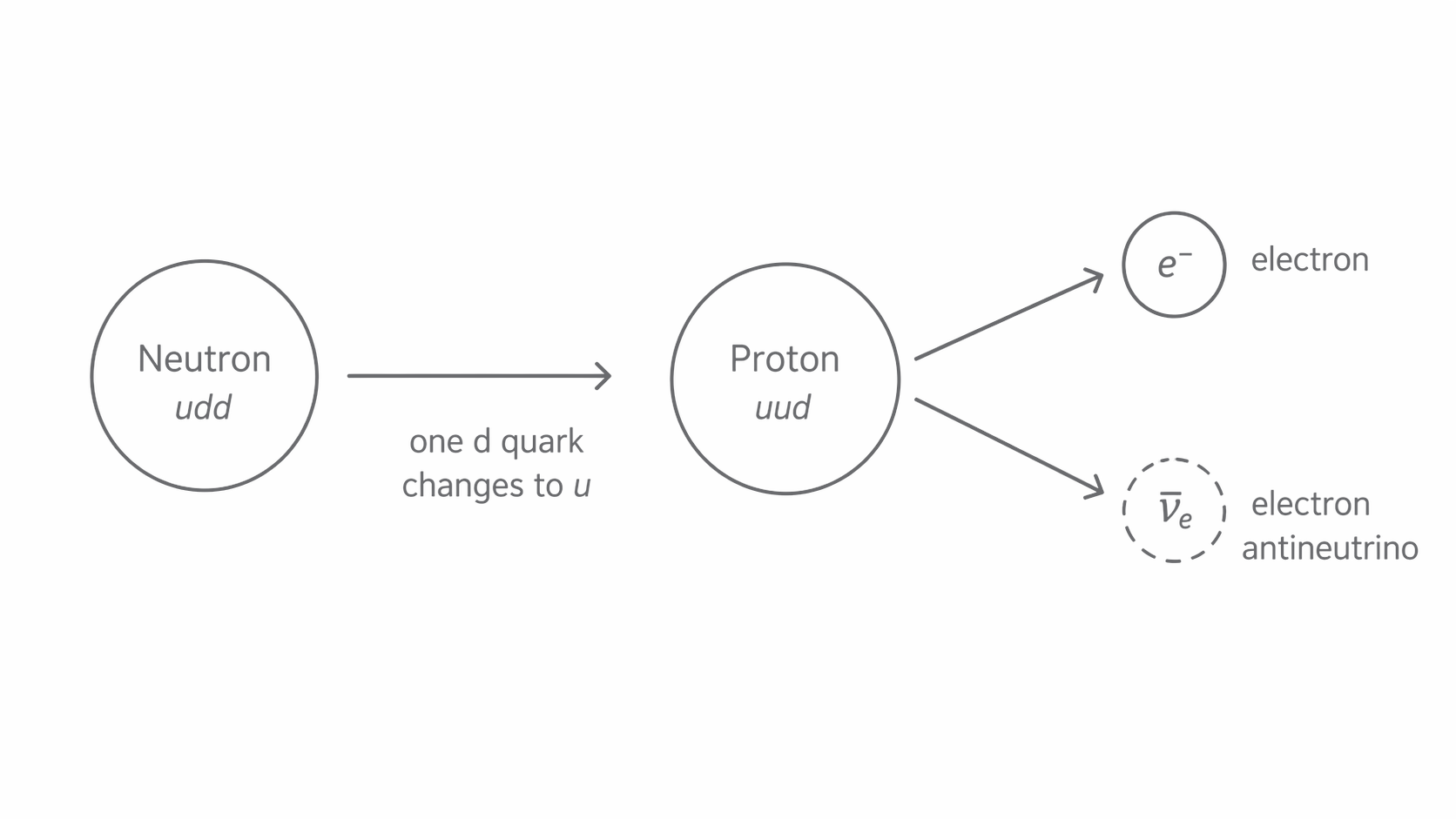
This is a weak interaction. For this specification point, the key knowledge is the decay equation and the fact that the quark content changes from to .
Connecting Quark Structures and Decay
The quark model therefore gives a compact way to understand both particle structure and simple particle decays without going beyond the combinations listed in the specification.