3.2.1.1 - Constituents of the Atom
Every element is built from just three subatomic particles: protons, neutrons, and electrons. In this lesson you will learn the properties of these particles, how to describe nuclei using standard notation, what isotopes are, how isotopic data is used, and how to calculate the specific charge of particles, nuclei, and ions.
Part 1 — The Structure of the Atom
At the centre of every atom sits a tiny, dense nucleus made up of protons and neutrons. Because protons and neutrons both live in the nucleus, they are collectively called nucleons. Surrounding the nucleus are electrons, which are held in the atom by the electrostatic attraction between their negative charge and the positive charge of the nucleus.
Nucleon
A nucleon is a proton or a neutron, that is, any particle found in the nucleus of an atom.
Rutherford's alpha-scattering experiment showed that the nucleus contains almost all of the mass of the atom, even though the atom itself is mostly empty space. The diameter of the nucleus is of order m, compared with about m for the atom as a whole. In the figure, notice how tiny the nucleus is compared with the electron shells, which is why most of the atom is empty space.
[DIAGRAM: asset_name: 2.1.1 - Constituents of the Atom - Diagram 1; asset_slug: 2.1.1 - Constituents of the Atom - Diagram 1; recommended_method: retained_png; description: Simple model of an atom showing a small central nucleus containing protons and neutrons, with electrons in shells around it. The nucleus should be drawn much smaller than the electron shells to emphasise that most of the atom is empty space.]
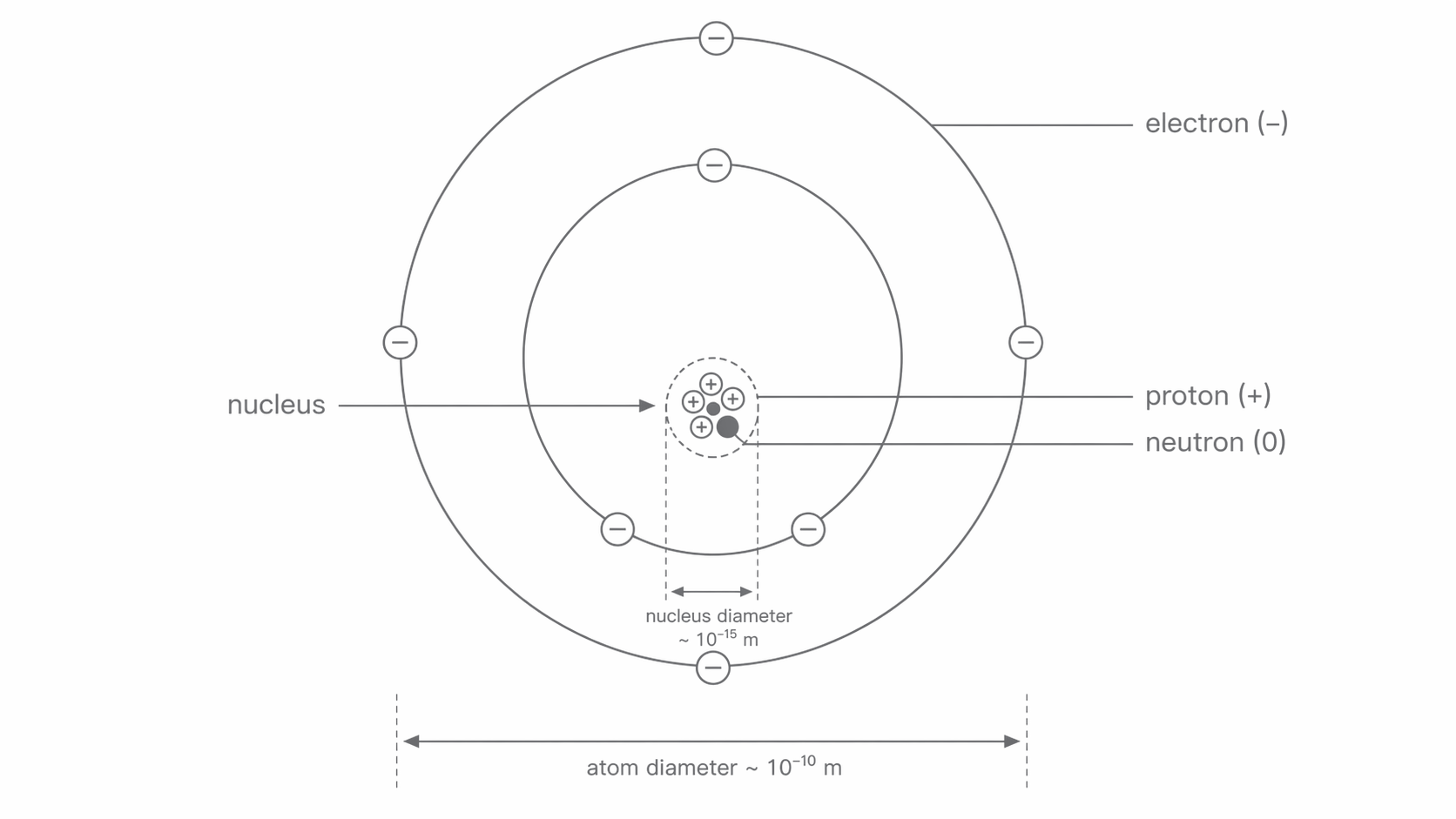
An uncharged atom has equal numbers of protons and electrons, so its total charge is zero. If the atom gains or loses electrons, it becomes an ion.
Part 2 — Charge and Mass of Subatomic Particles
The three subatomic particles differ in both charge and mass. You must know their values in SI units and in relative units, where the proton's charge and mass are each taken as 1.
| Particle | Charge / C | Relative Charge | Mass / kg | Relative Mass |
|---|---|---|---|---|
| Proton | ||||
| Neutron | ||||
| Electron |
Three observations matter immediately. The proton and neutron have almost the same mass, the electron is much lighter than either nucleon, and the proton and electron carry charges of equal magnitude but opposite sign.
Because the electron mass is so small compared with the nucleon mass, the mass of an atom is concentrated almost entirely in the nucleus. This is why, when calculating the mass of a nucleus or an ion, the electron mass is usually neglected.
The atomic mass unit (amu) belongs to the later nuclear-physics section, so for this lesson you only need kilograms, relative masses, proton number, nucleon number, and specific charge.
Part 3 — Specific Charge
The specific charge of a particle is its charge divided by its mass. It tells you how much charge the particle carries for each kilogram of mass.
Specific Charge
The specific charge of a particle is its charge divided by its mass.
This ratio is written using the symbol for charge divided by the symbol for mass.
Specific Charge
Here is the charge in coulombs, is the mass in kilograms, and the unit of specific charge is C kg. Because charge can be positive or negative, specific charge can also be positive or negative.
For a proton,
For an electron,
The electron's specific charge has a much larger magnitude than the proton's because the charges have the same magnitude but the electron has a far smaller mass. In questions, read the sign carefully: electrons have negative specific charge, while positively charged nuclei and positive ions have positive specific charge.
For a nucleus, the charge is approximately and the mass is approximately kg. For an ion, use the net ionic charge and take the mass as essentially unchanged because electron masses are negligible.
Part 4 — Proton Number, Nucleon Number, and Nuclide Notation
Every element is defined by the number of protons in its nucleus. This is the proton number or atomic number, symbol .
Proton Number ($Z$)
The proton number is the number of protons in the nucleus of an atom. It determines which element the atom is.
The total number of protons and neutrons in the nucleus is the nucleon number, symbol .
Nucleon Number ($A$)
The nucleon number is the total number of protons and neutrons in the nucleus.
If you know both and , you can find the number of neutrons by subtraction.
Number of Neutrons
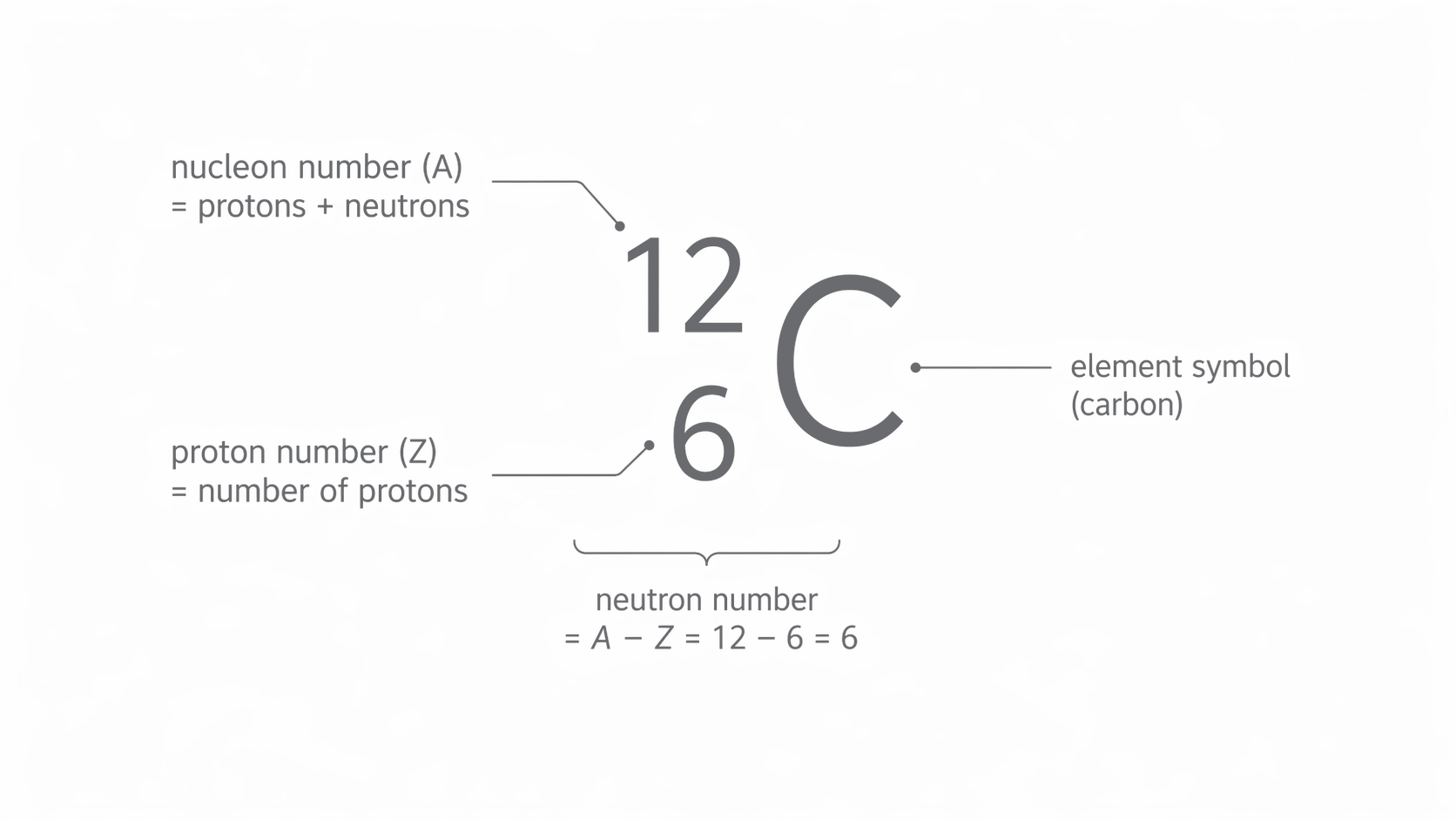
We represent a nuclide, meaning a specific nuclear species, using nuclide notation:
Here is the chemical symbol of the element, is the nucleon number, and is the proton number. For example, has 92 protons and neutrons. In the figure, notice where and sit around the symbol and how the neutron number is found by subtracting from .
[DIAGRAM: asset_name: 2.1.1 - Constituents of the Atom - Diagram 2; asset_slug: 2.1.1 - Constituents of the Atom - Diagram 2; recommended_method: retained_png; description: Nuclide notation for carbon-12 showing , with labels pointing to as the nucleon number, as the proton number, and a note that the neutron number is .]
Part 5 — Isotopes and Isotopic Data
Atoms of the same element always have the same proton number, but they can have different numbers of neutrons. Atoms of the same element with different numbers of neutrons are called isotopes.
Isotopes
Isotopes are atoms of the same element with the same proton number but different numbers of neutrons.
For example, carbon has several isotopes:
| Isotope | Protons () | Neutrons () | Nucleon Number () |
|---|---|---|---|
| 6 | 6 | 12 | |
| 6 | 7 | 13 | |
| 6 | 8 | 14 |
These are all carbon because they all have proton number 6. They have the same chemical properties because neutral atoms of each isotope have the same number of electrons and therefore the same electron arrangement. Their masses differ because their neutron numbers differ.
Carbon dating uses isotopic data. By comparing the proportion of radioactive to stable carbon isotopes in once-living material, scientists can estimate how long ago the organism died.
Another important use of isotopic data is calculating the average atomic mass of an element from the abundances of its isotopes.
Average Atomic Mass
At this stage, the isotope masses are often approximated using their nucleon numbers. For chlorine:
So the average atomic mass is about 35.5 in relative units.
Part 6 — Calculating Specific Charge of Nuclei and Ions
The same specific-charge idea applies to whole nuclei and ions. The key is to identify the correct total charge, estimate the mass using the nucleon number, and then divide.
For a nucleus, the charge is and the mass is approximately kg. For an ion, use the net ionic charge instead of , but still treat the mass as approximately kg.
Mass spectrometry separates ions by their specific charge. Isotopes of the same element can therefore follow different paths through the apparatus and be identified from the way they are deflected.
This is why isotope separation and isotope detection depend on both charge and mass, not just on the name of the element.
Read questions carefully: a nucleus and an ion of the same element do not have the same total charge, so they do not have the same specific charge.