3.2.1.3 - Particles, Antiparticles and Photons
Electromagnetic radiation can be described as photons, and the same energy ideas explain how matter and antimatter can be destroyed or created. In this lesson you will use the photon model, compare particles with their antiparticles, and link annihilation and pair production through conservation of energy and momentum.
Part 1 - Photons and Photon Energy
Electromagnetic radiation is emitted and absorbed in discrete packets called photons. A photon has zero rest mass, but it still carries energy and momentum.
Photon
A photon is a discrete packet of electromagnetic radiation. It has zero rest mass and energy proportional to its frequency.
The energy of a photon depends on the radiation frequency and wavelength .
Photon energy
Here is the Planck constant, is the speed of light in a vacuum, is measured in hertz, and is measured in metres. A higher frequency means a higher-energy photon, so shorter-wavelength radiation has the larger photon energy.
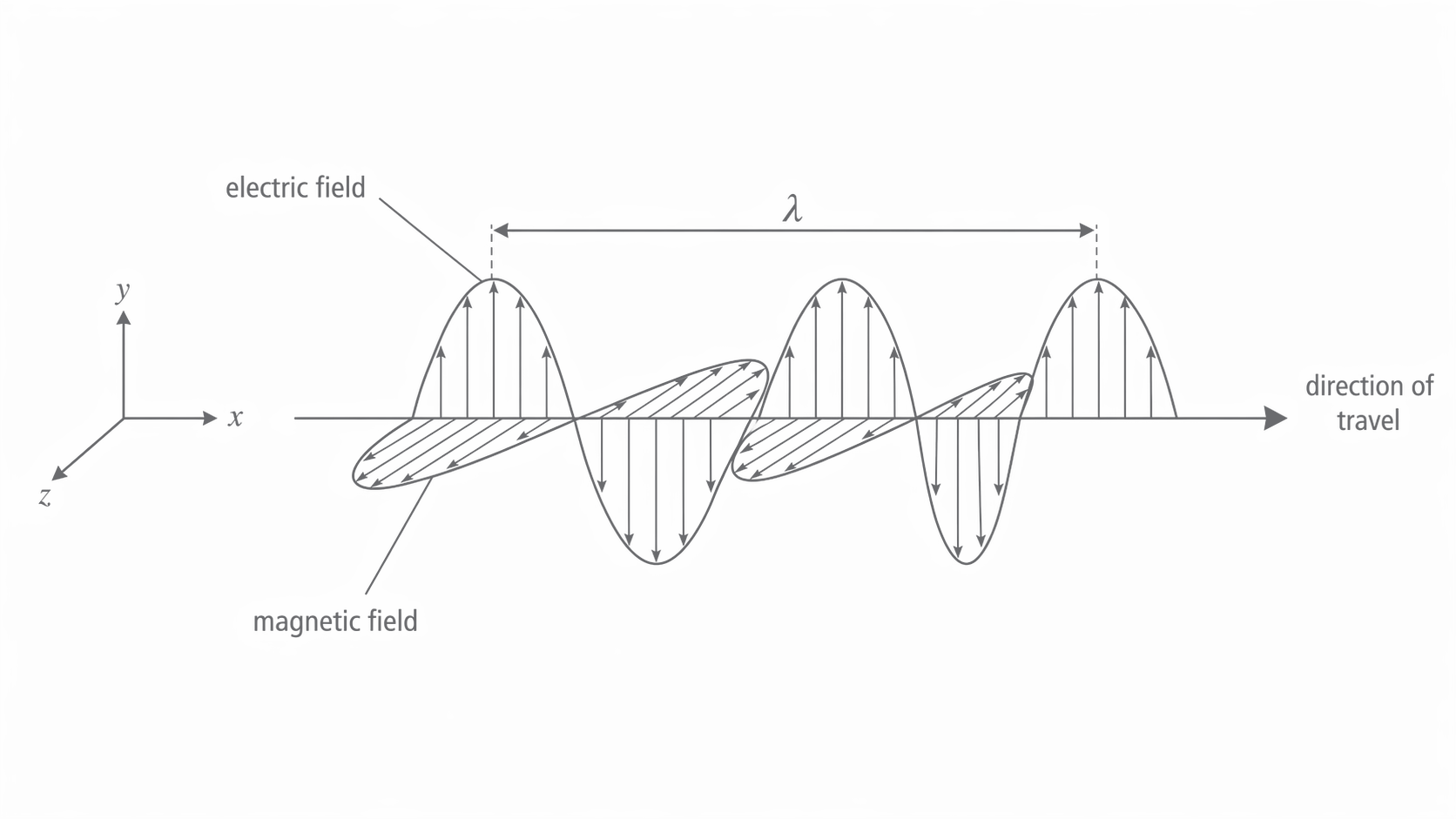
Use the diagram below to connect the photon equation to the wave picture by noticing that the wavelength is measured along the direction of travel while the electric and magnetic fields oscillate at right angles to each other.
[DIAGRAM: asset_name: 2.1.3 - Particles, Antiparticles and Photons - Diagram 1; asset_slug: 2.1.3 - Particles, Antiparticles and Photons - Diagram 1; recommended_method: retained_png; description: An electromagnetic wave with the electric field and magnetic field at right angles to each other and to the direction of travel, with wavelength labelled]
Photon energies are often converted from joules into electron volts because the values are small. The useful conversions are and .
Part 2 - Particles and Antiparticles
For every particle there is a corresponding antiparticle. The particle and antiparticle have the same mass and the same rest energy, but opposite charge if the particle is charged. Other quantum numbers are also opposite, which is why neutral pairs such as the neutron and antineutron are still distinct particles.
Antiparticle
An antiparticle is the partner of a particle with the same mass and rest energy as the particle, but opposite charge or other relevant quantum numbers.
The particle-antiparticle pairs named in this part of the course are the electron and positron, proton and antiproton, neutron and antineutron, and neutrino and antineutrino.
| Pair | Particle mass (kg) | Antiparticle mass (kg) | Particle charge (C) | Antiparticle charge (C) | Rest energy of each (MeV) |
|---|---|---|---|---|---|
| Electron / positron | 0.511 | ||||
| Proton / antiproton | 938.3 | ||||
| Neutron / antineutron | 0 | 0 | 939.6 | ||
| Neutrino / antineutrino | approximately 0 | approximately 0 | 0 | 0 | approximately 0 |
This table shows the comparison the specification expects: equal masses, equal rest energies in MeV, and charges that are opposite for charged pairs. The neutron and antineutron, and the neutrino and antineutrino, both have zero charge, so they must be distinguished by their other quantum numbers rather than charge alone.
Rest energy is just another way of expressing mass. The link is Einstein's equation , but you are not required to use that equation in calculations in this topic.
Part 3 - Annihilation
When a particle meets its own antiparticle, they can annihilate. Their rest energy is converted into photon energy, and if the particles were moving beforehand, their kinetic energy is transferred as well.
Annihilation
Annihilation is the process in which a particle and its corresponding antiparticle are destroyed and their energy is converted into photons.
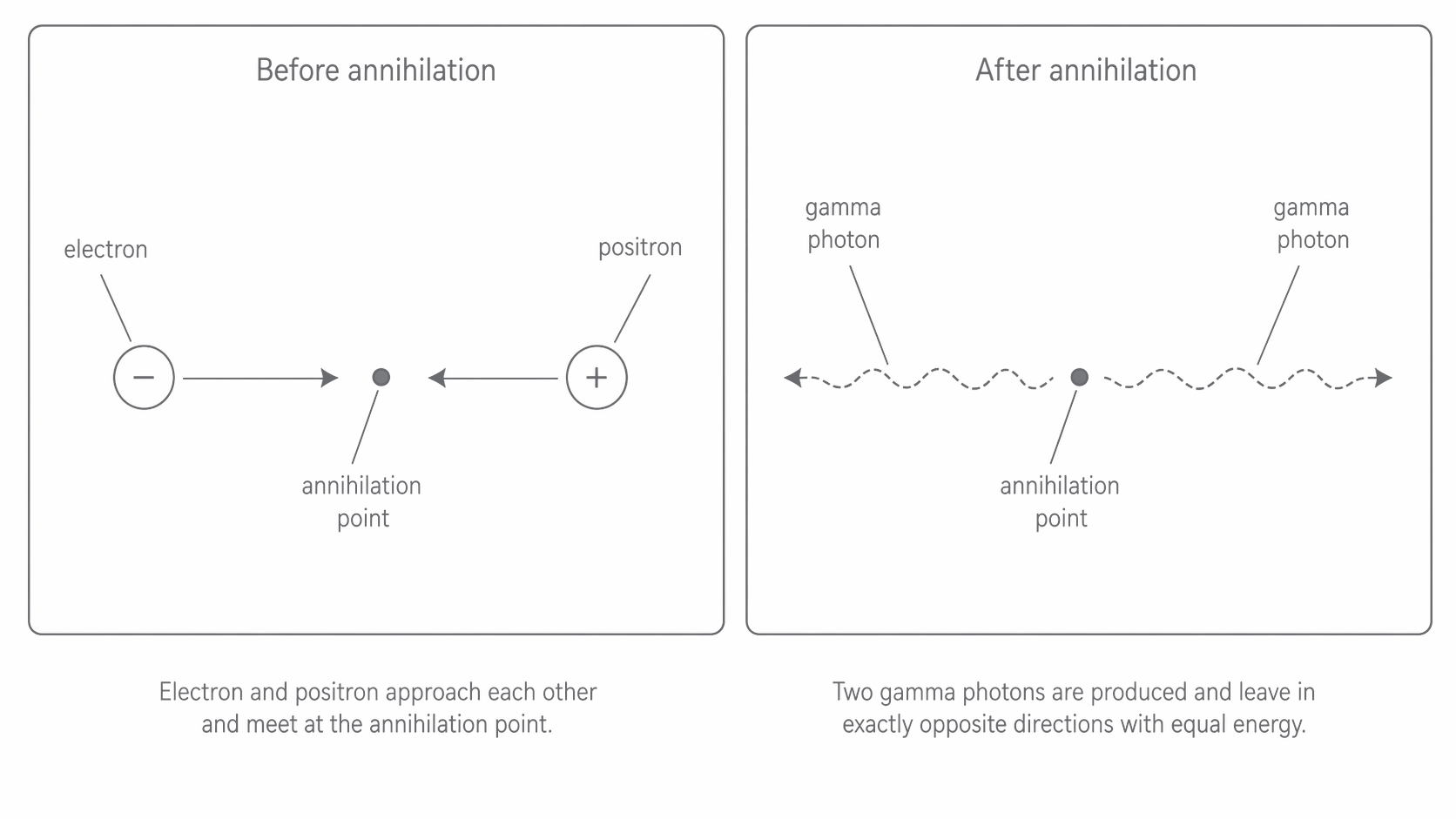
Two photons are produced so that momentum can still be conserved. If the particle and antiparticle are both at rest before the collision, the total momentum is zero, so the two photons must leave in opposite directions with equal energy.
In the diagram below, notice that the electron and positron meet and the two gamma photons leave in opposite directions, showing how zero initial momentum is balanced after annihilation.
[DIAGRAM: asset_name: 2.1.3 - Particles, Antiparticles and Photons - Diagram 2; asset_slug: 2.1.3 - Particles, Antiparticles and Photons - Diagram 2; recommended_method: retained_png; description: An electron and positron approaching, meeting, then two gamma photons leaving in opposite directions]
If each original particle has rest energy , the minimum-energy case is:
so each photon has minimum energy:
Minimum photon energy in annihilation
This is not an energy condition for causing annihilation. It is the minimum energy carried by each photon if the particle and antiparticle annihilate while at rest.
PET scanners use electron-positron annihilation. A tracer in the body emits positrons, each positron soon meets an electron, and two gamma photons are produced in opposite directions. Detecting those photon pairs allows the scanner to reconstruct where the tracer collected inside the body.
Any kinetic energy of the pair also contributes to the photon energy. In the centre-of-momentum case, where the electron and positron have equal and opposite momenta, the two photons leave in opposite directions with equal energies greater than .
Part 4 - Pair Production
Pair production is the reverse process. A photon disappears and produces a particle together with its antiparticle.
Pair production
Pair production is the process in which a photon creates a particle and its corresponding antiparticle.
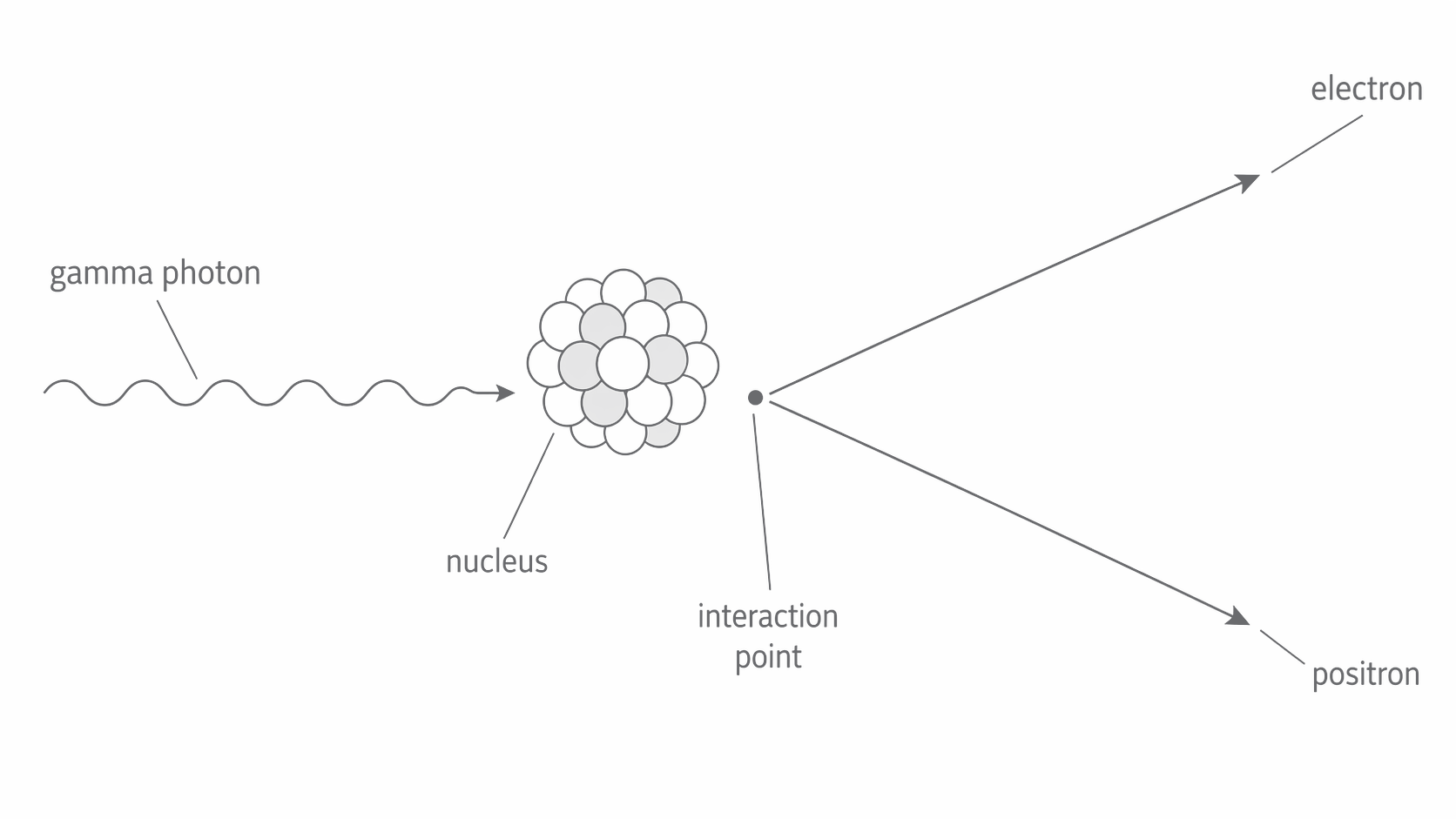
The photon must have enough energy to create the total rest energy of both particles, and the interaction happens near a nucleus so that momentum can be conserved.
In the diagram below, notice that the gamma photon passes close to the nucleus and turns into an electron-positron pair, with the nearby nucleus included to show how momentum can be conserved.
[DIAGRAM: asset_name: 2.1.3 - Particles, Antiparticles and Photons - Diagram 3; asset_slug: 2.1.3 - Particles, Antiparticles and Photons - Diagram 3; recommended_method: retained_png; description: A gamma photon passing close to a nucleus and producing an electron and a positron that move away from the interaction point]
If the particle and antiparticle each have rest energy , the threshold condition is:
Minimum photon energy for pair production
Any photon energy above this threshold appears as kinetic energy of the created particles.
For an electron-positron pair, the minimum photon energy is . Converting to joules gives , so the threshold frequency is
Part 5 - Comparing the Two Processes
Annihilation and pair production are inverse processes. In annihilation, mass is converted into photon energy. In pair production, photon energy is converted into mass. The same conservation laws apply in both cases.
| Feature | Annihilation | Pair production |
|---|---|---|
| Starting particles | Particle + corresponding antiparticle | One high-energy photon near a nucleus |
| End products | Two photons | Particle + corresponding antiparticle |
| Minimum energy statement | Each photon has energy if annihilation happens at rest | Photon must have energy at least |
| Momentum point | Two photons travel in opposite directions | A nearby nucleus helps conserve momentum |
| Overall change | Mass to radiation energy | Radiation energy to mass |
The most reliable way to remember the difference is to focus on what must already exist before the interaction. Annihilation starts with matter and antimatter already present. Pair production starts with a photon that must supply the rest energy of both created particles.