3.4.1.2 - Moments
Forces can do more than speed objects up or slow them down. If a force acts away from a turning point, it can also make an object rotate. In this lesson, you will focus on the turning effect of forces, how balanced turning effects lead to equilibrium, how the centre of mass helps you place an object's weight in calculations, and how a couple produces pure rotation.
Part 1 -- Measuring the Turning Effect of a Force
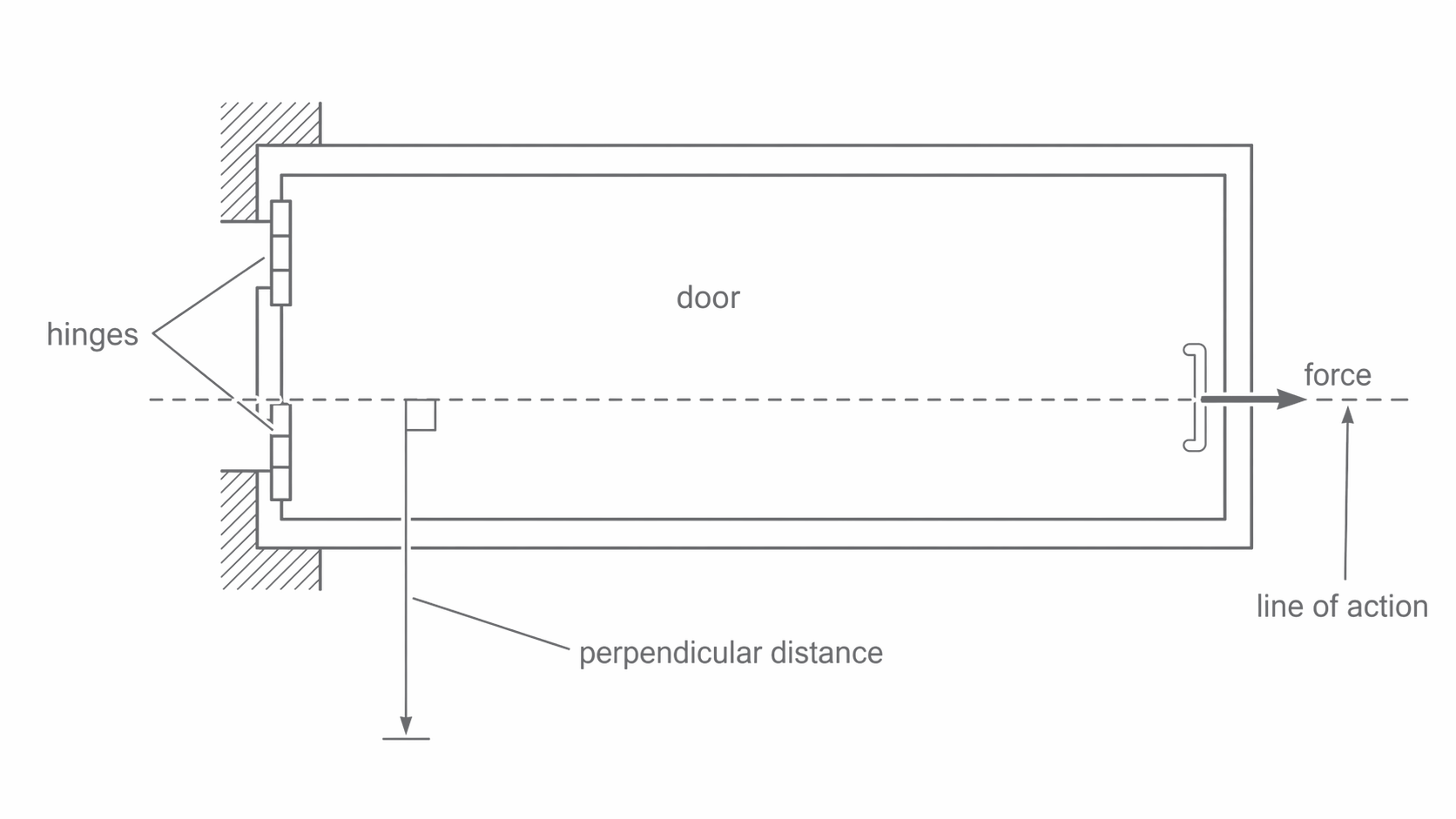
If you push a door near its hinges, it is hard to open. Push with the same force at the handle and the door swings much more easily. That tells you the turning effect of a force depends both on the force itself and on how far its line of action is from the pivot.
Moment of a Force
The moment of a force about a point is the force multiplied by the perpendicular distance from the point to the line of action of the force.
The line of action is the straight line in the direction of the force. The key word is perpendicular: you do not use the sloping length of a spanner or beam unless that length is already at right angles to the force. If the line of action passes through the pivot, the perpendicular distance is zero, so the moment is zero. The top-view door diagram below shows exactly what to measure: trace the force's line of action, then take the shortest perpendicular distance from the hinges to that line.
[DIAGRAM: asset_name: 4.1.2 - Moments - Diagram 1; asset_slug: 4.1.2 - Moments - Diagram 1; recommended_method: retained_png; description: A door viewed from above, with hinges on the left and a force applied at the handle on the right. Show the line of action of the force and the perpendicular distance from the hinges to that line.]
Moment of a Force
Here, is the moment in N m, is the force in N, and is the perpendicular distance in m from the pivot to the line of action of the force. A larger force gives a larger moment, and a larger perpendicular distance also gives a larger moment. If the force is at an angle, you can either resolve the force into a perpendicular component or work directly with the perpendicular distance to the line of action.
In exam questions, one of the most common mistakes is to use the wrong distance. Always ask yourself: "What is the shortest distance from the pivot to the line of action of the force?" That is the distance that belongs in the moment equation.
Part 2 -- Balancing Moments in Equilibrium
When several forces act on an object, some may tend to turn it clockwise and others anticlockwise. If the object is in rotational equilibrium, those turning effects must balance exactly.
Principle of Moments
For a body in equilibrium, the sum of the clockwise moments about a point equals the sum of the anticlockwise moments about the same point.
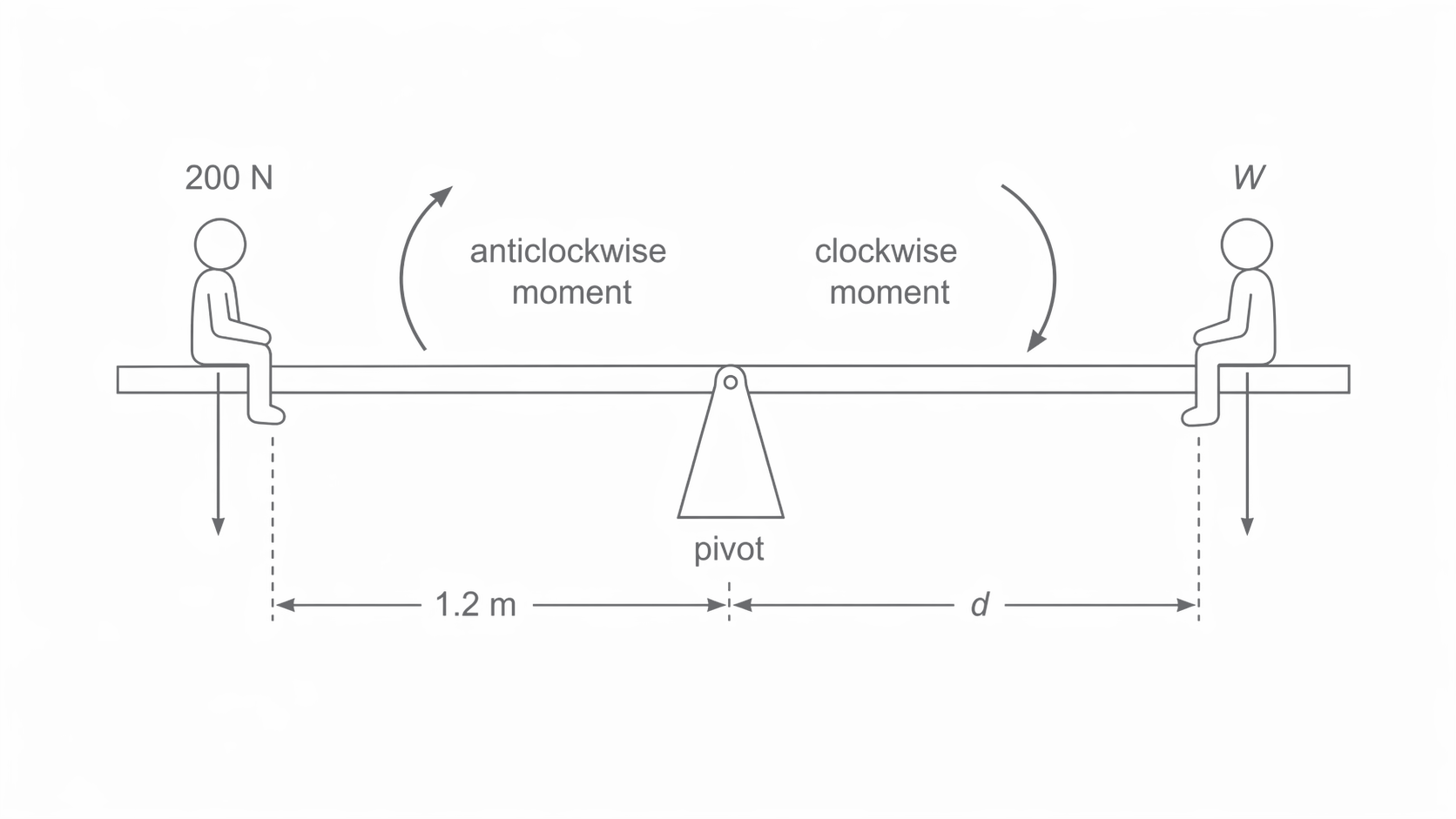
This is why a balanced seesaw stays level and why a beam can remain horizontal even when several forces act on it. You can take moments about any point, but it is often smartest to choose a point through which an unknown force acts, because that force then has zero moment and drops out of the calculation. In the beam diagram below, notice which force turns the beam clockwise and which turns it anticlockwise about the central pivot.
[DIAGRAM: asset_name: 4.1.2 - Moments - Diagram 2; asset_slug: 4.1.2 - Moments - Diagram 2; recommended_method: retained_png; description: A horizontal beam pivoted at its centre. A 200 N child sits 1.2 m to the left of the pivot and a second child of weight W sits to the right at distance d. Show clockwise and anticlockwise moments.]
Principle of Moments
If the pivot is at the centre of a uniform seesaw, the seesaw's own weight acts through the pivot and produces no moment. That lets you compare just the turning effects of the two children. This is a very common A-level setup: identify the pivot, work out which forces turn clockwise and anticlockwise, and then equate the totals.
Notice that the heavier child does not need to sit further out. In fact, the heavier child must sit closer to the pivot so that the two moments match. Moments are about balance between force and perpendicular distance, not about force alone.
Part 3 -- Centre of Mass
Real objects are not point particles. Their mass is spread out, so their weight is really distributed across the whole object. For moments calculations, we replace that distributed weight with a single force acting through one special point: the centre of mass.
Centre of Mass
The centre of mass of a body is the point through which its entire weight may be considered to act.
This idea matters because the object's own weight can create a turning effect. For a uniform regular solid, the centre of mass is at its geometric centre. So a uniform metre rule has its centre of mass at the 50.0 cm mark, a uniform rectangular block has it at its centre, and a uniform sphere has it at its centre. If the pivot is not at that point, the object's weight contributes a moment that must be included. The metre-rule diagram below shows that the rule's own weight acts at the 50.0 cm mark rather than at the knife-edge, so that offset must be included in the balance.
[DIAGRAM: asset_name: 4.1.2 - Moments - Diagram 3; asset_slug: 4.1.2 - Moments - Diagram 3; recommended_method: retained_png; description: A uniform metre rule balanced on a knife-edge at the 34.0 cm mark with a 4.5 N weight hanging at the 10.0 cm mark. Show the rule's weight acting downward at the 50.0 cm mark.]
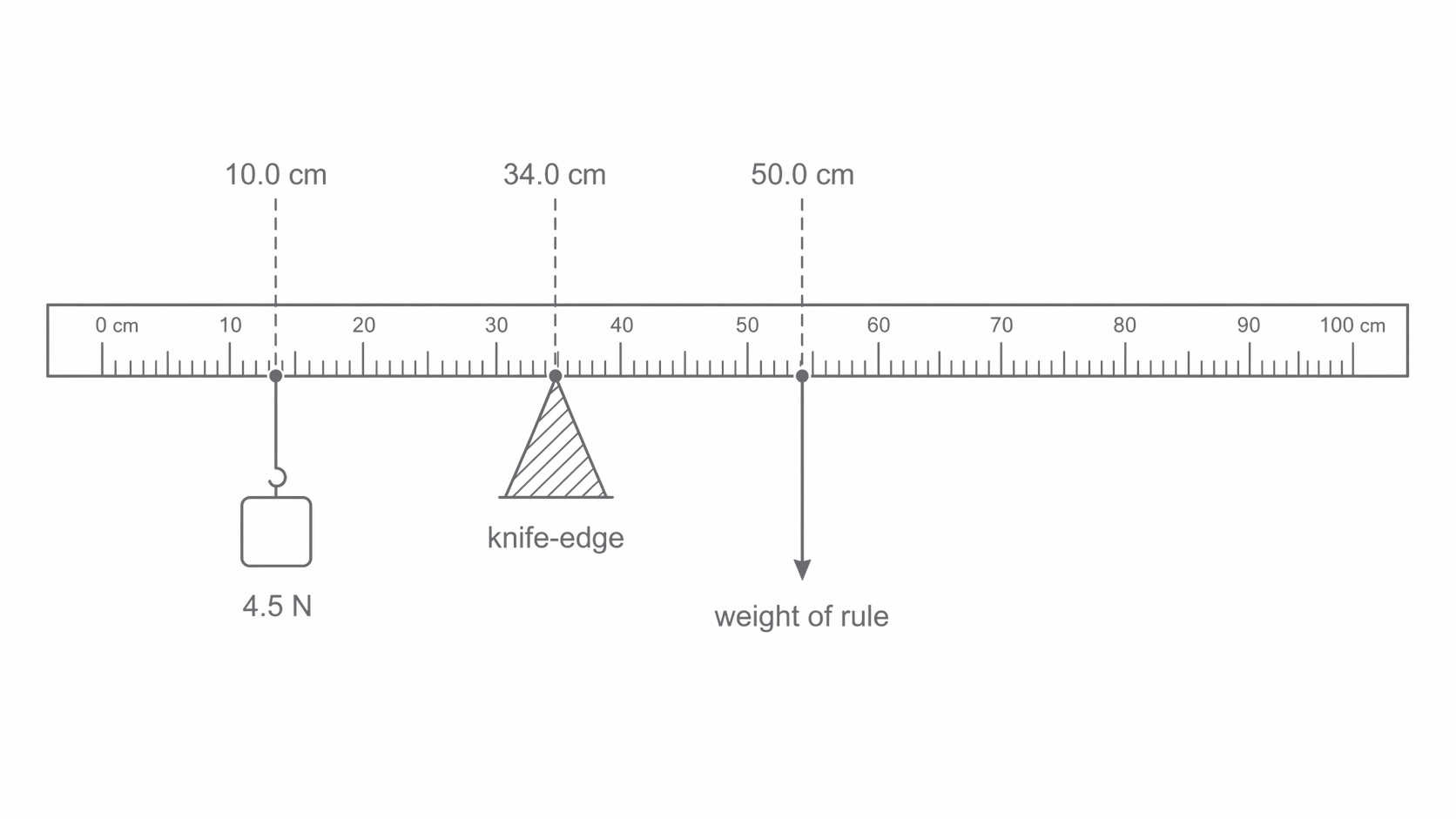
Suppose a uniform metre rule balances on a knife-edge away from its centre. The rule's weight still acts at the 50.0 cm mark, so it may turn clockwise while an added weight turns anticlockwise. The principle of moments then lets you calculate the weight of the rule itself. This is a nice example of how centre of mass links directly back to moments rather than being a separate idea.
The big idea is that centre of mass tells you where to place the weight of an extended object in a moments problem. Once you know that point, the calculation goes back to the same balancing rule as before.
Part 4 -- Couples and Pure Rotation
So far, we have treated turning effects about a chosen point. There is a special arrangement of forces that produces rotation without any resultant force at all. That arrangement is called a couple.
Couple
A couple is a pair of equal and opposite coplanar forces acting along different parallel lines.
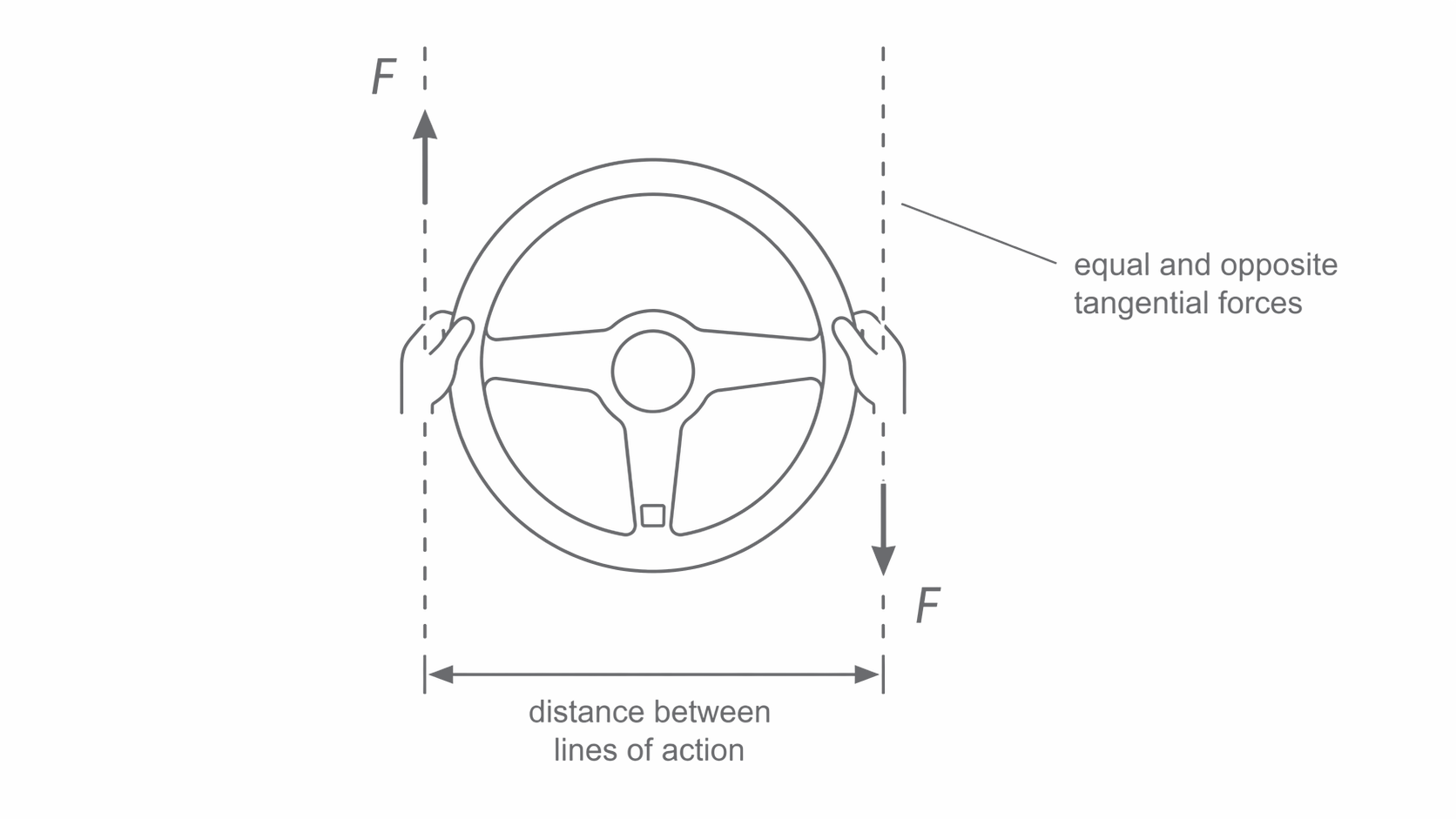
Coplanar means the forces act in the same plane. Because the forces are equal and opposite, their resultant force is zero, so they do not produce linear acceleration. But because their lines of action are different, they still produce a turning effect. Both forces contribute to rotation in the same sense. In the steering-wheel diagram below, notice that the two tangential forces are equal and opposite but separated, so the gap between their lines of action sets the size of the couple.
[DIAGRAM: asset_name: 4.1.2 - Moments - Diagram 4; asset_slug: 4.1.2 - Moments - Diagram 4; recommended_method: retained_png; description: A steering wheel with one hand pushing up on one side and the other hand pushing down on the opposite side. Show equal and opposite tangential forces and the perpendicular distance between their lines of action.]
Moment of a Couple
In this equation, is the magnitude of one of the forces, and is the perpendicular distance between the lines of action of the forces. You do not double the force in this formula. The reason is that the two forces have already been accounted for in the derivation: taking moments about any point gives one contribution of and the other of , so the total is .
When a driver turns a steering wheel, one hand pushes while the other pulls on the opposite side of the wheel. Those equal and opposite tangential forces form a couple, so the wheel rotates even though there is no resultant sideways force on the steering column.
This makes couples different from a single force acting off-centre. A single force can both translate and rotate an object, but a couple produces pure rotation only. That is why couples are so useful for turning handles, taps, and steering wheels.
Taken together, the topic now has a clear structure: a moment measures the turning effect of one force, the principle of moments tells you when turning effects balance, centre of mass tells you where an object's weight acts, and a couple is the special case of pure turning with no resultant force.